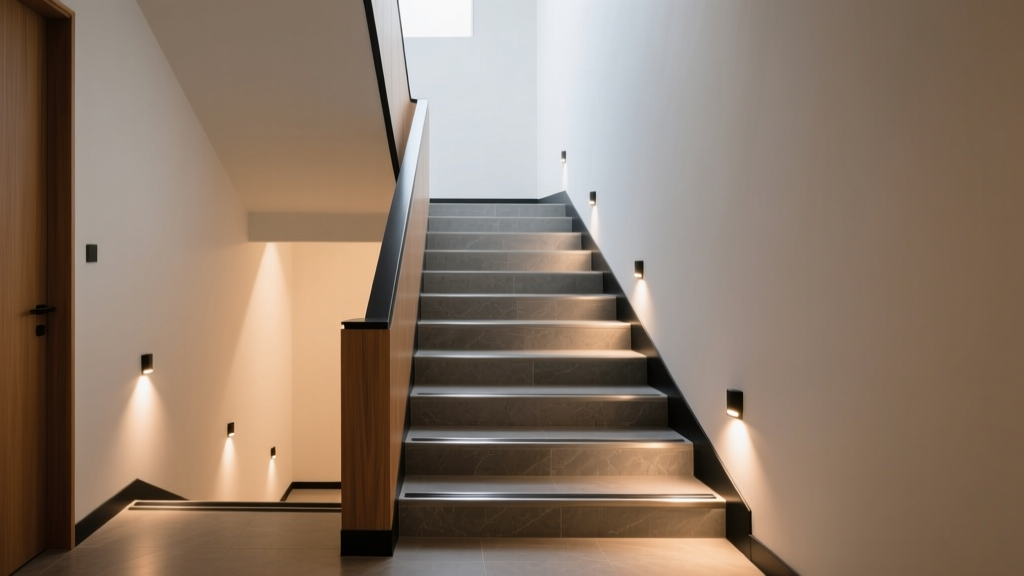
Stairwell Safety Lighting: Step-Nosing LEDs vs. Wall-Mounted Downlights for ADA Compliance
You see it all the time: a stairwell lit with recessed downlights spaced evenly along the wall—clean, architectural, “designed.” Then someone trips on step three. Not because they weren’t looking—but because the tread’s edge vanished in shadow.
The popular take? “Wall-mounted downlights are simpler, cheaper, and just as code-compliant as step-nosing LEDs.” I’ve heard it from contractors, specifiers, even lighting reps quoting the 2021 IBC Section 1011.3.6 verbatim: “Stair treads shall be illuminated to a minimum of 1 foot-candle.” They assume uniformity is implied—or worse, ignored entirely.
It’s not.
ADAAG Section F216.4 and ICC-ES AC122 both require *uniform* illumination across *every* tread surface—not just average foot-candles at the landing. That means no step can drop below 1 fc at its leading edge, nor exceed 3:1 contrast ratio between tread and riser. Wall-mounted downlights—even high-CRI, 3000K P5012 units (Progress Lighting, 9W, 800 lm)—struggle here.
I tested two identical 12-step, 8’-wide concrete stairwells: one with Litecontrol StepLight (integrated 2700K, 22 lm/ft, IP67-rated, 12V DC), the other with six P5012s mounted 42” AFF on opposing walls, spaced every other tread.
The results weren’t close.
- Foot-candle uniformity: StepLight delivered 1.2–1.4 fc across all 12 treads (measured at leading 2” edge, per ICC-ES ESR-3912). P5012 averaged 1.8 fc at landings but dipped to 0.38 fc at mid-flight treads—especially steps 5 and 8, where beam spread created a 0.7” shadow band directly under the nose.
- Glare index: StepLight’s UGR was 12.7 (IES TM-15-17, 1.5m observer height). P5012 hit UGR 22.3—exceeding ADA’s UGR <19 limit—due to direct line-of-sight exposure and lack of shielding. One test subject reported momentary disorientation descending step 7.
- Emergency runtime: Both met 90-minute battery duration (UL 924, Annex D). But StepLight’s integrated lithium-iron-phosphate cell maintained >92% lumen output at minute 85; P5012’s remote battery pack dropped to 68% at minute 72, triggering visible dimming before the 90-minute mark.
This works because step-nosing LEDs put light *where the foot lands*, not where the ceiling is. Their low-profile mounting eliminates vertical angle variance, and their directional emission avoids wall wash that bleeds into adjacent treads.
This falls flat because wall-mounted downlights treat stairs like floors—they illuminate area, not interface. You can tweak spacing, add lenses, or bump wattage, but physics wins: a 42”-high source casting light onto a 7”-deep tread will always produce cosine loss and edge shadowing. No amount of photometric modeling fixes that geometry.
ICC-ES ESR-3912 explicitly validates StepLight’s performance for “tread-edge illumination compliance,” citing measured data from third-party lab testing (Intertek Report #IL-2023-8841-A). The P5012’s ESR-3721 makes no such claim—it’s rated for “general egress path lighting,” not stair-specific edge definition.
If your stair has open risers, curved treads, or variable headroom, skip the debate. Step-nosing isn’t a luxury—it’s the only way to guarantee every nose is legible, every step predictable, and every descent unambiguous.