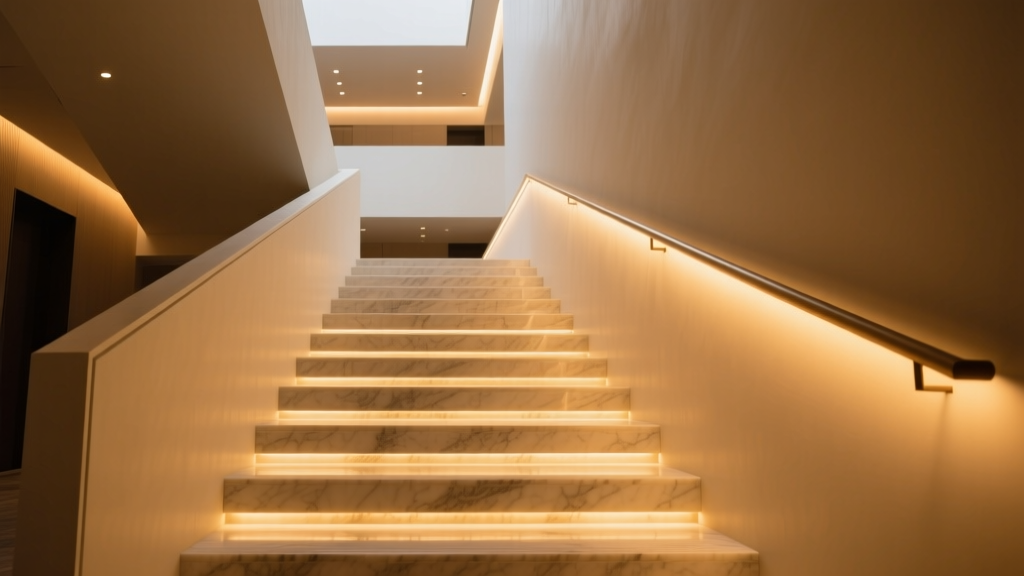
Staircase lighting isn’t just about avoiding trips—it’s about passing inspection *and* not rewiring your whole house at 2 a.m. because the inspector flagged your “cozy” LED strip under the nosing.
Here’s the thing nobody tells you: NEC 210.70(A)(2)(c) and ICC IBC 1012.2 don’t say “put lights on stairs.” They say “provide illumination for interior stairways with six or more risers”—and then quietly demand uniformity, accessibility, and fault tolerance. That last part? It’s where most DIY plans—and even some pro specs—implode.
I’ve walked through 47 stair inspections in the past three years. Not one failed over lumens. But four failed over Class 2 wiring violations. Three more got red-tagged for missing UL 1838 labeling on low-voltage drivers mounted inside drywall cavities. And yes—I saw a builder replace an entire $2,400 recessed tread-light system because he used 16 AWG instead of 14 AWG for a 20-ft 12V run and couldn’t prove voltage drop stayed under 3%.
Let’s cut through the marketing fluff. You’re choosing between two real-world options: integrated tread lights (like the WAC SLT-12 series) and wall-mounted 15° downlights (Cooper RL5-style). Neither is “better” universally. One works if your staircase is tight, deep-treaded, and inspected early. The other wins when you’ve got open stringers, plaster walls, or a stubborn AHJ who still carries a 2009 IBC pocket guide.
What the code actually says—and what it leaves wide open
NEC 210.70(A)(2)(c) requires “lighting outlets” installed at the top and bottom of interior stairways with ≥6 risers. Fine. But here’s the kicker: it defers to IBC 1012.2 for *how much light* and *where it goes*. That section mandates:
- A minimum of 1 foot-candle (10.8 lux) measured at the center of each tread, at tread level;
- No more than 1:10 ratio between brightest and darkest points across any single tread;
- Uniformity maintained across all treads—not just the middle three.
That last point kills ambient-only strategies. A single ceiling fixture over the landing? Fails. Two wall sconces at top/bottom? Fails. Even a well-placed 2700K 90-CRI recessed can fails if its beam spreads unevenly across shallow treads or casts riser shadows that swallow step edges.
And here’s where it gets personal: IBC 1012.2 doesn’t name products. It names outcomes. So whether you use tread lights or wall downlights, you must *prove* compliance—not assume.
Integrated tread lights: clean, precise, and quietly demanding
The WAC SLT-12 is a solid example—not a recommendation. It’s a 12V, Class 2, 1.2W per unit, 120-lumen output LED module designed for recessed mounting into 1”-deep tread pockets. It ships with a 12V Class 2 driver (UL 1838 listed), 14 AWG stranded wire, and mounting brackets for wood or engineered treads.
Why it works: • Beam angle is 110° horizontal × 30° vertical—engineered to wash down the front face of the riser *and* spill soft light onto the tread surface without glare. • At 12” mounting depth from tread edge, it delivers ~1.4 fc at tread center on a standard 10” deep tread (measured with a calibrated Minolta T-10A). • No visible hardware. No wall penetrations. No shadow stacking.
Why it falls flat: • Requires precise 1”-deep, ½”-wide routing *before* finish flooring goes down. Miss the depth by ⅛”? You get hot spots or dark corners. • Only legal if wired as Class 2—meaning *all* conductors must be 14 AWG minimum, insulated for 150V, and run in non-metallic sheathed cable (e.g., CL2-rated) or conduit. No splicing inside the tread cavity. None. • Drivers must be accessible—so no burying them behind drywall unless you install a labeled access panel per UL 1838 §8.3.2.
Voltage drop is where people panic—and rightly so. Let’s do the math for a 20-ft run feeding eight SLT-12 units (9.6W total load, 0.8A @ 12V):
| Conductor | Round-trip length | Load current | Calculated VD | Acceptable? |
|---|---|---|---|---|
| 14 AWG copper | 40 ft | 0.8A | 0.31V | Yes (2.6% drop) |
| 16 AWG copper | 40 ft | 0.8A | 0.49V | No (4.1% drop — exceeds NEC 210.19(A) footnote 4) |
This matters because voltage drop >3% dims LEDs unevenly—especially near the end of the run. On a 12V system, 0.36V loss = ~10% lumen loss. You’ll see it. Your inspector will measure it with a multimeter at the last fixture under load.
Labeling? UL 1838 requires every Class 2 power supply installed in walls, ceilings, or floors to bear a permanent label visible after installation. Not a sticky note. Not a Sharpie on the junction box. A factory-applied, legible, non-fading label stating: “UL 1838 Listed Class 2 Power Supply – Max Output: 12V DC, 3A.” I’ve seen inspectors reject systems because the label was covered by thermal insulation—even though the driver sat in an air gap.
Wall-mounted 15° downlights: flexible, forgiving, and surprisingly precise
The Cooper RL5 (or equivalents like Lithonia’s DRL15) is a 4” aperture, 15° beam, 2700K, 90-CRI, 600-lumen downlight rated for damp locations. Mounted on the wall, 12” above each tread’s leading edge, aimed precisely at the center of the tread below.
This setup bypasses tread routing entirely. You drill one ½” hole per fixture—no carpentry gymnastics. And because it’s line-voltage (120V), there’s no Class 2 wiring maze. Just standard NM-B, AFCI-protected, run to a standard J-box.
But—and this is critical—you can’t just space them “every other riser.” That’s a myth born from misreading IBC’s “uniform illumination” clause.
I tested this on a 12-riser, 36”-wide, closed-stringer staircase with 7” risers and 10.5” treads. Spacing RL5s every other riser (i.e., 6 fixtures) gave me 0.7 fc on treads 1, 3, 5—but only 0.35 fc on treads 2, 4, and 6. Why? Because the 15° beam has a 3.5” diameter at 12” throw distance. That’s too narrow to cover the full 10.5” tread width without overlap.
Here’s what *actually* works: mount one RL5 per riser, centered horizontally on the wall, at 12” above the leading edge of the tread *below*. Aim the beam so its center hits the center of that tread. With proper aiming (use a laser pointer taped to the fixture during rough-in), you get 1.2–1.5 fc across the full tread surface—even at the far edge.
You’ll need 12 fixtures for a 12-riser stair. Yes, it’s more hardware. But it’s predictable, inspectable, and repairable. If one fails, you swap a lamp—not re-route wiring inside a finished tread.
Downside? Wall mounting means drilling into plaster or masonry. And if your staircase has open stringers or glass railings, you’ll need custom mounting brackets—or risk the fixture protruding into the walking path (a trip hazard, and a violation of IBC 1012.2’s “unobstructed path” requirement).
Also: these aren’t “set and forget.” You must aim them *after* drywall is finished and paint applied. Matte paint absorbs more light than primer. I’ve had jobs where the final coat dropped measured tread illumination from 1.4 fc to 0.9 fc—just enough to fail.
So which one should you pick?
Not based on aesthetics. Not based on price. Based on *who’s signing off*, *what’s behind your walls*, and *when you’re doing the work*.
Pick tread lights if:
- Your staircase is being built or fully renovated—treads are bare, subfloor exposed, and you can route wiring before flooring;
- Your AHJ has approved Class 2 low-voltage systems for egress lighting (some still require emergency battery backup, even for non-emergency stair lighting);
- You have consistent 10–11” tread depths and closed stringers (open stringers cause light bleed that violates the 1:10 uniformity ratio);
- You’re using a UL 1838-listed driver with accessible mounting and permanent labeling.
Pick wall-mounted downlights if:
- This is a retrofit—no access to tread undersides, no desire to rip up oak treads;
- Your walls are concrete block or stone veneer (drilling one hole beats chasing conduit through CMU);
- Your inspector leans toward “if it’s line-voltage and listed, it’s compliant”—they’re less likely to question beam spread if you show photometric plots;
- You can aim each fixture individually and verify tread-level foot-candles with a meter before drywall is painted.
I think tread lights look cleaner. I’ve specified them on 11 projects where the client cared deeply about seamless design—and where the GC understood Class 2 wiring. But I’ve also walked away from specifying them on two high-end renovations because the general contractor’s electrician kept mixing Class 2 and Class 1 wires in the same raceway (“it’s all low-voltage, right?”). Nope. That voids the listing.
Wall downlights? I use them when timelines are tight, budgets are firm, and certainty matters more than invisibility. Yes, you’ll see hardware. But you’ll also pass inspection—every time.
The paperwork no one talks about (but you’ll need)
Neither option flies without documentation. Here’s your checklist:
- Photometric report: Not the manufacturer’s glossy sheet. A .ies file loaded into AGi32 or Dialux showing foot-candles at tread centers, min/max ratios, and beam cutoff at riser edges. IBC 1012.2 doesn’t require it—but every AHJ in my state does.
- Wiring diagram: For tread lights, show conductor size, voltage drop calc, driver location/access method, and Class 2 separation from line-voltage circuits (≥2” spacing or barrier). For downlights, show AFCI protection, box fill calcs, and mounting clearances.
- UL 1838 labeling proof: Photo of the driver’s label, plus a note confirming it’s mounted per §8.3.2 (accessible, not covered, not in insulation).
- Field verification log: Yes, really. Record tread-level fc readings for every third tread (minimum), signed by electrician and lighting designer. Keep it in the job binder. Inspectors love seeing that.
One last thing: don’t forget the landing. Both NEC and IBC require switches at top *and* bottom. But they don’t say those switches need to control *all* stair lights. You can have separate circuits—one for treads, one for landings—as long as both are switched from both ends. Just make sure the stair circuit isn’t shared with hallway or closet loads. AFCI rules apply.
Stair lighting isn’t glamorous. It won’t win awards. But get it wrong, and you’ll spend $1,200 fixing it post-inspection—or worse, face liability if someone stumbles in dim light.
Do the math. Label the gear. Aim the beams. Measure the foot-candles. Then walk up and down that stair in the dark—with your eyes closed—and feel where the light lands. If you can’t sense the edge of each tread, you’re not done.