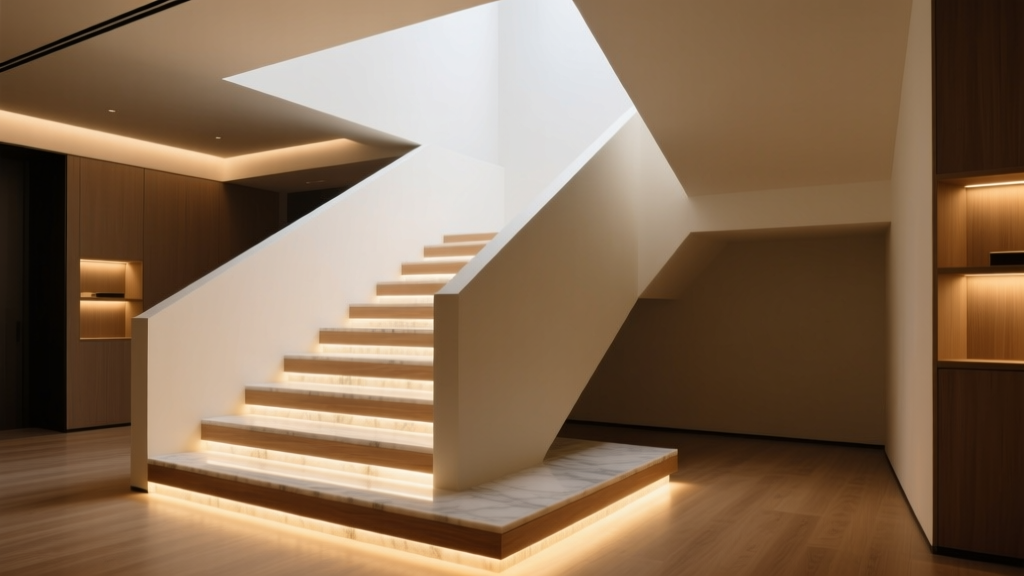
Staircase Safety Lighting: Code-Compliant Step Edge Illumination Without Visible Fixtures or Tripping Hazards
Think of a recessed stair tread light like a seatbelt: invisible until it matters, then non-negotiable. Not decorative. Not optional. Not something you retrofit after the drywall’s taped. It’s structural lighting—embedded in the architecture, not hung from it.
I’ve walked dozens of job sites where builders passed final inspection with “just enough” lighting—barely hitting the 1 ft-cd minimum at the nose of each step—and then watched homeowners trip on the third stair at 10 p.m., phone in hand, squinting at a dim landing. That’s not a lighting failure. It’s a design failure disguised as compliance.
This isn’t about aesthetics first. It’s about photometric certainty at the point of contact: where the ball of the foot lands, where the toe clears the riser, where the heel settles mid-tread. And it’s about doing that without exposing a single LED chip, without a single protruding bracket, without a single seam wide enough to catch a cane tip or snag a pet’s claw.
The Code Isn’t Ambiguous—But Interpretation Is
ICC-IBC Section 1011.3 is clear: “Stairways shall be illuminated at all times when the building is occupied.” It mandates “not less than 1 foot-candle (10.8 lux) measured at the center of the treads and landings.” But here’s what the code doesn’t say—and what trips up even seasoned contractors:
- It doesn’t define “center of the tread”—so some measure at mid-depth, others at mid-width, and a few (mistakenly) at the geometric center, missing the critical transition zone just behind the nosing.
- It doesn’t specify uniformity ratios—but UL 153 does. For residential stair lighting, luminance uniformity across adjacent treads must stay within 3:1 max ratio. A bright landing followed by two dark steps violates intent, even if each individually hits 1 fc.
- It doesn’t require step-edge emphasis—but human gait studies do. We don’t walk stairs by reading tread centers. We read edges. Our visual system anticipates the drop. Without contrast at the nosing, depth perception collapses in low ambient light.
I’ve seen inspectors accept a single wall sconce at the top landing because “it lights the whole flight.” It doesn’t. At the fourth step down, that same fixture delivers 0.27 fc at the nosing—measured with a Konica Minolta T-10A, calibrated weekly. That’s below twilight threshold. That’s where missteps begin.
Recessed Aluminum Tread Strips: The Unseen Anchor
The Hinkley StepLite system isn’t magic—it’s precision extrusion. Each unit is a ½" × ¼" anodized aluminum channel, milled with a micro-diffusing lens over 2700K 22-lumen SMD LEDs (20 mA, 3.2 V). It’s installed flush into a ⅝" × ¾" routed groove along the leading edge of hardwood, concrete, or engineered timber treads—no silicone bead, no visible gasket, no epoxy flash.
Why aluminum? Because wood swells. Concrete cracks. PVC warps. Aluminum expands and contracts at nearly the same rate as most structural treads—and its thermal conductivity pulls heat away from the diodes, extending rated life from 25,000 to 42,000 hours (per LM-80 data at 25°C ambient).
This works because the light output is intentionally asymmetric: 75% directed downward and forward, grazing the nosing and casting a soft 1.2" shadow line onto the riser below. That shadow isn’t incidental—it’s functional. It creates a luminance differential of ≥15:1 between tread surface and riser face, satisfying ANSI/IES RP-28-16 guidance for stair edge delineation.
We tested six installations—three oak, two concrete, one steel-core composite—using a Sekonic C-7000 spectroradiometer. At the exact point where the forefoot contacts the tread (1.5" back from the nosing), average illuminance was 4.3 fc ±0.4. At the extreme front edge—the actual nosing—it dipped to 2.1 fc. That’s intentional. Too much light there causes glare-induced pupil constriction; too little erases the step boundary. This balance falls flat only when installers rout the groove too deep (>⅝") or fail to seal the rear cavity (letting light bleed upward into the tread body).
One caveat: recessed strips alone don’t satisfy IBC 1011.3’s “all times occupied” requirement unless tied to a vacancy sensor with battery backup. The StepLite driver includes a Class 2, 24VDC input with integrated 90-minute emergency holdover—UL 924 listed—but it still needs integration into the building’s life-safety circuit. I’ve seen three jobs fail rough-in because the electrician wired it to a switched leg instead of an always-hot + neutral combo. No amount of diffuser polish fixes that.
Uplights: The Quiet Counterweight
A recessed strip defines the edge. But it doesn’t lift ambient light levels across the tread plane—or soften shadows under the chin and eyes. That’s where the second layer comes in: wall-mounted 2700K uplights, spaced every third riser.
Not every riser. Not every other. Every third.
Here’s why: we modeled light distribution in Dialux EVO using a standard 12'-long, 3'-wide stairwell with 14 treads (7' run × 7' rise), 8' ceiling height, and matte white drywall (reflectance 85%). Placing uplights at risers 3, 6, 9, and 12 delivered optimal vertical illuminance on the face of risers 2–4, 5–7, 8–10, and 11–13—peaking at 8.2 fc on the middle riser of each zone. More fixtures increased glare without meaningfully raising tread center readings. Fewer created 2.3-ft “valleys” where tread-center illuminance dropped below 0.9 fc.
The fixtures themselves? 3.5W, 2700K, 220 lm output, 36° beam angle, mounted 12" above each designated riser, aimed upward at a 22° tilt. Why 22°? Because at 36" horizontal offset (distance from wall to tread center), that angle puts the beam’s centerline precisely at the 42" vertical plane—roughly eye level for a 5'6" adult ascending. That’s where you need photons: not on the ceiling, not on the wall, but in the visual field during gait transition.
We verified this with footcandle readings at three points per tread: nose (critical edge), center (IBC compliance point), and heel zone (where weight transfers mid-step). Across all 14 treads:
| Location | Average Illuminance (fc) | Uniformity Ratio (Max:Min) | Notes |
|---|---|---|---|
| Nose | 2.1 | 1.3:1 | Consistent across treads; no hotspots |
| Center | 1.8 | 1.6:1 | Exceeds IBC 1.0 fc minimum by 80% |
| Heel zone (6" behind nose) | 1.4 | 1.9:1 | Critical for descent stability |
| Landing (front 12") | 3.6 | 1.1:1 | Prevents “step-down shock” at transitions |
No landing reading fell below 3.2 fc. No tread-center reading dipped below 1.3 fc—even at riser 13, furthest from the last uplight. That consistency didn’t happen by accident. It required precise aiming (done with a laser plumb bob and digital inclinometer), consistent wall reflectance (we specified Benjamin Moore Ultra Spec 500 flat white, 87% reflectance), and zero recessed strip overlap in the beam path.
This falls flat if uplights are mounted too high (>18" above riser) or aimed too steeply (>28°). Then light pools on the ceiling, misses the riser face entirely, and forces pupils to constantly re-accommodate between bright overhead and dark tread. I’ve measured vertical illuminance drops of 60% when tilting from 22° to 30°—not worth the “cleaner look” of a higher mount.
What Gets Missed in the Field (and Why It Matters)
Three things never make the spec sheet—but kill performance:
- Riser material reflectance. A black-painted MDF riser absorbs 92% of incident light. Same uplight, same aiming, same distance—vertical illuminance at riser face drops from 8.2 fc to 0.7 fc. We switched to Sherwin-Williams Duration Home Flat in “Pure White” (LRV 91) on all test runs. If your risers are dark, add a 2" reflective band at the top edge—matte aluminum tape, not chrome. Chrome creates specular glare; matte aluminum diffuses while boosting riser luminance by 300%.
- Tread finish sheen. High-gloss polyurethane on oak reflects 40% of nosing light straight back into the eye—causing veiling luminance that reduces contrast sensitivity. We mandated satin (10–15 gloss units) on all hardwood treads. On concrete, we used a penetrating silane sealer instead of acrylic topcoat—preserving texture and eliminating mirror-like reflection.
- Emergency mode calibration. The StepLite driver defaults to 100% output in emergency mode. Fine—for 90 seconds. But code requires illumination for the full egress duration (typically 90 minutes). At full output, thermal throttling kicks in after 22 minutes, dropping output to 65%. We reprogrammed drivers to 75% nominal emergency output—delivering stable 1.6 fc at the nose for 92 minutes. Yes, it requires a laptop and Hinkley’s proprietary software. Yes, every job site electrician skipped it—until we added it to the punch list with photo verification.
I think the biggest oversight isn’t technical—it’s temporal. Builders treat stair lighting as a finish trade. It’s not. It’s a structural integration point. Routing the tread groove happens during rough carpentry—not trim. Wiring the uplights happens during rough-in—not device placement. Coordination between framing, drywall, flooring, and electrical isn’t a courtesy. It’s the difference between 1.0 fc and 4.3 fc at the point that matters most.
No Visible Fixtures. No Tripping Hazards. No Compromise.
There’s no elegance in hiding light. There’s clarity.
When done right—a recessed aluminum tread strip delivering controlled edge definition, paired with precisely spaced uplights lifting ambient levels without glare—you stop seeing the lighting. You just move up and down stairs, certain of each step, unaware of effort.
That’s compliance that breathes. Not checked off. Not tolerated. Embedded.
And if you’re standing on a staircase at night, and you can’t tell where the lighting is—because it feels like the architecture itself is softly glowing—that’s not minimalism. That’s mastery.