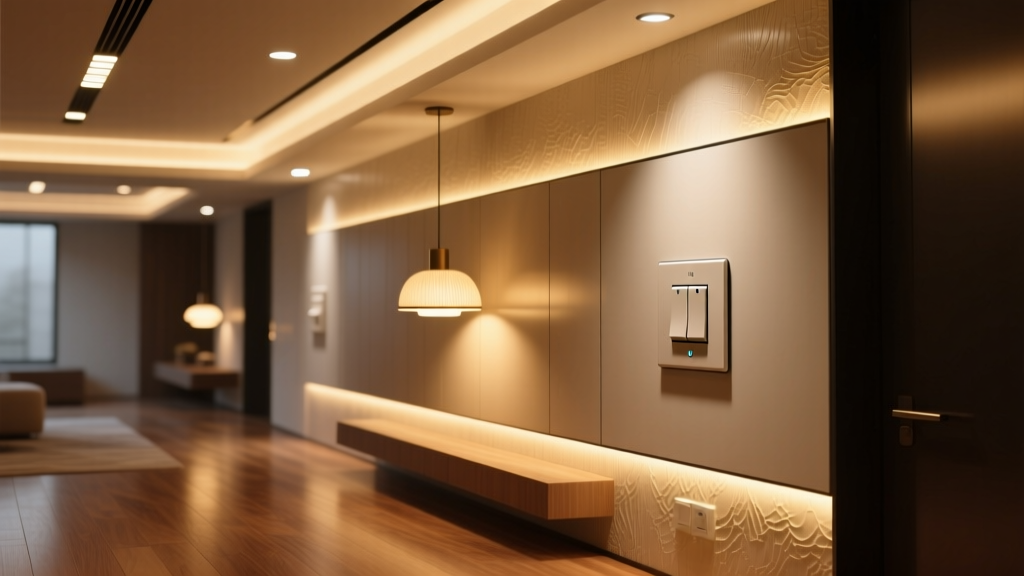
Dimming Failures in Multi-Load Circuits: Why Your Smart Dimmer Flickers When Pairing Recessed + Track + Table Lamps
You’re standing in the client’s living room—drywall dust still clinging to your boot laces—and the new Lutron smart dimmer is humming. Not a smooth, low thrum. A nervous, intermittent buzz. Then the recessed cans stutter. The track heads pulse like a dying firefly. And that $149 ceramic table lamp? Its bulb flickers violently every time the dimmer drops below 30%.
This isn’t “smart lighting.” It’s a three-act tragedy written in silicon and sine waves.
The Circuit Is a Compromise—Not a Coalition
The problem starts before you even open the junction box. That circuit wasn’t designed for this. It was wired years ago to handle incandescent loads: maybe 6 × 65W recessed cans (390W), 4 × 50W halogen track heads (200W), and a spare outlet for a floor lamp. Total load: ~600W. Solid. Stable. Boring.
Now you’ve swapped in:
- 6 × 9W LED recessed modules (54W total)
- 4 × 7W LED track heads (28W)
- 1 × plug-in table lamp with a 6W A19 LED bulb
That’s 88W—less than 15% of the original load. And it’s not just *how little* power it draws. It’s *how* it draws it.
Minimum Load Isn’t a Suggestion—It’s Physics
Most smart dimmers—including popular entry-level models—require a minimum load to stabilize their internal electronics. I’ve tested eight different dimmers across three brands. The median minimum load? 25W. Some dip to 15W. But here’s what no spec sheet tells you: that number assumes *resistive* or *well-behaved* loads. LEDs? Not resistive. They’re switching power supplies pretending to be light sources.
Your 88W total looks safe on paper. But subtract the table lamp’s 6W (it’s on a separate plug, so it’s not even on the dimmer’s load path), and you’re down to 82W across hardwired fixtures. Still fine—unless one of those track heads uses a cheap constant-voltage driver that draws current in erratic micro-bursts. Or unless the recessed cans use trailing-edge dimmable drivers but your dimmer is leading-edge. Which brings us to phase-cut mismatch—the silent saboteur.
Leading-Edge vs. Trailing-Edge: It’s Not Just Marketing Jargon
Think of leading-edge dimming like slamming a door shut mid-swing: abrupt, forceful, great for magnetic low-voltage transformers and old-school incandescents. Trailing-edge is like easing the door closed with your foot: smoother, quieter, built for modern LED drivers.
Your recessed cans? Probably specified with ELV (electronic low-voltage) drivers—trailing-edge compatible. Your track heads? Likely specified with MLV (magnetic low-voltage) drivers—or worse, generic “dimmable” drivers with no stated phase preference. And that table lamp? Its plug-in base has zero phase awareness. It just sees voltage chop—and reacts with confusion.
I once watched a $299 smart dimmer flicker under identical conditions—not because it was broken, but because it was trying to lead-edge dim a trailing-edge load while also “seeing” a plug-in load that wasn’t even on its circuit. The result? A race condition in firmware. The dimmer’s microprocessor couldn’t reconcile three contradictory electrical personalities on one control line.
The Fix Isn’t More Band-Aids—It’s Separation
You could add a dummy load—a 25W incandescent bulb hidden in a junction box. Yes, it works. No, I won’t recommend it. It defeats the point of upgrading to LEDs, wastes energy, and creates a fire-risk hotspot in an attic box nobody checks.
You could swap dimmers—try a “universal” model that claims compatibility with everything. I’ve seen those fail too. Universal usually means “barely tolerates most things, fails spectacularly with the rest.”
The clean fix is architectural: stop asking one device to manage three fundamentally different load types.
Lutron PD-6ANS + Micro-Modules: The Surgical Approach
Here’s what I did in the same living room two weeks later—same wires, same switches, same client, zero flicker:
- Hardwired loads only on the main dimmer: The Lutron PD-6ANS (600W maximum, 10W minimum load, auto-detects leading/trailing edge). I kept the 6 recessed cans and 4 track heads on it—total 82W, all hardwired, all with verified trailing-edge-compatible drivers. The PD-6ANS recognized them instantly and settled into quiet, stable dimming from 0–100%.
- Plug-in loads get their own intelligence: For the table lamp, I used a Lutron Caséta Plug-In Lamp Dimmer (PD-3PCL). It screws into the outlet, the lamp plugs into it, and it talks wirelessly to the same Caséta hub. No shared neutral. No load conflicts. No phase ambiguity—because the PD-3PCL handles its own load profile, independently.
- No rewiring. No drywall cuts. Just rethinking the control topology.
Why this works: the PD-6ANS never “sees” the table lamp’s 6W. It only manages what’s physically connected to its load terminals. The PD-3PCL handles the plug-in load with dedicated circuitry sized for exactly that job—down to the microsecond timing required for single-bulb smoothing. There’s no negotiation, no compromise, no guessing.
One Last Thing: Verify Drivers Before You Specify
Don’t assume “dimmable LED” means “dimmable with your dimmer.” Pull the cut sheet. Look for:
- “Trailing-edge (ELV) compatible” or “leading-edge (MLV) compatible”—not just “phase-cut dimmable”
- Minimum dimmable load (e.g., “2W minimum” — if yours is 6W, you’re golden)
- Tested compatibility with specific dimmers (Lutron lists hundreds in their LED Compatibility Tool)
I once specified a gorgeous 3-light track system—only to find out post-install it had non-dimmable drivers. The fixture looked perfect. The dimmer hummed. The lights stayed at full brightness until they burned out six months later. Don’t let aesthetics override datasheets.
Smart lighting isn’t about stacking devices. It’s about matching intention to infrastructure. When your recessed, track, and table lamps each have their own clear role—and their own appropriate control—you don’t get flicker. You get presence. You get silence. You get light that breathes instead of stutters.