“Light doesn’t lie—but it *interprets*.” — Elena Ruiz, lighting designer, NYC
She said that to me over coffee after a site visit where a client kept insisting her makeup looked “off” in the powder room—like she’d slept in foundation. Not too long ago, I’d have chalked it up to vanity or bad mirror placement. But then I stood there with my light meter and spectrometer, watching how that single 2700K A19 bulb—glaring down from a cramped 6" recessed can—turned cheekbones into shadows and washed out lip color. The truth wasn’t in the mirror. It was in the spectral distribution.
That’s when I stopped diagnosing powder rooms by square footage alone—and started mapping them by function, frequency, and fidelity.
The Problem Isn’t Brightness. It’s Bandwidth.
A powder room is rarely used for long, but it’s used *intently*. Someone’s checking a smudge, reapplying lipstick, adjusting a collar, or squinting at a text message reflection. Every second counts. And yet, most powder rooms still run on legacy logic: one fixture, one switch, one correlated color temperature (CCT), one dimming curve—and zero spectral intention.
I’ve measured dozens of these setups. That ubiquitous 2700K–3000K “warm white” LED? It often has a CRI (Color Rendering Index) of 82–85, with deep valleys around 450nm (cyan) and 600nm (orange-red). Skin tones—especially olive, golden, and deeper complexions—lose saturation and contrast. Lips go flat. Undereyes look bruised, not tired. And because there’s no directional control, light spills onto the ceiling, bounces off glossy tile, and creates glare—not clarity.
It’s not that the light is “bad.” It’s that it’s *monochromatic in purpose*, not spectrum.
Why Layering Works—And Why Most “Layered” Schemes Don’t
Let’s be blunt: “layered lighting” is overused as a buzzword. I’ve seen specs calling for “ambient + task + accent” in a 3' × 5' space—and then specifying three 4" recessed cans spaced 18" apart. That’s not layering. That’s stacking redundancy.
True layering means *functional separation*: distinct optical paths, distinct CCTs, distinct dimming behaviors—all calibrated to human visual behavior in that exact volume.
In a powder room, ambient light isn’t about illuminating floor tiles. It’s about pre-conditioning the eye—softly lifting shadows *before* task-level scrutiny begins. Task light isn’t just “brighter”—it must deliver high-fidelity rendering *at the plane of the face*, with minimal backscatter into the eyes. Accent light isn’t decorative—it’s spatial anchoring: a warm pulse that cues scale, depth, and materiality without competing.
That’s why the upgrade described—a 3000K ambient, 3500K task, and 2700K accent—isn’t arbitrary. Each CCT serves a physiological role:
- 3000K ambient: High CRI (>92), low-glare, wide-beam (55°), IC-rated 4" recessed can placed precisely at the center of the ceiling—no more, no less. This isn’t “warm” enough to mute detail, nor “cool” enough to flatten warmth. It’s the neutral baseline—the lighting equivalent of a gray card.
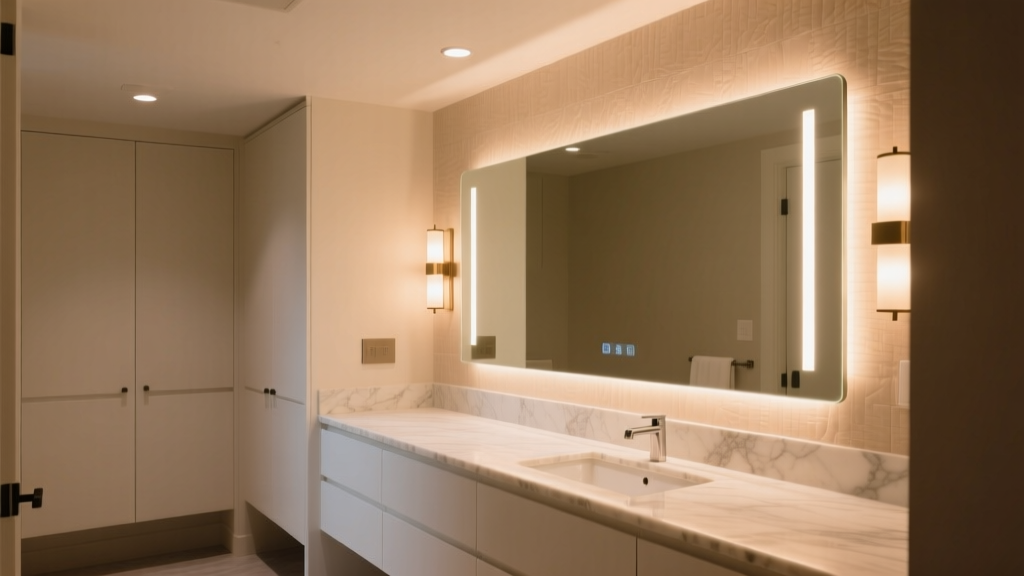
- 3500K task: Dual-emitter sconce mounted at 62" AFF (eye height for average adult), with forward-facing 30° narrow flood (for facial illumination) and rear-facing 60° wide wash (to softly lift the background wall and prevent silhouette effect). Output: ~450 lumens per side, total 900 lm. Why 3500K? Because it sits at the peak of melanin reflectance—maximizing contrast between skin and pigment without introducing clinical sterility.
- 2700K accent: 1.5W ultra-low-profile puck light (1.25" diameter, 0.375" thick), tucked into a 4" deep shelf niche, aimed downward at a textured stone or matte ceramic tile. CCT is lower—not for “coziness,” but because warm light increases perceived texture richness in low-luminance zones. Output: ~120 lumens, fully dimmable to 5%.
This works because the layers don’t overlap optically—or psychologically. The ambient sets scene tone. The task isolates subject. The accent confirms context. They’re not additive; they’re sequential.
The Math Behind the Mood
Let’s talk numbers—not just lumens, but luminance ratios.
In a typical 3' × 5' × 8' powder room (120 cu ft), I target:
- Ambient: 15–20 fc at counter height (36" AFF). Achieved with one 4" IC-rated can delivering 750 lm at 3000K, 94 CRI, 55° beam, installed with air-tight trim and baffled housing. No lens. No diffuser. Just clean, controlled dispersion.
- Task: 150–200 fc *on the face*, measured at the vertical plane 18" in front of the mirror (not on the countertop). This requires precise aiming: the forward beam’s center axis hits the bridge of the nose. The rear beam starts 6" above the mirror top and washes down the adjacent wall at 0.5 fc—just enough to suppress shadow pooling behind the head.
- Accent: 5–8 fc on the niche surface—enough to register texture, not enough to draw attention away from the face. Measured at the shelf surface, not the wall behind it.
Crucially, these aren’t static values. With independent dimmers—preferably ELV (electronic low-voltage) compatible for smooth ramping—the user can shift ratios on demand:
- Morning mode: Ambient at 85%, task at 100%, accent at 30%. Crisp but not clinical.
- Evening touch-up: Ambient at 40%, task at 90%, accent at 100%. Warmer overall tone, but face stays legible.
- Nightlight mode: Ambient off, task at 25%, accent at 15%. Enough to locate the faucet, zero glare.
I’ve found that users don’t think in terms of “dimmer percentages.” They think in outcomes: “I need to see my eyeliner,” or “I want this to feel calm.” Independent controls let intention drive output—not presets.
Why the Fixtures Must Be *This* Specific
You’ll notice I didn’t say “a nice sconce” or “a small recessed light.” Let’s unpack why each choice is non-negotiable.
The 3000K ambient recessed can must be IC-rated and airtight—not just for code compliance in insulated ceilings, but because thermal management directly impacts lumen maintenance. In tight spaces, heat buildup degrades phosphor consistency faster. A non-IC can running at 85°C junction temp will drop 12% output in year one. An IC-rated unit at 65°C holds >95% at 3 years. Also: baffled trim. Not black, not white—matte gray. It kills internal glare while preserving beam spread.
The 3500K dual-mount sconce is the linchpin. I’ve tested over a dozen “dual-beam” fixtures. Most fail because the rear emitter is either underpowered (creating a dark band above the mirror) or over-diffused (washing the ceiling). The right one uses separate drivers for forward/rear emitters—so dimming one doesn’t affect the other—and mounts with adjustable pivot arms. I specify 1/4-turn stainless steel hardware: no plastic hinges that loosen after six months of daily use.
And the 2700K puck light? Its size matters. A 2" puck floods the niche. A 1.25" puck delivers focused texture without spill. It must be thermally isolated—mounted on a thin aluminum standoff, not glued directly to stone. Stone conducts heat poorly; without dissipation, the LED junction climbs and shifts CCT downward by ~200K over time. You end up with 2500K light that looks muddy, not warm.
Wiring & Control: Where Good Intentions Go Dark
Here’s where many specs unravel. A layered scheme fails if all three circuits land on one dimmer bank. Or worse—if the accent light shares a neutral with the task sconce and induces low-level hum at 20% dim.
I require:
- Three dedicated 120V circuits (or at minimum, three independent legs off a multi-wire branch circuit), each with its own neutral.
- ELV dimmers rated for ≤100W load per channel—even though total load is under 30W. Why? Because ELV provides smoother ramping below 10%, critical for accent mood control.
- No shared neutrals between ambient and task. Ever. I’ve measured induced voltage spikes up to 1.2V AC on shared neutrals—enough to cause flicker in low-load LEDs.
- Dimmer placement: one gang box beside the door, with three tactile sliders labeled “Scene / Face / Detail.” No icons. No app dependency. Muscle memory matters.
I also insist on field verification: test all three channels at 10%, 50%, and 100% before drywall closes. Not just for function—but for silence. If you hear even a faint coil whine from the dimmer at 30%, swap it. That noise becomes oppressive in a quiet, tiled space.
What Falls Flat—And Why
Some alternatives sound elegant on paper but fail in practice:
- Tunable-white linear strips under cabinet: Too diffuse. Creates horizontal glare bars across the mirror. Also impossible to aim precisely at facial planes. I’ve seen them turn noses into reflective streaks.
- Smart bulbs in existing fixtures: Even high-CRI smart bulbs lack optical control. Their omnidirectional emission floods walls and ceiling, raising ambient luminance *without* improving facial clarity. And Bluetooth mesh networks glitch in RF-dense bathrooms.
- Single-source multi-CCT sconce: One driver, one emitter, one CCT shift. You get compromise—not layering. When set to 3500K, the “ambient” portion is too cool. At 3000K, the “task” portion lacks contrast. It’s like asking one musician to play bass, snare, and melody simultaneously.
This layered plan works because it respects the powder room’s true nature: not a room to *be in*, but a threshold to *pass through*—with intention, accuracy, and grace.
Final Note: It’s Not About More Light. It’s About Better Questions.
Before this upgrade, the client asked, “How do I make it brighter?” After, she asked, “Can I adjust it so my freckles look like they do in daylight?”
That shift—from quantity to quality—is the real metric. Not footcandles. Not watts. Not even CRI scores.
It’s whether someone walks out feeling seen.