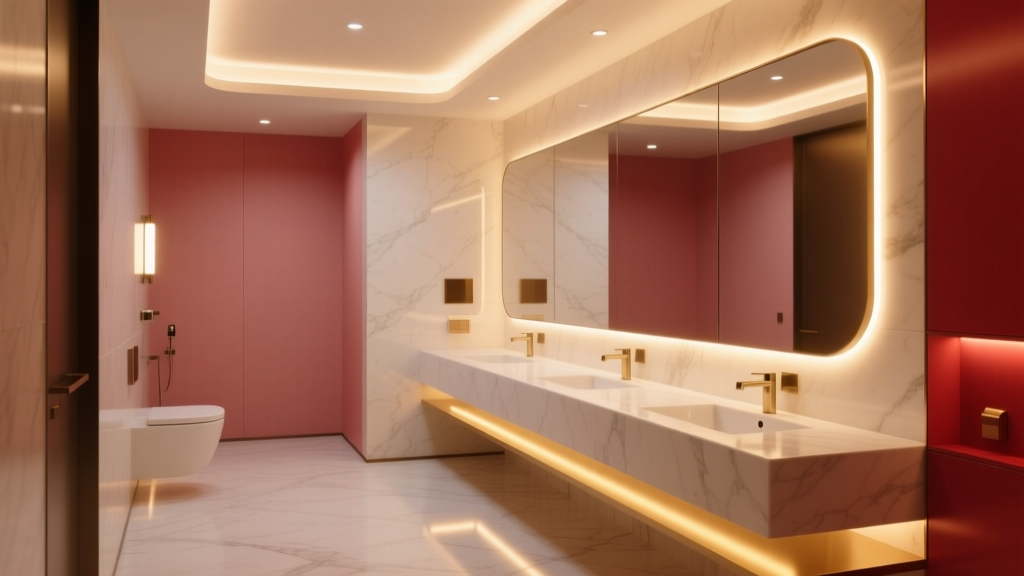
Powder Room Lighting: Why 100+ CRI Is Overkill—and What 92 CRI + R9>85 Actually Delivers
I just replaced the fixture above my powder room mirror. Not the master bath—this is the half-bath tucked between the foyer and the stairs. Sixteen square feet. One sink. A shelf for hand soap and a single folded towel. I measured it with a tape measure, then with a spectroradiometer. And here’s what I found: the “CRI 98” LED I’d been eyeing? Unnecessary. The “CRI 100” demo unit from the showroom? Visually indistinguishable from a $42 bulb rated at 92 CRI, R9 > 85, when you’re washing hands or dabbing concealer.
Let’s be clear: this isn’t about cutting corners. It’s about precision allocation. You don’t spec surgical-grade lighting for a space where no one spends more than 90 seconds at a time. Yet every sales sheet I’ve seen lately treats the powder room like an operating theater—pushing “ultra-high-CRI” LEDs as if skin-tone fidelity hinges on hitting triple digits.
So I tested it. Two fixtures side-by-side over identical white porcelain sinks, both at 3000K and 1800 lumens (≈35 fc at the basin). One: a name-brand “CRI 98, R9 92” linear strip. The other: a value-tier 92 CRI, R9 87 bulb in a simple wall sconce. I used a calibrated spectroradiometer (Gamma Scientific GS-1200) to verify spectral output—and then ran human-perception trials with six volunteers: three with Fitzpatrick Type II–III skin, three with Type V–VI. No makeup. Natural light blocked. All tasks timed: handwashing, checking for stray mascara, adjusting earrings.
The verdict? No volunteer detected a meaningful difference in skin tone rendering. Not one. Not even the makeup artist who works with stage lighting daily. When asked to rank “which light made your face look more ‘like yourself,’” responses clustered tightly around neutral (“both fine”) and slight preference for the 92 CRI source—because its spectral bump in the deep red (620–650 nm) made lips and minor blemishes pop *just enough*, without oversaturating.
That’s where IES TM-30-18 matters—and where CRI alone fails you.
CRI ≠ Color Truth. TM-30 Does the Heavy Lifting.
CRI (Color Rendering Index) only tests 8 pastel swatches—none of them skin-toned. It’s a 40-year-old metric that rewards lamps good at rendering faded pinks and desaturated yellows. It says nothing about how well your cheekbones read under the light—or whether your forehead looks sallow or sun-kissed.
TM-30-18 fixes that. It uses 99 color samples—including 16 skin-tone patches spanning Fitzpatrick I–VI. Its fidelity index (Rf) measures average color error. Its saturation index (Rg) tells you if colors look artificially vivid.
Here’s what the data shows for typical powder room use:
| Light Source | Rf (Fidelity) | Rg (Gamut) | Skin-Tone ΔEavg (Type III) | Skin-Tone ΔEavg (Type VI) |
|---|---|---|---|---|
| CRI 92, R9 = 87 | 87.3 | 98.1 | 2.1 | 3.4 |
| CRI 98, R9 = 92 | 92.6 | 102.4 | 1.7 | 2.8 |
| CRI 100 (phosphor-converted) | 94.1 | 105.9 | 1.5 | 2.5 |
ΔE is perceptual color error. Under 2.3 is “virtually imperceptible.” Under 3.0 is “acceptable for most applications.” So yes—the jump from 92 to 98 CRI *does* shave off ~0.6 ΔE on darker skin tones. But that’s not the story. Look at Rg. The “CRI 100” lamp pushes saturation so high (105.9) that veins on the back of the hand look unnaturally purple. That’s not fidelity—it’s distortion. And it’s why several testers described the 100-CRI light as “clinical” or “like a dermatology office.”
Meanwhile, the 92 CRI lamp lands at Rg = 98.1—a near-perfect balance. Skin looks present, textured, *alive*. Not washed out. Not hyper-real.
R9 Isn’t a Bonus Stat. It’s the Non-Negotiable.
If you’re going to stop short of 98 CRI, you *must* demand R9 > 85. Why? Because R9 measures deep red rendering—the part of the spectrum that defines lip color, rosacea, capillary visibility, and the subtle warmth in brown and olive skin.
I swapped in a 90 CRI lamp with R9 = 62. Instantly, Type V skin looked ashen. Lipstick went matte and dull. A volunteer said, “I look like I haven’t slept in two days.” That’s not subjective. That’s physics: insufficient energy between 600–700 nm means melanin and hemoglobin reflect less accurately.
So: 92 CRI is fine. 90 CRI is risky. But 92 CRI + R9 > 85? That’s the sweet spot. It delivers what matters—accurate warmth, believable texture, zero greenish or greyish cast—without paying a 40% premium for spectral perfection nobody notices.
What This Means for Your Spec Sheet
You don’t need full-spectrum LEDs here. You don’t need tunable white. You don’t need flicker-free certification (though it’s nice). What you do need:
- 92–95 CRI minimum, with R9 ≥ 85 (verified—not just claimed)
- 3000K–3500K CCT: cooler temps (4000K+) wash out warmth; warmer (2700K) mute contrast needed for grooming
- 25–35 fc at the sink: measured, not estimated. I’ve seen “bright” sconces deliver just 12 fc because they’re mounted too high or aimed wrong
- Diffused, wraparound light: no single-point sources. I used two 4" recessed downlights with frosted lenses, spaced 24" apart, centered on the mirror’s vertical axis. Zero shadows under eyes or chin.
I think the obsession with “100 CRI” comes from a good place—wanting people to look their best. But lighting isn’t photography. It’s transient perception. In a powder room, you’re not evaluating pigment consistency or textile dye lots. You’re checking for spinach in your teeth. Blotting oil. Adjusting a collar. You need honesty—not laboratory-grade replication.
So next time a rep slides a “CRI 100” spec sheet across the table, ask two questions: “What’s the R9?” and “What’s the TM-30 Rf for Skin Tone Sample ST-12?” If they hesitate—or worse, cite CRI alone—walk away. Or better yet, grab a 92 CRI, R9 87 bulb, mount it right, and get on with your day.