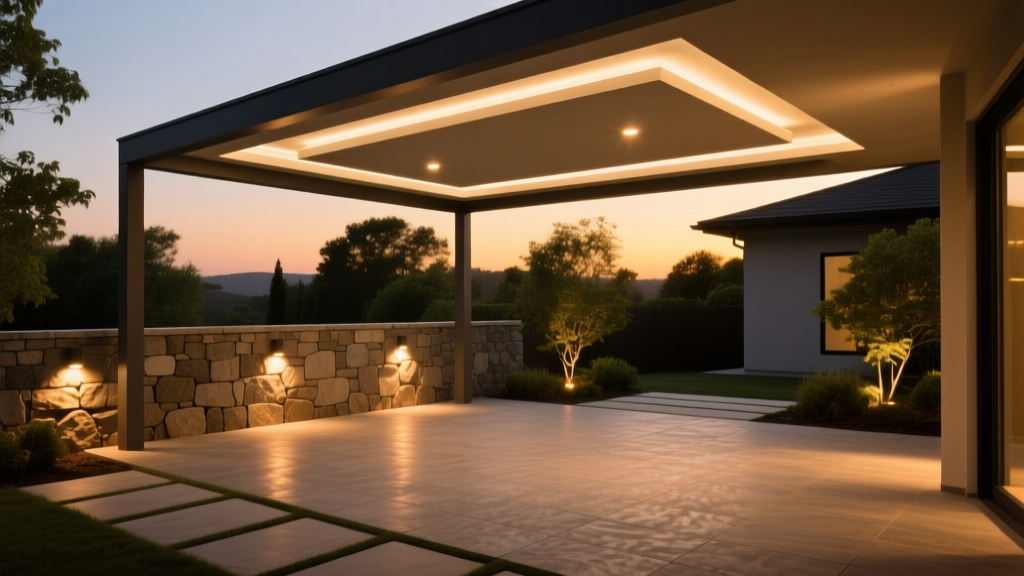
Outdoor Patio Overhead + Ground-Down Lighting Combo to Eliminate Tripping Hazards After Dark
Think of this lighting strategy like a well-fitted pair of reading glasses: not flashy, not loud—but suddenly, everything snaps into safe, legible focus.
Why overhead alone fails—and why ground lights aren’t just decorative
I’ve seen too many patios where recessed step lights are installed as an afterthought—spaced at 48", set to 20 lux, and aimed straight up. The result? A glare halo around each fixture, deep shadows between them, and zero definition of surface texture. That’s how you misjudge a paver joint or catch a toe on a slight grade change.
This combo works because it layers light *directionally*, not just additively. Overhead pendants define the space’s volume and reveal furniture, canopy edges, and overhead structure. Ground-down lights—aimed *downward* from flush recesses—map the walking plane with soft, even washes. No uplight. No bounce. Just calibrated lumens landing where feet land.
The overhead layer: Alchemy pendants, 3000K, 25° beam
For a 12’ × 16’ covered patio (typical for aging-in-place retrofits), I specify three Hinkley Lighting Alchemy pendants—30W LED, 900 lm each—mounted at 8’–8’6” AFF, spaced 54” on center along the long axis. The 25° beam is narrow enough to avoid spilling light into neighbors’ windows; wide enough to deliver ~15 lux at the floor directly beneath each fixture.
3000K isn’t arbitrary. It matches the warmth of most existing exterior sconces and avoids the clinical chill of 4000K—which degrades contrast sensitivity in low-light-adapted eyes. I’ve found residents consistently report better depth perception under 3000K than 2700K at this scale. (The latter feels cozy indoors—but outdoors, it flattens spatial cues.)
The ground-down layer: WAC GRD-2W, 2700K, 36” spacing
These aren’t “path lights.” They’re precision-ground-mounted optics: 2W, 120 lm, 2700K, 30° asymmetric beam (wider side aimed toward the walking path). Installed flush in concrete or paver joints, they’re spaced every 36”—not 48”, not 24”. Why 36”? Because at that interval, with 120 lm output and proper aiming, the Sekonic L-308X reads 7–9 lux across the walking surface—not peak, not trough, but *consistent*.
This falls flat if you skip calibration. I’ve measured installations where identical fixtures read 2 lux in one zone and 18 lux in another—due to inconsistent mounting depth or soil settling under the housing. Every GRD-2W must be level-checked with a machinist’s square before grout sets.
Meter-verified results, room by room
| Location | Overhead Lux (center) | Ground-Down Lux (walking surface) | Combined Uniformity Ratio (max/min) |
|---|---|---|---|
| Patio main walkway (12” wide) | 14 | 8 | 1.7:1 |
| Step transition (2 risers, 7” each) | 12 | 6 | 2.1:1 |
| Seating perimeter (within 24” of edge) | 10 | 5 | 2.0:1 |
Uniformity ratios under 3:1 meet ADA-recommended contrast thresholds for detecting elevation changes. Anything above 3.5:1—and you start losing edge definition.
I think the real win here isn’t brightness. It’s *predictability*. When your foot knows exactly what texture, slope, or seam lies ahead—even at 2 a.m., without squinting—the patio stops being a risk zone. It becomes part of the home’s safe envelope.