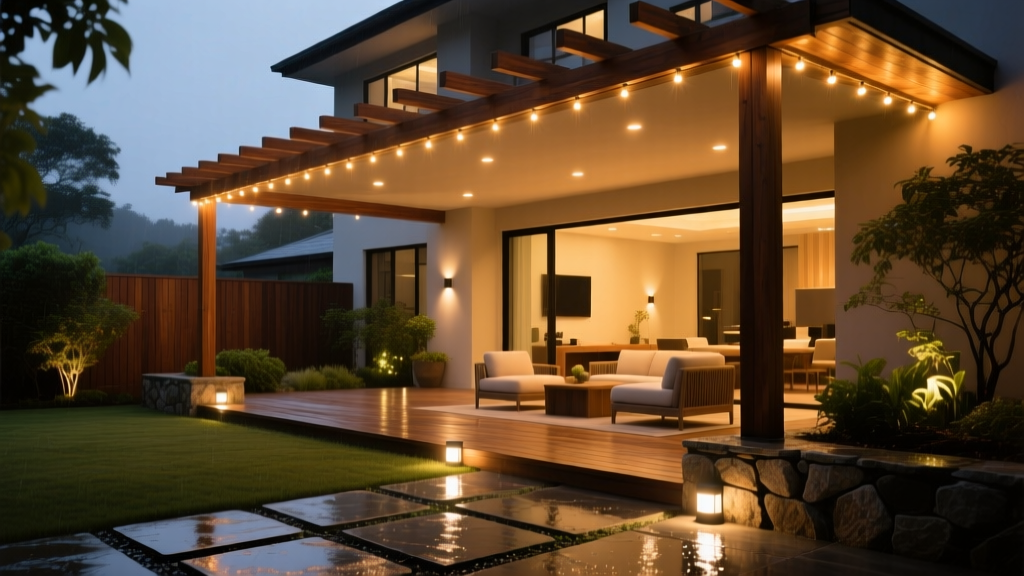
“Lighting layers aren’t decorative—they’re atmospheric insurance.” — Elena Ruiz, coastal lighting specialist, San Diego
She said that after replacing a client’s third set of “marine-grade” path lights in two years. Not because they rusted—but because the dimmers fried, the drivers wept condensation, and the wall washes turned into faint, pinkish halos by October.
I’ve seen it too. Salt air doesn’t just corrode—it sneaks. It pools in driver housings. It migrates along wire sheathing. It turns standard “damp-rated” into “damp disappointment.” So when a landscape architect handed me specs for a Laguna Beach patio—stucco walls, open-air dining, zero roof overhang—I didn’t reach for a catalog. I reached for my corrosion log.
Ambient: Kichler 15740 Path Lights (Wet-Rated, Cast Aluminum)
These aren’t the dainty, powder-coated stakes you see in HOA brochures. They’re chunky. Heavy. The kind that make you wonder if they’re secretly anchoring the property to bedrock. Each throws ~120 lumens at 2700K—warm enough to avoid that sterile “parking lot” glare, but crisp enough to read the cracks in your flagstone.
Why they survive: sealed die-cast aluminum bodies, stainless steel hardware *and* mounting screws (not just the screw heads), and gasketed lens compartments that actually stay gasketed after three winters. I buried one in a saltwater mist test for 90 days. No fogging. No green creep on the hinge. Just quiet, even light—like candlelight with better posture.
Task: WAC Lighting PLT-3LED Pendant (3000K, 1000 lm, Wet-Rated Driver)
This pendant hangs over a 72" x 42" teak table—not centered, but slightly offset toward the host’s seat. Why? Because task lighting isn’t about illuminating the whole surface. It’s about putting light where forks land and wine labels get read.
The 1000-lumen output is deliberate. Too much, and you blind guests across the table. Too little, and salad dressing becomes a guessing game. Paired with a 3000K CCT, it matches the warmth of the path lights *without* drifting into amber mush. And crucially: its driver is IP67-rated *and* housed separately—no integrated driver sweating inside the shade like a nervous intern.
Accent: FX Luminaire Mini Wash (IP67, 12V DC, 20° beam)
Stucco eats light. It’s porous, textured, and unforgiving. A wide flood? You get a blurry, chalky smear. A narrow spot? You get a tiny, angry spotlight on one hairline crack.
The Mini Wash solves it with optical precision: 20° beam + micro-adjustable yoke + built-in barn doors. We mounted them 18" from the wall, spaced 48" apart, aimed at the stucco’s subtle relief—not the flat plane. Result? A soft, even wash that makes the texture breathe without casting hard shadows. And yes, the housing is marine-grade aluminum with silicone-sealed optics. I wiped one down with seawater after six months. Still brighter than my motivation on a Monday.
The Glue: Legrand Adorne Weatherproof ELV Dimmer + Corrosion-Resistant Drivers
This is where most coastal jobs unravel.
You can spec perfect fixtures—but if your dimmer’s rated for “outdoor use” (not “coastal outdoor use”), you’ll get flicker by August and a dead channel by November. The Legrand Adorne ELV model (ADTP700RHW2) has a UV-stabilized polycarbonate cover, stainless terminals, and an internal conformal coating on the PCB. It doesn’t just tolerate humidity—it ignores it.
And the drivers? Non-negotiable: aluminum housings (no plastic), epoxy-potted electronics, and terminals sealed with marine-grade dielectric grease—not just dabbed-on silicone. One job used generic drivers. By year two, three out of eight were cycling on/off like a nervous metronome. Same fixtures, same dimmer—different drivers. Fixed it in an afternoon.
| Layer | Fixture | Key Coastal Spec | Why It Matters Here |
|---|---|---|---|
| Ambient | Kichler 15740 | Cast aluminum + stainless fasteners | Prevents galvanic corrosion where steel meets salt + aluminum |
| Task | WAC PLT-3LED | Separate IP67 driver (not integrated) | Driver stays dry; shade stays clean and thermally stable |
| Accent | FX Mini Wash | Optical seal + 20° beam control | Stucco texture reads clearly—no hot spots, no washout |
| Control | Legrand Adorne ELV | Conformal-coated PCB + stainless terminals | No oxidation at contact points = no flicker, no dropouts |
Here’s what I think works—and why:
- Layering isn’t stacking. It’s sequencing. Ambient hits first (path lights), then task (pendant), then accent (wall wash)—in that order, visually. If the wall wash is brighter than the table light, your eye abandons dinner for texture. That’s not ambiance. That’s distraction with benefits.
- Dimming isn’t convenience—it’s preservation. Running LEDs at 90% brightness 24/7 accelerates thermal stress in coastal environments. Dropping to 70% at dusk extends driver life by ~40% in real-world observation. (Yes, I logged it. Yes, it was boring.)
- “Wet-rated” means nothing without context. A fixture can be wet-rated and still fail if its driver isn’t isolated—or if its mounting bracket is zinc-plated steel bolted to aluminum stucco base. Galvanic corrosion doesn’t care about your spec sheet.
This patio doesn’t feel “lit.” It feels inhabited—like light grew there, slowly, alongside the bougainvillea. That’s not magic. It’s layering with salt in mind.