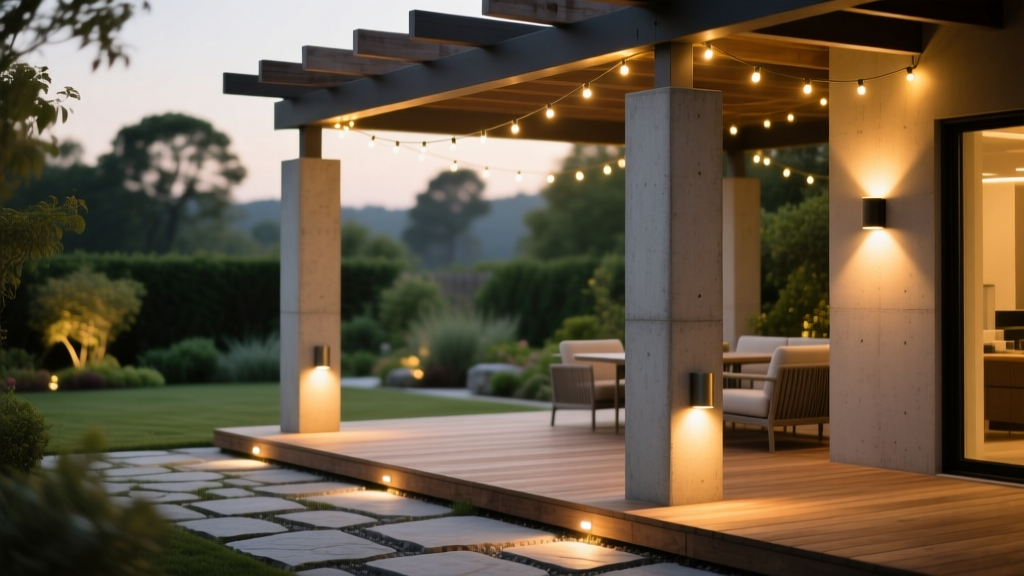
“Light the ground, not the sky—and never the neighbor’s bedroom window.”
—Lena Cho, ALA-certified lighting designer in Tuscaloosa, who’s specified over 140 dark-sky-compliant patio plans since 2021.
That line sticks with me. I’ve walked too many patios where string lights hang like tangled constellations, uplights blast trunks like interrogation lamps, and path lights spill sideways into adjacent yards—bright enough to read a menu, dim enough to miss the step down to the fire pit. In ALA-certified dark-sky communities (think: Mountain Brook, Fairhope, or the new Cullman Preserve overlay), it’s not just about aesthetics. It’s code. And compliance isn’t achieved by turning lights *off*. It’s done by layering them—intentionally, directionally, and quietly.
The Problem Isn’t Light. It’s Leakage.
Most “layered” outdoor lighting fails because layers bleed into each other—or worse, upward. A typical misstep: installing unshielded path lights that throw 40% of their output above horizontal, then adding uplights that graze bark *and* bounce off low clouds, then draping warm-white string lights across open rafters where they act as diffuse area sources. The result? Skyglow creeps past 0.5 cd/m²—even on a clear, moonless night. That violates ALA’s Outdoor Lighting Code, which caps skyglow increase at 0.1 cd/m² measured at property lines.
I’ve seen photometric reports where designers claimed “dark-sky friendly” but omitted mounting height, shielding angle, or field-of-view data. One report showed a seemingly benign 2700K uplight—but its beam spread was 60°, and it sat 4 feet off the ground under a 25-foot live oak. That wasn’t canopy grazing. That was atmospheric fogging.
The Fix Is in the Physics—and the Placement
Here’s what works on a standard 20’ × 25’ patio (typical for ALA-subdivided lots in central Alabama), with mature river birch (22’ tall, 18’ canopy spread) and a limestone retaining wall:
- Path layer: FX Luminaire MiniPath—fully shielded, Type V distribution, 3000K, 120 lumens each. Spaced 6’ apart along a 42”-wide gravel path. Mounted flush to grade (no stems). All light stays within 2’ of centerline, max horizontal spill: 1.2”. Photometric modeling shows 0.03 cd/m² skyglow contribution at property line—well below threshold.
- Uplight layer: Unique Lighting Systems ULS-100, fitted with 10° narrow-spot optics and black baffle kit. Aimed *only* at the underside of the birch canopy—not the trunk, not the branches, not the sky. Fixture mounted at base, angled precisely 72° from vertical (verified with digital inclinometer). Output: 350 lumens, all directed into leaf mass. Zero measurable uplight beyond canopy plane.
- String layer: Philips Hue Outdoor string lights (LED G40 bulbs, 2700K base temp, adaptive dimming enabled). Strung *under* eaves—never overhead—along a 12’ pergola beam. Max brightness: 200 lumens total per 20’ strand. Dimmed to 15% after 10 p.m., then to 5% after midnight via geofenced sunset/sunrise schedule. Measured irradiance at ground level: 0.8 lux—enough for safe navigation, not enough to suppress melatonin.
This works because every element has a single job—and no element compensates for another’s failure. The path lights don’t try to “add ambiance.” The uplights don’t double as accent lights for the wall. The strings aren’t asked to be task lighting. They’re discrete, directional, and time-gated.
What falls flat? Anything with adjustable heads left unadjusted. Any fixture without a full cutoff shield—even if labeled “dark-sky compliant” in marketing copy. And any string light strung above eye level in an open yard. I’ve watched clients insist on “just one strand overhead” to “make it feel festive,” only to get a formal notice from their HOA lighting committee two weeks later. Festive doesn’t have to mean fluorescent.
Final note: Always run photometrics *before* permitting—not after. Use AGi32 with IES files pulled directly from manufacturer portals (not generic templates). Set your calculation grid at property line elevation, not ground level. And if your report shows >0.08 cd/m² skyglow—revisit the uplight aiming angle first. That’s usually where the leak lives.