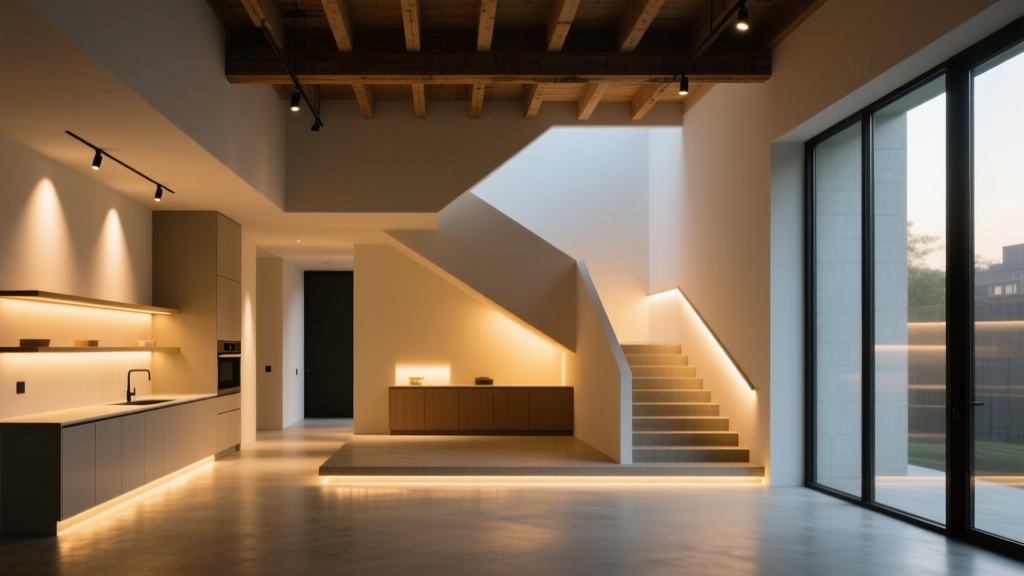
Open-Plan Living/Dining/Kitchen: Breaking Up Light Zones Without Walls
You’re standing in that gorgeous 24’ x 36’ loft—exposed beams, floor-to-ceiling windows, zero walls between living, dining, and kitchen. It’s airy. It’s dramatic. And at 7 p.m. on a Tuesday? It’s one giant, washed-out, indecisive glow.
I’ve seen this dozens of times. Clients love the openness—until they realize their dinner guests are squinting past the TV glare, or the chef can’t read a label under flat, uniform light, or the “cozy” sofa zone feels like an airport lounge because the same 3000K downlight floods everything.
You don’t need drywall to define space. You need light that *behaves* differently in each zone—like furniture you can’t see but absolutely feel.
Beam Angle: Your First Line of Spatial Definition
Start with where light lands—not just how much, but *how tightly*.
- Dining zone: A 15° adjustable gimbal downlight centered over the table. Not 20°, not 25°—15°. Why? Because at 8’ ceiling height, it throws a clean 36"–40" pool of light—just enough to illuminate plates, faces, and wine glasses without spilling into the rug or hitting the barstools. I specify narrow-beam LEDs with CRI ≥92 here. Anything softer blurs the boundary.
- Living zone: 45° wall-washers grazing the sofa wall, plus a pair of 36° recessed downlights spaced 6’ apart over the seating group. The wash softens the edge; the wider downlights layer ambient fill without spotlighting anyone mid-conversation.
- Kitchen zone: 24° task lights over the island (aimed at counter height, not eye level), paired with 60° perimeter downlights for general orientation. That 24° beam stops cleanly at the edge of the countertop—no spill onto the dining chairs.
This isn’t about brightness. It’s about contrast in focus. When your eye moves from the tight, warm pool over the table to the broader, cooler wash beside the sofa, your brain registers *transition*. No wall required.
Color Temperature: Shift Like a Room Has Its Own Time Zone
Forget “warm white everywhere.” That’s visual mush.
I layer CCT like paint:
- Living (2700K): Feels like sunset in a well-worn library. Perfect for sinking into the sofa. Use dimmable filament-style LEDs in sconces or low-profile recessed fixtures. Keep output modest—1,200–1,500 lumens total for a 12’ x 14’ seating area.
- Dining (3000K): Slightly brighter, slightly more neutral—but still intimate. This is where food looks real, skin tones stay honest, and candlelight doesn’t fight the overheads. I spec 3000K in those 15° gimbals, dialed to 80% max output.
- Kitchen (3500K): Crisp, functional, alert—but not clinical. 3500K reads as “focused,” not “sterile,” especially when layered: 3500K task lights over the sink and stove, 3000K under-cabinet strips for prep surfaces (so herbs and spices don’t look gray), and 2700K toe-kick lighting for warmth near the floor.
That 800K jump—from 2700K to 3500K—creates perceptible zoning. Your eyes adjust, yes—but they also *expect* different behavior in each zone. You don’t linger in the kitchen like it’s a lounge. The light reinforces that.
Dimming Profiles + Occupancy Sensors: Let Light Follow Intent
A static scene doesn’t cut it. People move. Activities change. Light should too.
We use dual-tech (PIR + ultrasonic) occupancy sensors—mounted high, aimed across zones, not down at floors—and tie them to three distinct dimming profiles:
- “Evening In” (living zone active): Living lights at 65%, dining at 30%, kitchen at 15%. Ambient only—no task lights. Sofa zone glows; table is quiet; countertops are shadowed.
- “Dinner Mode” (dining + kitchen active): Dining jumps to 90%, kitchen task lights ramp to 100%, living drops to 25% (just enough to navigate). The shift is immediate—and unmistakable. You’re no longer “in the living room.” You’re at the table.
- “Cook & Clean” (kitchen dominant): Kitchen task lights at 100%, perimeter at 70%, dining at 10%, living at 5%. Even if someone’s sitting on the sofa scrolling, the kitchen *feels* like the center of gravity.
No remotes. No apps. Just presence—and light that answers.
One caveat: Avoid over-segmenting. If your dining table is 8’ from the sofa, don’t drop the living lights to 5% during dinner—that creates disorientation. There’s a sweet spot where zones breathe *near* each other, not against each other.
This isn’t lighting design as decoration. It’s lighting as architecture—quiet, responsive, and deeply human.