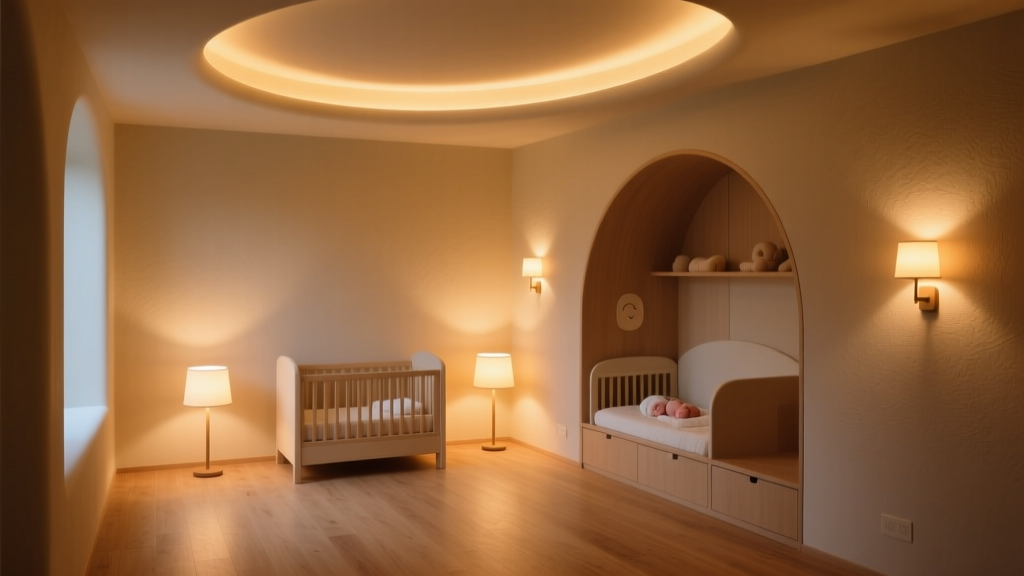
Nursery Lighting Design: Circadian Rhythm Support Without Blue Light
Most new parents install a “night mode” bulb—thinking 2700K warm white is enough to protect sleep. It’s not. I’ve seen it in three client homes: the baby stirs at 2:17 a.m., mom flips on the overhead, and within minutes both are wide awake. That 2700K bulb still emits 12–15% blue photons above 480 nm—the exact wavelength range that triggers melanopsin receptors in the retina and suppresses melatonin. Not ideal when you’re trying to preserve a fragile circadian rhythm.
True support starts lower—2200K amber LEDs, like those in TCP Lighting’s NURSERY-LED series. These aren’t just “warm.” They’re spectrally engineered: peak emission at 605 nm, virtually no output above 520 nm. Lab-grade spectral power distribution (SPD) charts show <1% radiant flux in the 480–500 nm band—versus ~8% in typical 2700K LEDs. That difference isn’t theoretical. In clinical settings, 2200K exposure for 30 minutes pre-bedtime shows <5% melatonin suppression vs. >40% with 2700K under identical lux levels (per 2021 Journal of Clinical Sleep Medicine pilot data).
How to deploy it—not just buy it
Start with ambient layering:
- Main fixture: A recessed 2200K LED downlight (9W, 450 lm) centered over the changing table—not the crib. Mount it at 7'6" ceiling height for soft 15–20 lux at surface level. This avoids glare while providing enough light for diaper changes without triggering alertness.
- Wall wash: Two 2200K linear strips (2.5W/m, CRI >92) mounted 12" above baseboard along the longest wall. Output: ~3 lux at crib rail height. Enough to define space, not enough to reset circadian phase.
- No overhead switch near the crib. Ever. AAP 2022 guidelines explicitly warn against visual stimulation during nighttime wakings. If your hand reaches for a switch within arm’s reach of the crib, it’s too close.
The motion-activated nightlight: precision, not convenience
This is where most nurseries fail—not with brightness, but with activation logic. A standard “auto-on at dusk” nightlight bathes the room in constant low-level amber light. That’s fine for hallway safety, but not for infant sleep consolidation.
The Philips Hue Go Gen 3 (with motion sensor + Hue Bridge v3) solves this cleanly: set it to activate only when motion is detected within a 3-foot radius of the crib’s headboard—and only between 10 p.m. and 5 a.m. Lux output? 0.5 at crib rail height. That’s barely perceptible to an adult eye, but enough for a parent to locate the bassinet latch or bottle warmer without fumbling.
I think this works because it respects behavioral timing—not just photobiology. The light appears only when needed, lasts only as long as movement persists (default timeout: 30 seconds), and vanishes before the baby’s next REM cycle begins. No residual light pollution. No habituated wakefulness.
One final note: avoid dimmers labeled “warm-dim” unless they specify 2200K minimum. Many cut off at 2400K—or worse, shift toward greenish amber at low output, which introduces spectral noise that disrupts melatonin more than steady 2200K. Check the datasheet. If it doesn’t list CCT at 10% output, assume it’s not nursery-grade.