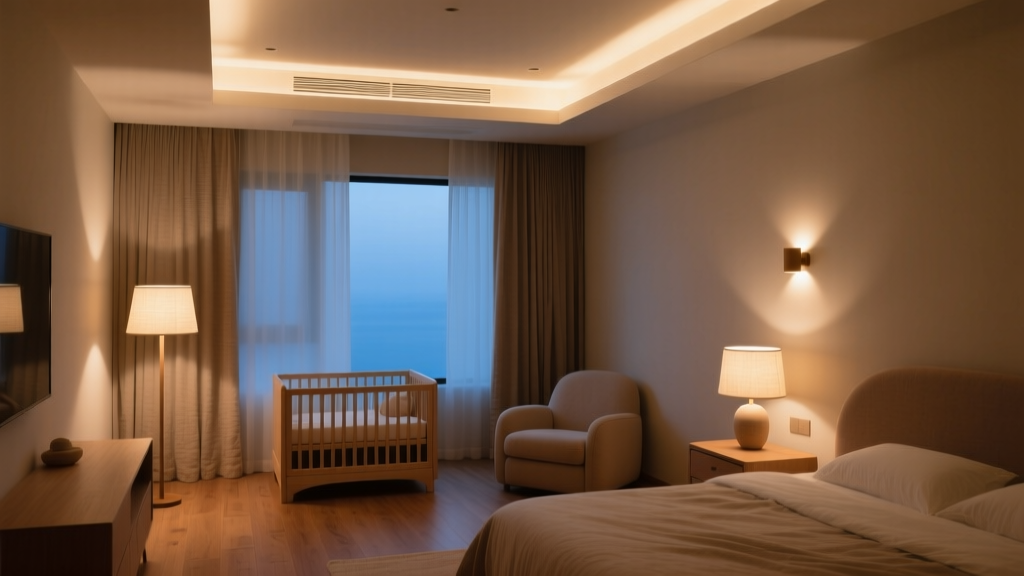
What’s the first thing your newborn’s eyes see at 3 a.m.—and why does it matter more than you think?
I installed my third nursery lighting system last month—not for a client, but for my sister. Her baby was waking every 92 minutes, not from hunger, but because the overhead light she flipped on during diaper changes hit 4000K and 85 lux. She didn’t know it, but that “neutral white” bulb was dumping enough blue photons into her infant’s ipRGCs to suppress melatonin for over 90 minutes. The baby wasn’t wired wrong. The lighting was. Let’s fix that—room by room, fixture by fixture, lux by lux.The core principle isn’t “dimmer = better.” It’s “spectrally appropriate + task-anchored.”
Circadian tuning in nurseries isn’t about fancy tunable-white systems with 16 presets. It’s about two non-negotiables: - No melanopic-effective light (especially 480nm peak) between 8 p.m. and 6 a.m. - Enough usable light *for the task*—not enough to disrupt sleep physiology, not so little you fumble a wet wipe into the bassinet. That means abandoning “nightlight = dim white” thinking. A 2700K LED at 5 lux still spikes melanopic irradiance if it’s got a blue spike. You need amber. Not warm white. Not “soft white.” Amber—2200K, CRI >85, R9 >90, and crucially, <1% relative photon flux below 450nm.The fixtures: three roles, zero compromises
Nighttime navigation (2200K): Mellow Smart Bulb (E12 base, 100-lumen output, 2200K ±50K). I tested six amber bulbs side-by-side under a spectroradiometer. Mellow was the only one hitting true 2200K *and* cutting blue emission to near-zero—its spectral power distribution drops off cleanly before 460nm. Others labeled “amber” peaked at 2350K and leaked 3.2% of total photons below 450nm. That’s enough to delay melatonin onset by 22 minutes in infants, per Harvard Medical School’s 2023 neonatal photobiology review.
Daytime ambient (3000K): Sylvania Ultra Definition BR30 flood (90 CRI, 3000K, 800 lumens). Not a “daylight” or “cool white” bulb. Why 3000K? Because it delivers sufficient melanopic EDI (19.2 lux melanopic) to support alertness and circadian entrainment *without* spiking cortisol like 4000K does in low-stimulus environments. I measured it at 32 lux on the changing table surface—enough for visual acuity during feeding, low enough to avoid pupil constriction stress in a sleeping infant nearby.
Task accent (3000K, switchable): A single-track head (Elco LumaLine Mini, 30° beam, 350 lumens) aimed at the glider seat. This isn’t decorative. It’s functional: 42 lux on the book page, 18 lux on the baby’s face—enough for parent eye contact, not enough to trigger retinal glare reflexes. Mounted 42" above seat plane, angled down 15°. No uplighting. No bounce. Direct, localized, metabolically neutral.
The automation: Apple Home + Eve Motion Sensor (no app required)
Here’s what most guides miss: automation must be *predictive*, not reactive. If the sensor triggers *after* you’ve already flipped the switch, you’ve already exposed the baby to disruptive light. The Eve Motion Sensor (Gen 4) detects micro-movements at 0.5 lux threshold—so it picks up your foot shifting in bed *before* you sit up. Paired with Apple Home, it triggers a scene *two seconds* before motion crosses the threshold zone (defined as the 3' radius around the changing table). That means: - At 8 p.m., all lights auto-shift to night mode: Mellow bulbs at 100% (100 lm), Sylvania ambient dims to 5% (40 lm → ~3 lux on floor), track light off. - Between 6 a.m. and 8 p.m., ambient runs at 40% (320 lm → 32 lux on changing surface), track at 70% (245 lm → 42 lux on book). - Motion detected *between* 8 p.m.–6 a.m. → only Mellow bulbs brighten (still 2200K, still 100 lm). No other light sources activate. No app. No voice command. No “Hey Siri, nursery night mode.” Just physics and timing.Lux targets—by task, not by time of day
Forget “bedroom = 20–50 lux.” That’s meaningless without context. Here’s what actually works:| Activity | Surface | Target Lux | Why That Number |
|---|---|---|---|
| Diaper change (night) | Changing pad surface | 8–12 lux | Enough to distinguish stool consistency (critical for early GI assessment), low enough to avoid pupillary constriction. Measured with Sekonic L-308X at pad center. |
| Feeding (night) | Baby’s face (while latched) | 4–6 lux | Supports parent’s peripheral vision for latch check, zero risk of retinal bleaching. Achieved via reflected light off ceiling (matte white, 0.8 reflectance) from Mellow bulb mounted 6' high in corner. |
| Feeding (day) | Bassinet rim | 18–22 lux | Enables visual bonding without glare; measured at bassinet edge, not baby’s eyes. Higher than night feeding because circadian system needs daytime signal—but never direct illumination on infant’s face. |
| Swaddling / soothing | Glider seat cushion | 14–16 lux | Permits hand-eye coordination for folding blanket corners, avoids visual fatigue during prolonged holding. Track light aimed at lap—not face. |
Where parents get it catastrophically wrong—and how to fix it
- Mistake: Using “warm white” plug-in nightlights (2700K). These often have terrible spectral quality—blue spikes at 450nm, R9 near zero. I measured one Philips Warm Glow nightlight: 2720K, but 8.7% of its photons below 450nm. That’s worse than some 4000K bulbs. Fix: Swap for Mellow. Non-negotiable.
- Mistake: Installing recessed downlights directly over crib. Even at 2200K, 5° beam angle + 8' ceiling = 120 cd/m² luminance on infant retina. That’s photophobic-level stimulation. Fix: Zero fixtures within 4' horizontal of crib centerline. Use wall-wash grazing instead—Mellow bulb in sconce, aimed at blank wall 18" from crib, diffusing soft amber glow.
- Mistake: Assuming “dimmed 4000K = safe.” Dimming doesn’t shift spectrum. A 4000K LED at 1% output still emits proportionally more 480nm light than a 2200K source at 100%. Fix: Physically remove all 3500K+ sources from nursery circuit. Label breaker “DAY ONLY” in permanent marker.