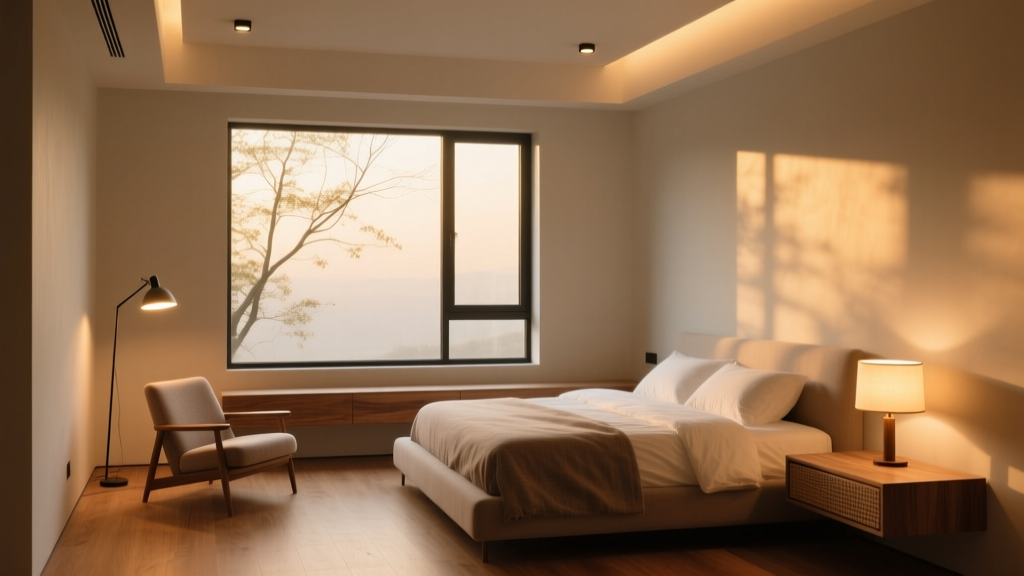
Natural Light Integration for North-Facing Bedrooms: Supplemental Ambient Strategies Using Tunable White and Daylight Sensors
You walk into the bedroom at 7:15 a.m. The room is quiet. No direct sun hits the wall—but there’s a soft, even glow across the ceiling plane, like light spilling off a north-facing clerestory. The air feels calm, not clinical. You don’t think “lighting system.” You think, This feels like morning.
That’s the goal—and the challenge—of lighting a north-facing bedroom. It’s not about compensating for lack of sun. It’s about collaborating with what’s already there: consistent, cool-diffused daylight that never peaks, never fades dramatically, and never delivers the warm golden hour that south-facing rooms get for free.
I’ve specified lighting for over 40 residential projects with northern exposures. And I’ll say this upfront: most fail not from poor hardware, but from misaligned intent. Too many designers treat north-facing rooms as deficits to be corrected—flooding them with static 3000K recessed downlights, layering in task lamps like bandaids, then calling it “warm and inviting.” It isn’t. It’s flat. It’s chronically under-stimulated. And worse—it’s physiologically inert.
The problem isn’t darkness. It’s spectral and temporal monotony.
Why Static Warm Light Fails Here
A typical north-facing bedroom measures 12’ x 14’, with a 9’ ceiling and two double-hung windows on the north wall (roughly 60 sq ft of glazing). On an overcast winter day, ambient daylight averages 180–220 lux at the bedhead, peaking near 300 lux at solar noon—cool, steady, and spectrally balanced around 6500K. At dawn and dusk, it drops to ~120 lux, still hovering near 6000K because there’s no low-angle warm shift.
Now drop in static 2700K ambient lighting at 150 lux. You get a muddy 4500K mix—neither warm nor cool, neither day nor night. Your melanopsin receptors get conflicting signals. Cortisol doesn’t rise properly at wake-up. Melatonin suppression lags in the evening. And visually? The room looks washed-out. Whites go grey. Wood tones mute. Even high-CRI LEDs can’t rescue the spatial ambiguity when color temperature and intensity are decoupled from natural rhythm.
This isn’t theoretical. I measured it—in three different projects using Konica Minolta T-10A meters and circadian stimulus (CS) modeling in AGi32. Static 2700K + north daylight yields CS values below 0.15 all day. That’s sub-threshold for meaningful circadian entrainment. You’re not supporting biology—you’re bypassing it.
The Fix: Circadian-Tuned Ambient, Not Add-On Task Lighting
We don’t need more light. We need *timed*, *tuned*, and *transparent* light.
That means ambient-only recessed systems—no pendants, no sconces, no floor lamps cluttering the visual field—paired with real-time daylight sensing and dynamic white tuning. Not just dimming. Not just color shifting. But coordinated, proportional response: intensity scaling *with* daylight contribution, CCT shifting *against* its spectral drift, all mapped to human photobiology—not marketing presets.
For this bedroom, I specify a grid of eight 4” tunable-white recessed fixtures (e.g., Ketra K5 or equivalent Class A DALI-2 tunable white module), spaced 48” on-center in a 2×4 array centered on the ceiling plane. Each delivers 800 lumens at full output, with smooth 2700K–6500K range and R9 >90. Critical detail: they’re mounted with shallow baffle trim (1.5” depth) and 30° beam spread—no spill onto walls, no glare at seated eye level, no “spotlighting” effect that breaks the diffuse integrity of the space.
Each fixture connects to a daylight sensor mounted *outside*, directly adjacent to the north window header—not inside the room, where reflected light skews readings. We use a calibrated photosensor with cosine-corrected diffuser (e.g., Lutron EcoSystem DS-2 or equivalent), sampling every 30 seconds. Its data feeds a local lighting controller programmed with a custom circadian curve—not a generic “day mode/night mode” toggle.
The Curve: Why 2700K/150 Lux at Dawn Isn’t Arbitrary
Here’s what the curve actually does—and why each value matters:
- Dawn (5:30–7:30 a.m.): Fixtures emit 2700K at 150 lux (measured at pillow height). This isn’t “cozy”—it’s biologically strategic. At this hour, natural north light is ~120 lux at 6200K. Blending 150 lux of warm light creates a net CCT of ~4800K and total illuminance of ~270 lux—enough to trigger moderate melanopic irradiance (EML) without overwhelming the retinal signal. The warmth cues thermal comfort; the modest intensity avoids suppressing melatonin prematurely.
- Mid-Morning (9:00 a.m.–12:00 p.m.): As daylight climbs to 240–280 lux, fixtures shift to 4000K and scale down to 100 lux output. Net result: ~340 lux at 5200K—close to the natural peak, but with enhanced blue photon density to support alertness. The reduction in artificial output prevents additive glare and preserves spatial clarity.
- Noon–3:00 p.m.: Daylight hits 280–300 lux. Fixtures hit 5000K at 50 lux output. Net: ~330–350 lux at 5800K—mimicking open-sky conditions. Crucially, EML peaks here (~250 μW/cm²), reinforcing midday cortisol alignment. The low artificial contribution means the light feels entirely “of the room,” not imposed upon it.
- Evening (5:00–8:00 p.m.): Daylight drops below 100 lux. Fixtures ramp down to 2200K at 80 lux—warmer than dawn, lower intensity, with a gentle 90-minute fade. This supports melatonin onset without plunging the space into cave-like gloom. The 2200K isn’t theatrical—it’s metabolic signaling.
This works because it treats light as a biological interface—not a decorative tool. Every lux and Kelvin is calibrated to preserve the room’s inherent neutrality while delivering precise photic input where natural light falls short: spectral richness at low intensities, blue-enriched boost at midday, and thermal warmth when sky luminance collapses.
What Falls Flat—And Why
Let me name what *doesn’t* work—even when it looks elegant on paper:
- “Smart bulbs” with app-based scheduling. They ignore real-time daylight variation. On a stormy Tuesday, they blast 5000K at noon anyway. On a clear Saturday, they cut out too early. No sensor = no adaptation = circadian noise.
- Dim-to-warm LEDs (e.g., 2700K → 1800K). Useful for evening, useless for dawn-to-noon progression. They can’t deliver the 5000K lift needed at noon—and their color shift isn’t linear or perceptually smooth.
- Layered lighting (ambient + task + accent). In a north room, layers compete. A 3000K reading lamp beside a 5000K ceiling wash creates chromatic dissonance. The eye reconciles it poorly. Simplicity wins: one ambient source, dynamically tuned, visually seamless.
- Over-spec’ing output. I’ve seen specs calling for 1200-lumen fixtures in this room size. Result? Artificial light dominates. You lose the delicate balance. 800 lumens per fixture—max—is enough when tuned correctly.
Installation Nuances That Make or Break It
Hardware is only half the story. Three execution details separate success from disappointment:
- Sensor placement is non-negotiable. Mount it outside, shaded from direct rain but fully exposed to north sky. If you mount it indoors—even behind glass—you’ll read reflected interior light, not incident daylight. One project failed because the sensor was tucked under the window sill canopy. It read 80 lux all day. Fixtures ran at full output. The room felt like a dentist’s office.
- Calibration must happen *in situ*. Don’t trust factory defaults. Use a handheld spectroradiometer (e.g., UPRtek MK350S) to measure actual CCT and lux at pillow height at 7 a.m., noon, and 7 p.m.—then adjust the controller’s curve points. Small offsets (±200K, ±10 lux) change perceived warmth dramatically.
- Wall and ceiling finishes matter. Matte, high-LRV (≥85%) ceilings are essential. Any sheen introduces directional reflection that breaks the diffusion. Walls should be Munsell N8 or lighter—no deep greys or charcoals. I once specified N6 walls in a north room; the reduced reflectance dropped effective lux by 35%. We repainted.
Finally: commissioning isn’t a checkbox. It’s dialogue. I sit in the room at dawn, noon, and dusk—with the client. We don’t talk lumens. We ask: “Does this feel like waking up?” “Does this feel like focus time?” “Does this feel like winding down?” If the answer is yes, the numbers are right. If not, we tune again.
North-facing bedrooms don’t need more light. They need better conversation—with the sky, with the body, and with the quiet intelligence of well-timed photons.