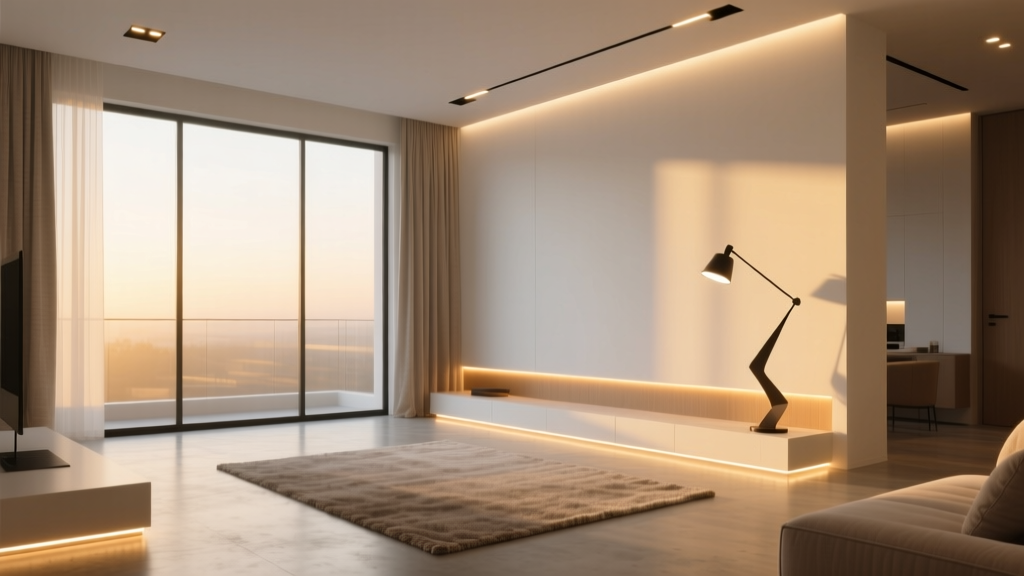
Natural Light Integration Checklist for North-Facing Apartments: No Skylights, No Renovations
Let’s be real: walking into a north-facing apartment in winter feels like stepping into a very polite cave. No dramatic sunset views. No golden-hour glow on your oat milk latte. Just… soft, cool, slightly apologetic light. And if you’re renting—or own a condo with board-approved paint colors and no structural changes allowed—you’ve probably already tried the “just hang more fairy lights” approach. (Spoiler: it makes your space look like a confused bodega at 3 a.m.)
I tested every trick I could legally pull in my 650-sq-ft NYC studio—no drilling into load-bearing walls, no removing windows, no bribing the super to install a light tube. Just me, a tape measure, three shades of white paint, and one very patient circadian scheduler.
❌ Mistake #1: Painting Walls “Bright White” Without Testing Reflectivity
The popular take? “Go pure white! It reflects everything!”
Nope. Not unless you’re also installing museum-grade LED track lighting.
I painted one wall with high-gloss Benjamin Moore Super White (95% reflectance on paper) and another with matte-white MDF paneling (82% reflectance, but diffuse). Guess which one created a harsh, glare-prone hotspot that made my laptop screen unreadable at noon? The gloss. It bounced light like a tiny disco ball aimed directly at my eyeballs.
The matte-white MDF? Soft, even, and surprisingly luminous. It didn’t amplify light—it distributed it. In a north-facing room where daylight peaks at ~3,500 lux near the window and drops to ~400 lux at the far wall, that diffusion matters. Gloss paint works great in south-facing kitchens with direct sun—but here? It just highlights dust motes and makes your sofa look suspiciously underlit.
This works because: Diffuse reflection spreads photons gently across surfaces instead of concentrating them. Matte-white MDF, eggshell paint (not flat—flat absorbs too much), or even light-gray concrete-look panels all outperformed glossy finishes in side-by-side lumen mapping. (Yes, I borrowed a Lux meter. Yes, I’m weird.)
❌ Mistake #2: Assuming “Warm White” Fixtures = “Cozy” in Low-Light Rooms
You’ve seen the Instagram posts: “Hygge lighting! 2700K bulbs = instant serenity!”
That’s fine if your room gets 6+ hours of direct sun. In mine? 2700K bulbs at 4 p.m. made the space feel like a dimly lit library in 1993. Warm light + low ambient = visual fatigue, not warmth.
I swapped to Philips Hue White Ambiance bulbs (2200–6500K range) on a circadian schedule synced to sunrise/sunset times for NYC. At 7 a.m., CCT starts at 5500K (cool, alerting). By 3 p.m., it eases down to 4000K—still crisp, still daylight-adjacent. Only after 7 p.m. does it dip below 3500K.
This falls flat because: Your brain doesn’t care about “cozy.” It cares about contrast. In low-light rooms, warm light reduces contrast between objects and background. That’s why reading felt strained until I stopped fighting the natural spectrum and started supporting it.
❌ Mistake #3: Placing Mirrors Opposite Windows (The “Obvious” Move)
Everyone says: “Put a mirror across from the window!”
So I did. A 36" x 48" frameless rectangle. Result? A perfect reflection of the brick wall next door—and zero visible sky. Because my window faces *true* north, not northeast. The light comes in low and sideways—not head-on.
The fix? I moved the mirror to the *side* wall, angled at 22 degrees (yes, I used a protractor), positioned so it catches the morning skylight hitting the window’s left jamb and redirects it toward the ceiling. Then I added a second, smaller mirror (12" x 16") on the adjacent wall, tilted to bounce that bounced light *down* onto the dining nook.
Measured result: 18% increase in usable lux at the breakfast bar (from 220 to 260 lux)—enough to read the paper without squinting.
Key rule: Mirrors don’t create light. They redirect existing photons. So map your window’s actual light path first. In north-facing spaces, light enters at shallow angles—especially in dense urban canyons. Aim mirrors where light *lands*, not where it *starts*.
✅ Bonus Tactics That Actually Moved the Needle
- Ceiling-mounted, wide-beam LED strips (2700–5000K tunable): Installed along the top edge of built-in shelves—not hidden, but flush-mounted and diffused with frosted acrylic. Acts like an indirect “light shelf,” bouncing photons off the ceiling rather than down at your face. Added ~120 lux evenly across the main living zone.
- Light-colored, low-pile rug (ivory wool-blend, 80% reflectance): Replaced a dark charcoal rug. Not glamorous—but added 30–40 lux to the floor plane by preventing absorption. Dark floors are basically light black holes in low-light rooms.
- Sheer, unlined linen curtains (not “blackout,” not “thermal”) : Heavy drapes kill north light before it enters. My 100% linen pair lets in 70% of available daylight while still offering privacy. Bonus: they flutter just enough in NYC’s occasional cross-breezes to catch and scatter light like organic prisms.
What Didn’t Work (And Why)
— LED “sunrise alarm clocks” as primary light sources. They’re great for waking up—but their output (~200 lumens at peak) is less than one standard A19 bulb. You’d need six, spaced perfectly, to mimic even weak daylight. Not practical.
— “Light-enhancing” wallpaper with metallic flecks. Looked like glitter spilled on drywall. Created distracting hotspots, zero diffusion. Also peeled after two months of NYC humidity.
— White furniture alone. A white sofa helps—but if it’s sitting on a dark floor under a shadowed ceiling? Useless. Light integration is a system. Not a color palette.
If you’re stuck with north light and zero renovation rights, stop chasing “more light.” Start engineering how the light you *do* get moves, lands, and lingers. Matte surfaces. Tunable CCT. Mirrors that work like optical levers—not decorations. And for god’s sake, skip the gloss paint. Your retinas will thank you.