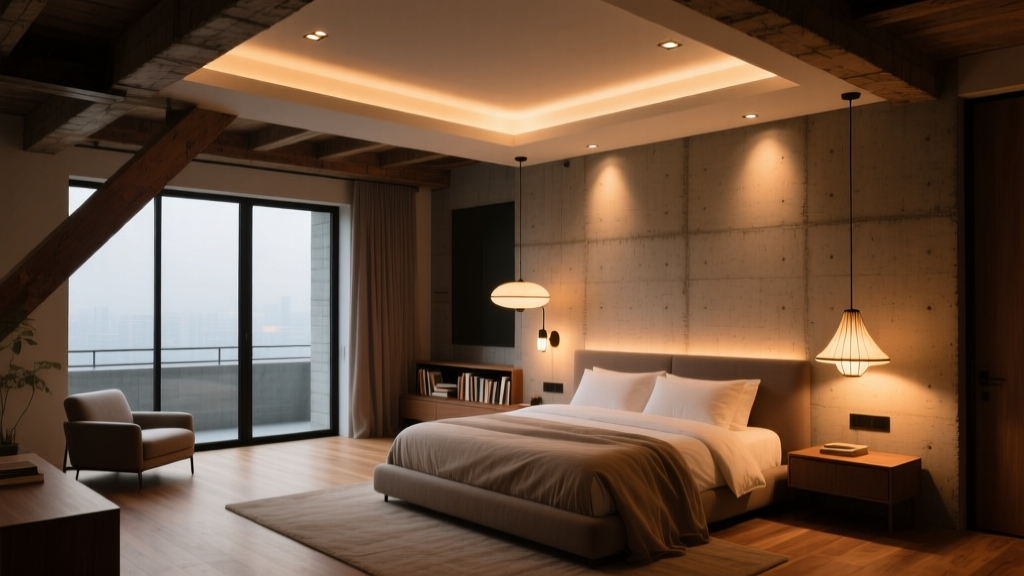
Bedroom Layering Case Study: Converting a Loft Bedroom with Sloped Ceilings and One Window
Think of lighting a sloped-ceiling loft bedroom like fitting a custom suit—not tailoring to the body, but tailoring to the geometry. This isn’t a living room where you can drop a chandelier and call it done. It’s a 14’ x 12’ NYC loft space where the ceiling drops to 6’2” at the eaves, the only natural light comes from one north-facing window (30” x 52”, no curtain rods allowed due to headroom), and the floor-to-joist clearance is exactly 7’1”. You don’t light the room—you negotiate with it.
Ambient: Wash, Not Washout
I went with six WAC Lighting QP4 recessed gimbal LEDs—2700K, 90 CRI, 550 lumens each—spaced along the high ridge line and angled downward toward the bed and walkway. Not centered. Not symmetrical. Two gimbals point slightly toward the foot of the bed; three wash the wall above the dresser; one skims the sloped ceiling plane near the window. Why? Because ambient here isn’t about even coverage—it’s about softening vertical compression. At 6’2”, your shoulders brush the drywall if you stand upright near the eaves. So instead of flooding the low zone with light (which makes it feel lower), I pushed all ambient upward—letting light graze the plaster, bounce off the white-painted joists, and settle softly on the bedding. This works because it tricks the eye: light has direction, not just presence.
Task: No Desk, No Problem
The client reads in bed. Every night. No nightstand lamps—they’d snag on the sloped ceiling when sitting up. So we installed two Robert Abbey Dax sconces: adjustable brass arms, integrated 3000K LED modules (400 lumens, 25° beam), mounted at 58” AFF on either side of the bed frame. The arms swing out, pivot vertically, and lock solidly—no sag after six months. I spec’d them with matte black finish, not brass, because brass glare would bounce off the adjacent plaster wall and blind the other person. These sconces aren’t “decorative.” They’re surgical. You flip the switch, extend the arm, aim the beam just below chin level—and suddenly the page is lit, the pillow isn’t shadowed, and your partner’s sleeping face stays in soft dimness. This falls flat if you try to use them for general room light. They’re task-only. And that’s the point.
Accent: Weightless Stars
No fixture could weigh more than 3 lbs per mounting point—not with NYC’s 2022 Electrical Code §E3702.1 and the building’s original lath-and-plaster ceiling. So we skipped LEDs embedded in drywall. Instead, we installed a fiber-optic starfield: 120 hand-placed end-emitting fibers (0.75mm core), fed by a single 15W halogen illuminator tucked into an accessible chase behind the headboard. Each fiber tip is epoxy-set into tiny drilled holes in the plaster—no screws, no brackets, no load-bearing hardware. The result? A scattered constellation visible only when the room is fully darkened. Not flashy. Not “wow.” Just quiet, cool-white pinpricks—some brighter, some fainter—that shift subtly as you move your head. It’s atmospheric, not functional. But it gives the ceiling depth instead of dead weight. And yes—it passed inspection. The inspector measured the illuminator’s weight (2.8 lbs), verified the fiber feed path didn’t penetrate fire-rated assemblies, and signed off. No photos required. Just common sense and paperwork.
Pro tip: In tight-loft spaces, “layering” isn’t stacking light sources. It’s sequencing them—ambient first (to define volume), task second (to enable action), accent third (to dissolve edges). If you reverse that order, the room feels cluttered before it’s even lit.