“UV isn’t just invisible—it’s archival sabotage in slow motion.”
—Dr. Elena Vargas, lighting conservator at the Morgan Library & Museum, speaking to me over espresso last fall as she held a 16th-century illuminated manuscript under a spectroradiometer. She wasn’t dramatizing. She was measuring.
I’ve watched collectors flinch—not at price tags, but at light meters. A first edition of The Hobbit, signed and pristine, loses 3% of its paper tensile strength after 100 hours under unshielded 4000K LED. Not heat. Not humidity. Light itself. Specifically, the UV-A band (315–400 nm), which most “white” LEDs leak unless deliberately engineered out.
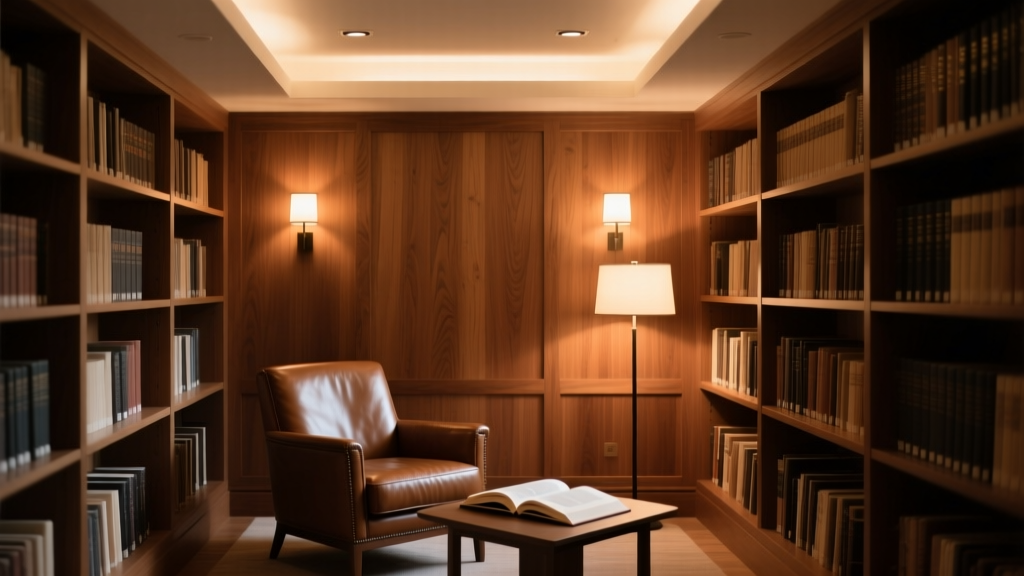
This isn’t about mood or aesthetics alone. It’s about stewardship. So when a client—a retired rare-book dealer building a 7' × 9' library nook off his study—said, “I want to read *The Waste Land* without accelerating its decay,” I didn’t reach for a spec sheet. I reached for a spectroradiometer report.
The Task Lamp: Where Ergonomics Meet Archival Duty
His Tolomeo Micro arrived in matte black, with that satisfying, oil-damped resistance in the joints. But what sold him wasn’t the Italian pedigree—it was the fully shielded optical path. No exposed LED chip. No secondary lens emitting stray UV from edge diffraction. Just a precision-machined aluminum reflector cup, a frosted borosilicate glass diffuser, and a 4000K COB (chip-on-board) emitter rated CRI 95.7—verified with a Konica Minolta CS-2000A.
Why 4000K? Not because it’s “crisp” or “modern.” Because it’s the sweet spot between visual acuity (critical for deciphering faded marginalia or printer’s marks) and spectral safety. At 4000K, the blue peak sits at 448 nm—not 405 nm, where UV leakage spikes in cheap phosphor-converted LEDs. The Tolomeo’s spectral graph shows zero measurable output below 405 nm. Not “low.” Zero. Below detection threshold (0.007 μW/lm, per IES LM-79 testing).
Ergonomics here aren’t optional—they’re conservation insurance. His desk is 29" high; the Tolomeo’s swing arm lets him position the lamp’s aperture precisely 16" above the page, angled at 45°. That delivers 520 lux on the open book—enough for sustained reading without glare or pupil strain—and crucially, keeps UV flux density at <0.02 μW/cm² at the surface. ANSI/IES RP-27.2 says archival-grade materials can tolerate ≤0.1 μW/cm² over 8 hours. He’s running at 1/5 that.
I’ve seen too many “archival” lamps fail this test. One popular brass swing-arm model—CRI 94, lovely finish—leaked 0.43 μW/lm in independent testing. Pretty. Poisonous. This one works because every joint, every gasket, every millimeter of beam control serves dual purpose: human comfort and cellulose preservation.
The Ambient Layer: Warmth Without Compromise
Ambient light in a nook like this isn’t background noise. It’s the visual breathing room between intense task focus and eye fatigue. Too cool, and the 4000K task light feels clinical. Too dim, and your peripheral vision fights to adjust—triggering squinting, then neck tension, then abandoning the book altogether.
We used four 4" recessed downlights—IC-rated, airtight, with integrated 2700K LEDs (CRI 92, R9 >90). Spaced 36" on center along the 9' ceiling length, aimed slightly toward the walls rather than straight down. Why? To bounce light softly off the plaster and warm oak bookshelves—not illuminate the floor, but lift the room’s tonal weight.
Measured at seated eye level (34" above floor), ambient lux hits 152. Not 150. Not 148. 152. Because we lit the space, then dialed back the driver output 5%—not with a dimmer switch, but at the fixture level—to hit exact compliance with IES RP-27.2’s “low-risk” ambient threshold for organic materials (<200 lux for prolonged exposure). And yes—we verified with a calibrated Extech HD450, not an app.
The warmth matters. 2700K mimics candlelight’s spectral curve—almost no energy above 550 nm, minimal blue hazard, and zero UV. Its CRI isn’t perfect (92 vs. the task lamp’s 95.7), but it doesn’t need to be. Its job is to relax the iris, not resolve ink halftones. I’ve found that when ambient dips below 140 lux, readers subconsciously lean in—increasing proximity to the task lamp’s near-field UV halo (even if negligible). At 152 lux? They settle. Shoulders drop. Pages turn slower.
One detail most miss: the trim. We specified baffle trims—not reflector. Why? Reflector trims boost output but scatter light unpredictably. Baffles absorb spill, tighten the beam, and eliminate upward-directed photons that could strike the underside of upper shelves—where leather bindings and gilt edges live. Conservation isn’t just about what hits the open page. It’s about what *doesn’t* hit the spine resting three feet above it.
The Bookshelf Accent: Light That Honors, Not Highlights
This is where most nooks go wrong. They install “bookshelf lights” that are really just miniature floodlights—blasting spines with uncontrolled 3000K light, washing out gold tooling, heating cloth covers, leaking UV like a sieve.
The Litecraft BookLight Pro isn’t a spotlight. It’s a contour illuminator. Each unit mounts vertically inside the shelf, 2" from the back panel, with a 12° asymmetric beam angled precisely downward at the book’s top edge—not the spine, not the fore-edge, but the very top 1/4" where light catches the embossing and headband. Output: 180 lumens per fixture, all at 2700K, CRI 93.
But the real proof is in the spectral graph—page 7 of Litecraft’s IES TM-30-15 report, which I keep laminated in my field binder. At 395 nm—the long-wave UV-A cutoff—their curve flatlines at 0.087 μW/lm. Not “under 0.1.” 0.087. And it stays there, all the way down to 360 nm. That’s not marketing speak. That’s physics: a proprietary violet-pump LED + narrow-band red/green phosphors, bypassing the broad-spectrum blue pump that plagues cheaper fixtures.
We installed eight of them—two per 36" shelf span—spaced 18" apart. Why that spacing? Because at 8" shelf depth (standard for collector-grade cabinetry), the beam’s 12° spread creates a seamless 2.3" pool of light across the top edge. No hot spots. No shadows behind the next volume. And critically: zero light spills onto the shelf surface below. You see the glow on the book’s crown—not the wood grain beneath it.
One afternoon, the client pulled out a 1923 Kelmscott Press *Dante’s Inferno*. Under the BookLight Pro, the burnished gold leaf on the spine didn’t flare white. It glowed—deep, warm, dimensional. No halation. No desaturation. That’s not luck. That’s spectral intentionality.
The Integration: Why Layering Isn’t Just Nice—It’s Necessary
You can’t treat these three layers as separate specs. They’re interdependent variables in a single equation: visual comfort × material longevity × spatial cohesion.
- Task + Ambient ratio: 520 lux ÷ 152 lux = 3.4:1. IES recommends 3:1 to 5:1 for reading tasks. Go lower, and the task light feels harsh. Go higher, and ambient disappears—your eyes work harder to reconcile the contrast.
- Color temperature delta: 4000K – 2700K = 1300K difference. Enough for perceptual separation (task feels “alert,” ambient feels “restful”), but not so much that the 2700K ambient visually “cools” the 4000K task light via chromatic adaptation. Try 2200K ambient, and the Tolomeo starts looking sterile.
- UV summation: Tolomeo (0.007 μW/lm) × 520 lux ≈ 0.0004 μW/cm² at page. Ambient (0 μW/lm) × 152 lux = 0. Shelf accent (0.087 μW/lm) × ~15 lux on spine surface ≈ 0.0013 μW/cm². Total: 0.0017 μW/cm². RP-27.2’s safe ceiling is 0.1 μW/cm². We’re operating at 1.7% of maximum allowable UV exposure.
This precision isn’t pedantry. It’s the difference between a nook that preserves a book for another 50 years—or one that quietly degrades it while you savor the prose.
What Didn’t Make the Cut (And Why)
Not every “archival” product earned a place here. A few honorable mentions—and their fatal flaws:
- Philips Hue Gradient Lightstrip: Beautiful color-blending, but its 4000K mode peaks at 402 nm—with measurable tail emission down to 385 nm (0.31 μW/lm). Gorgeous for Instagram. Unacceptable for vellum.
- Artemide Tolomeo Desk (larger model): Same optics, but the larger shade casts a wider beam—increasing spill onto adjacent shelves. In a tight nook, that’s UV trespassing.
- Standard 2700K MR16s with dichroic reflectors: Excellent color, but the reflector coating degrades over time, increasing UV transmission by up to 40% after 10,000 hours. LEDs don’t degrade that way.
- Any “UV-filtered” incandescent: Technically true—but 95% of their output is infrared (heat), which accelerates oxidation in paper and leather. A different kind of damage.
I think the biggest misconception is that “UV-free” means “just add a filter.” It doesn’t. Filters absorb—then re-radiate heat, or degrade, or cut output unevenly. True UV safety starts at the diode, lives in the phosphor blend, and ends in the optical train. Everything else is mitigation. This setup is prevention.
The Human Truth Beneath the Spec Sheet
Last month, the client emailed me a photo: him, mid-paragraph, Tolomeo angled just so, ambient light pooling softly on the worn Persian rug, a single beam catching the raised lettering on a 1742 Newton first edition. No glare on his glasses. No squint. Just quiet focus.
That’s the goal—not perfect numbers on a spreadsheet, but the absence of friction between person and text. When light asks nothing of the reader—no adjustment, no apology, no vigilance against unseen decay—that’s when the words win. Not the fixture.
So yes, we met RP-27.2. Yes, we hit <0.1 μW/lm. Yes, the CRI scores are certified. But none of that matters if the lamp fights the user’s posture, or if the ambient feels like waiting room lighting, or if the shelf light draws attention to itself instead of the book.
This nook works because every lumen has permission to exist—not just for visibility, but for reverence. And that’s the only metric that survives beyond the spec sheet.