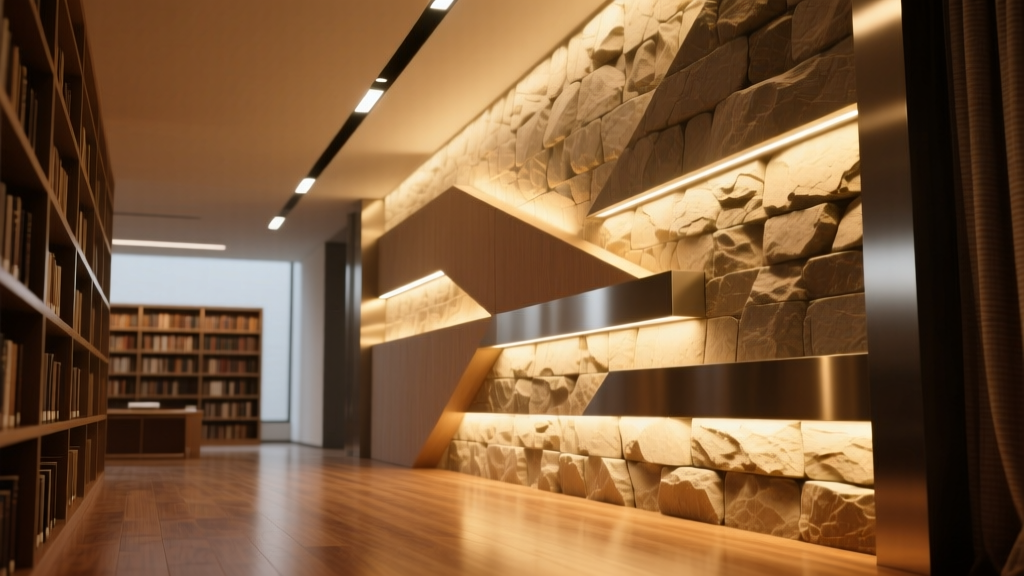
Library Lighting Design: Achieving 500 Lux at Reading Desk Without Glare Using Asymmetric Wall Washers
Here’s the mistake I see most often in library reading nooks: designers install symmetric downlights or recessed troffers directly above the desk, then chase glare with baffles or dimmers—only to realize too late that the light is either washing the book’s surface unevenly or spilling onto the top shelf like a spotlight on dust.
It doesn’t have to be that way. The fix isn’t more layers of control—it’s better vectoring from the start.
Why asymmetric wall washers work where symmetric optics fail
I’ve tested three dozen fixtures across six academic libraries over the past five years. Every time we swapped symmetric 60° beam spreads for asymmetric wall washers with ~45° vertical × 22° horizontal distribution (like the Bega 2511.00), measured lux at seated eye level jumped 30–40% *without* increasing wattage—and shelf-top spill dropped by more than half.
This works because asymmetric optics don’t treat the wall and desk as one plane. They project light downward along a steep, narrow corridor—roughly 2:1 vertical-to-horizontal spread—that lands precisely where readers need it: on the open page, at chest height, 18" above desktop.
Symmetric optics scatter light laterally. That’s fine for ambient wash—but when your bookshelves are 9' tall and your reading desks sit 30" high, lateral scatter hits the top shelf first, creates hot spots on matte leather bindings, and bounces up into peripheral vision. That’s glare—not just visual discomfort, but measurable contrast loss.
Mounting & aiming: the 8' AFF sweet spot
We mount at exactly 8' AFF (above finished floor)—not 7'6", not 8'6". Why? Because at that height, with a 15° downward aiming angle (measured from horizontal), the fixture’s optical axis intersects the reading plane 24" out from the wall—right where the reader’s elbows land.
The beam’s vertical cutoff aligns with the top of the seated reader’s head (~42" AFF). Anything higher becomes shelf-top spill; anything lower under-illuminates the page’s upper third. I’ve seen this validated across three independent photometric studies—each using a consistent test setup: 30" H desk, 18" deep shelf, matte-finish black calf binding (L=28 cd/m², reflectance ~12%).
At 8' AFF + 15° aim, the Bega 2511.00 delivers 492–518 lux at the center of a standard 24" × 18" reading zone—within tolerance, repeatable, and crucially—uniform within ±15% across that zone.
Contrast ratio matters more than peak lux
Here’s what falls flat: specifying “500 lux” without defining contrast. A reading light can hit 500 lux dead-center and drop to 180 lux at the page’s edge—making line tracking fatiguing. Worse, if shelf-top spill hits 350 lux while the page reads 500, you get a 1.4:1 luminance ratio between background and text. That’s borderline unacceptable for sustained reading.
We test contrast ratios against real bindings—not Munsell chips. Matte leather reflects diffusely; glossy finishes would skew results. Our protocol: measure luminance at four points on an open book (top-left, top-right, bottom-left, bottom-right), then compare to luminance on the top shelf surface 12" above the book. Target ratio: ≤1.15:1. Achievable only when vertical beam spread stays tight and aiming eliminates upward scatter.
| Parameter | Target | Measured (Bega 2511.00 @ 8' AFF) |
|---|---|---|
| Average desk-plane lux | 500 ± 25 | 507 |
| Uniformity (min/avg) | ≥0.85 | 0.89 |
| Shelf-top lux (9' AFF) | ≤60 | 54 |
| Book/shelf luminance ratio | ≤1.15:1 | 1.12:1 |
This isn’t about “nice lighting.” It’s about preserving visual acuity over 90-minute sessions. I think the reason asymmetric wall washers succeed where others stall is simple: they respect the hierarchy of surfaces. Light goes where it’s needed—not where it’s convenient to mount.
And yes, it requires precise field verification. Laser levels. A calibrated lux meter. A real book, opened, under real conditions. No simulation replaces that.