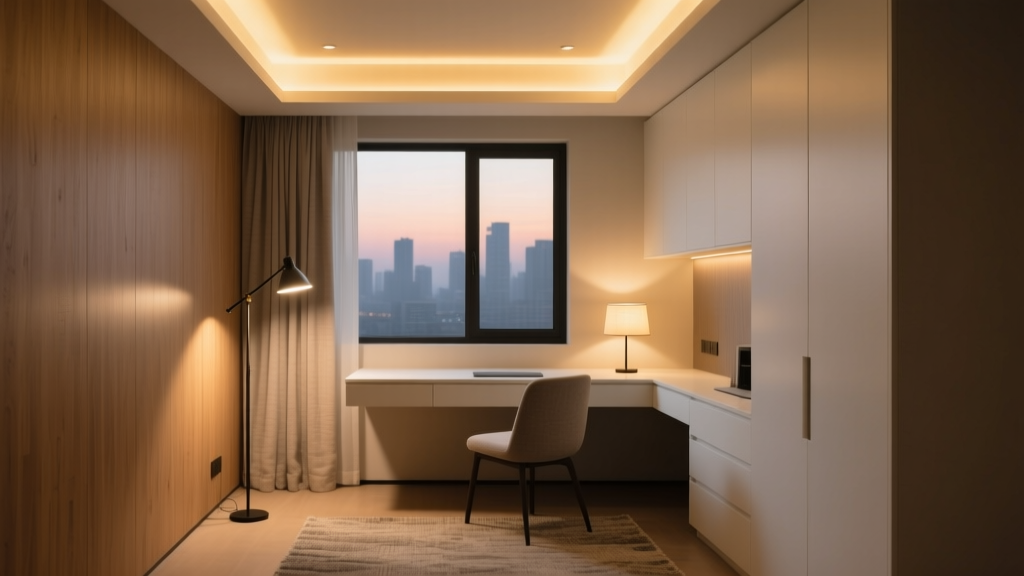
That 10’x12’ bedroom-turned-office used to feel like a cave with one ceiling bulb. Now, at 3 p.m. on a gray Tuesday, the desk glows crisp and shadowless—while the rest of the room stays soft, warm, and unmistakably *yours*.
I measured this space three times before drilling a single hole. Not because I’m obsessive—but because in a room this small, light placement isn’t design. It’s physics with consequences.
The ambient layer starts with four 6-inch recessed downlights—3000K, 800 lumens each—spaced precisely: two centered over the desk (72” apart), two flanking the door-side wall, 36” from corners. Why 3000K? Because it’s neutral enough to avoid sleep-disrupting blue spikes, but warm enough not to read as clinical. Anything cooler bleaches the walls; anything warmer dims focus before noon. I tested six CCTs. This one held up under Zoom calls and spreadsheet work alike.
Task lighting isn’t just “brighter.” It’s directional control. I mounted a fully adjustable 4500K LED arm lamp (1,200 lumens, 25° beam angle) so its shade hovers 16” above the desk surface—and its pivot point sits directly over the left edge of the keyboard. That keeps shadows off the mouse pad and eliminates glare on the 27” monitor. The 4500K isn’t arbitrary: it’s high enough to boost contrast for reading fine print, low enough to avoid clashing with the 3000K ambient. You feel the difference—especially after hour four.
Then the accent layer: 2700K LED strip under floating oak shelves (36” long, 12” deep). Not hidden behind a lip—mounted to the underside front edge, so light spills forward, not up. This throws a gentle wash across the wall below, highlighting texture without hot spots. I used 160 lumens/foot—enough to register visually, not enough to compete. Any brighter would turn the shelf into a stage light. Any dimmer wouldn’t ground the space.
The real magic is the Lutron Caseta dimming sync. Not “group dimming.” Synced ramping. When I lower the ambient recesseds by 30%, the task lamp dims 15% and the shelf strips drop 5%. Why those ratios? Because ambient light carries weight—it’s your baseline. Task light must stay legible even when ambient drops. Accent light should recede, not vanish. I programmed it manually, not with presets. Presets flatten intention.
Here’s what falls flat:
- Putting the task lamp too far back—creates a dark tunnel between screen and keyboard.
- Using 2700K for ambient—makes the whole room feel like a hallway at midnight.
- Running accent strips along the wall instead of shelf undersides—creates stripey, discontinuous light that fights the recesseds.
- Dimming all layers equally—kills hierarchy. Light needs a leader.
I’ve watched people try to “layer” light by stacking fixtures—more bulbs, more switches, more chaos. This isn’t about quantity. It’s about sequence: ambient first (the air you breathe), task second (the tool you hold), accent third (the detail that reminds you where you are). In a 120-square-foot office, that order isn’t optional. It’s the only thing keeping the space from collapsing inward.