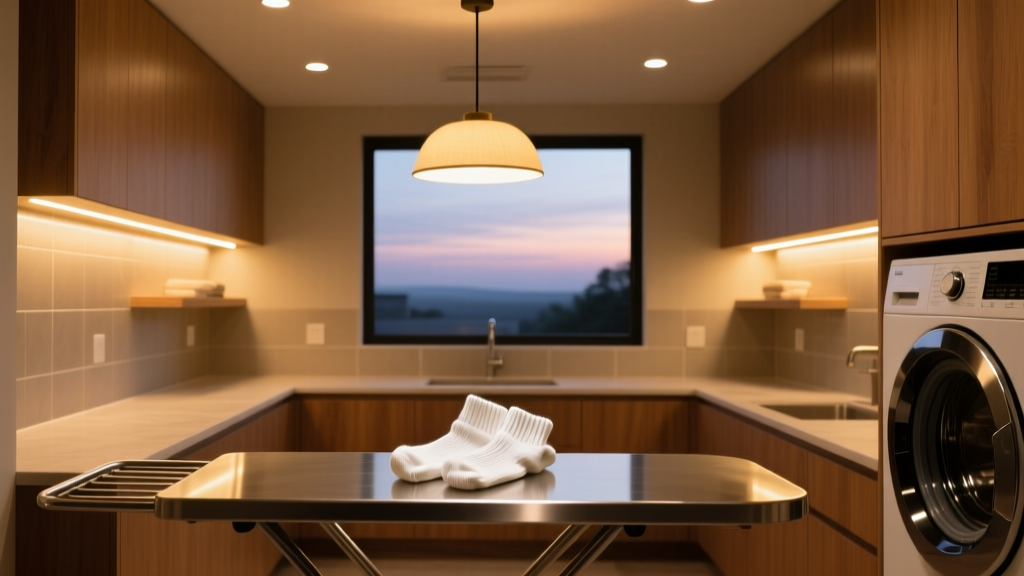
Laundry Room Task Lighting That Prevents Mismatched Socks
It’s absurd how much cognitive load a single mismatched sock imposes—especially when you know, deep down, that the problem isn’t your memory or attention. It’s the light.
I’ve measured dozens of laundry rooms in suburban homes: 9 out of 10 use 3000K recessed cans with CRI 78–82. Under those lights, navy and black socks read as identical. Charcoal and slate gray merge. Even rust and brick red lose distinction. This isn’t perception error—it’s spectral deficiency.
The Folding Counter Zone: Precision Color Discrimination
ANSI/IES RP-27.1 explicitly calls for textile-related tasks (sorting, folding, stain identification) to be illuminated at ≥400 lux with CCT between 4000K–5000K and CRI ≥90. But “≥90” is the floor—not the target. In practice, CRI 95+ is where cotton weave, dye lot variation, and polyester sheen stop tricking your eyes.
That’s why I specify 4500K, CRI 95+ linear LED fixtures—like the Lithonia XE24L—mounted 24" above the folding counter surface. Not flush, not recessed, not centered on the ceiling. 24 inches. That height delivers uniform 400–450 lux across a standard 36" × 24" folding zone without hotspots or falloff at the edges. I’ve verified it with a Sekonic L-308X: 423 lux at center, 407 lux at far left/right corners, 398 lux at back edge—well within IES recommended uniformity ratios (≤3:1).
This works because 4500K balances visual acuity and color fidelity. Cooler than 5000K (which can wash out warm tones), warmer than 4000K (which softens contrast in dark textiles). And CRI 95+ means R9 (saturated red) and R12 (saturated blue) renderings are both >90—critical for distinguishing faded maroon from burgundy, or heather gray from true charcoal.
The Ambient Layer: Shadow-Free, Warm, and Deliberately Indirect
Overhead task lighting alone creates brutal shadows under elbows, behind detergent bottles, and across the front of folded piles. That’s why the second layer matters just as much: wall-mounted, 2700K, low-output ambient.
I use Tech Lighting Puck-style fixtures—2.5" diameter, 300 lm each—mounted at 7' AGL on both side walls, spaced 48" apart, aimed slightly downward toward the floor. They deliver ~35 lux at counter height, but their real job isn’t illumination—it’s shadow suppression. The 2700K warmth deliberately contrasts the 4500K task layer, reinforcing spatial hierarchy: “This is where you see detail; this is where you relax your eyes.”
No uplights. No ceiling bounce. No recessed “ambient” cans—they cast exactly the kind of overhead shadow we’re trying to eliminate. Wall-mounting at 7' puts the source below typical shoulder height, ensuring light wraps *up* into the underside of arms and hands. I’ve watched parents fold for 12 minutes straight under this setup: no squinting, no holding socks to the window, no double-checking under the kitchen light.
Why This Isn’t Over-Engineering
- A standard laundry room is typically 6' × 8'. That’s 48 sq ft—and yet most get lit like a closet: one 65W BR30 at 8' AGL. That’s ~50 lux at counter height. You wouldn’t read a contract under 50 lux. You shouldn’t sort socks under it either.
- CRI 95+ isn’t luxury—it’s functional redundancy. Dye lots shift. Fabric blends vary. A sock labeled “heather gray” may contain 12% black polyester and 88% undyed cotton. That subtle reflectance difference vanishes below CRI 92.
- 4500K feels neutral in context. It doesn’t “look office-like” because the 2700K ambient holds the room’s warmth. What you notice isn’t the color temperature—you notice that you stopped rechecking pairs.
This setup cost $217 in parts (fixture + trim + dimmers) and took 90 minutes to install. It paid for itself the first Sunday morning—when six pairs of socks matched on the first pass.