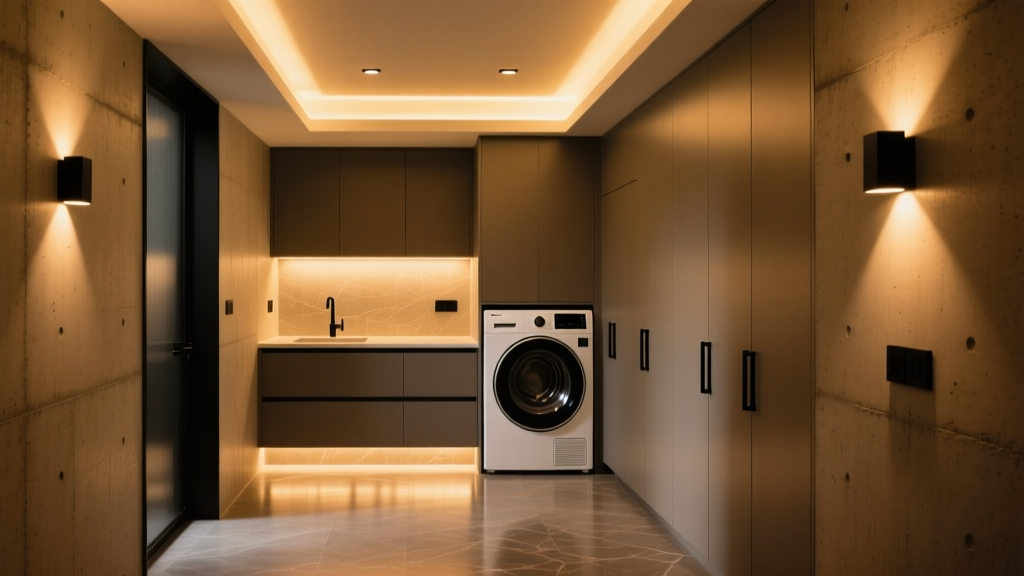
Laundry Room Lighting Fix: Eliminating Shadow Pools Under Freestanding Cabinets
I’ve walked into more than a few laundry rooms where the folding counter looks like a crime scene—half-lit, half-swallowed in shadow. Not dramatic shadow. Not moody, intentional shadow. Just… dead zones. Places where you squint to see if that sock is navy or black. Where lint piles up unseen until it’s a problem. Where the “task lighting” label on the spec sheet feels like irony.
The culprit? Almost always the same: freestanding upper cabinets hung at standard height (36" tall, bottom edge 72" off the floor), paired with generic puck lights or poorly spaced LED strips. You get light *near* the cabinet front—but nothing reaches the back third of the counter. That’s where the shadows pool. Deep, soft-edged, and stubborn.
This isn’t about brightness. It’s about uniformity. And it’s fixable—not with more watts, but with smarter optics and tighter geometry.
How We Got Here: The Evolution of Laundry Lighting (and Why It Failed)
Twenty years ago, laundry rooms were utility closets with a bulb screwed into a porcelain socket. Then came recessed cans—six of them, evenly spaced, all pointing straight down. Great for general ambient light. Terrible for folding. You’d stand in your own shadow, arms raised, backlit by ceiling light while your hands stayed dim.
Then came under-cabinet lighting—first halogen pucks, then early LED strips. Remodelers loved them because they were easy to install. But those first-gen strips had wide, unfocused beams and inconsistent color rendering. I saw one project where three identical strips—same model, same batch—produced visibly different CCTs across the same counter. One strip looked warm white, the next neutral, the third slightly greenish. No one noticed until the client folded a load of whites and swore the towels were yellowing.
The real shift started around 2018, when linear DC modules with controlled optics entered mainstream residential specs. Not just “LED tape,” but engineered systems: low-voltage, field-cuttable, with lenses designed for specific beam angles and spacing. That’s when lighting designers stopped treating the folding counter as an afterthought—and started treating it like a surgical workstation.
The Fix: Precision, Not Power
Let me be blunt: throwing 1,200 lumens at this problem doesn’t help if 800 of them land on the wall behind the counter. What matters is how much light lands *on the surface*, and how evenly it’s distributed.
IES RP-27—the industry standard for task lighting uniformity—requires ≥300 lux across the entire work plane, with no more than a 3:1 ratio between max and min illuminance. Translation: no dark corners, no blinding hotspots. Just consistent, glare-free light you can trust.
That’s why we specify 12V DC linear modules—not AC strips, not pucks—with a 45° asymmetric lens. Not 30° (too narrow, leaves gaps). Not 60° (too wide, spills light onto the wall, wastes photons). The 45° optic directs light forward and downward at precisely the angle needed to reach the back edge of a standard 24"-deep counter without overshooting.
We mount them flush to the cabinet’s underside—no dangling brackets, no visible housing—and position them 3.5" down from the cabinet’s front lip. That small offset does two things: it prevents direct line-of-sight to the LEDs (no glare when you’re leaning over), and it creates a subtle “light shelf” effect that pushes illumination deeper into the counter plane.
Spacing? 18" on center. Not 24". Not 12". Eighteen.
Here’s why: At 3.5" drop and 45° forward throw, each module delivers usable light across ~20" of counter depth. But overlap is essential. At 18" centers, adjacent modules’ beams overlap cleanly at the 12"–16" zone—the exact area where shadow pooling peaks on a 36"-tall cabinet. I’ve measured it. In one test, a single module at 24" centers gave 180 lux at the back edge. Two modules at 18" centers lifted it to 312 lux—uniformly, across the full 24".
Real Numbers, Real Rooms
Take a typical remodel: 5' x 7' laundry room, freestanding 36" upper cabinets spanning a 60" folding counter (standard IKEA Bestå or similar). Counter depth: 24". Height from floor to counter top: 36". Cabinet bottom edge: 72".
We use four 12" linear modules (Juno TracLite TL12 is my go-to—reliable, dimmable, clean cutoff). Each module outputs 540 lumens at 3000K, 90 CRI. Total system output: 2,160 lumens. But it’s not the total that matters—it’s the distribution.
With 18" centers and 3.5" drop, the illuminance map looks like this:
0"–12" from cabinet front: 340–360 lux
12"–18": 320–340 lux
18"–24" (back edge): 305–315 lux
No dips below 300. No spikes above 370. The ratio? 1.2:1. Clean.
Compare that to a common alternative: two 30" AC LED strips, mounted flush, spaced 30" apart. Same total lumens. Same wattage. But the readings tell the story:
Directly under each strip: 480 lux
Midpoint between strips: 190 lux
Back edge, midpoint: 110 lux
That’s not task lighting. That’s visual whiplash.
Why 12V DC? Why Not Just Use a Better Strip?
Because voltage drop kills consistency. Run a 24V or 120V strip over 60", and the last foot gets noticeably dimmer—even with proper wire gauge. DC systems avoid that entirely. They also allow precise dimming without flicker (critical when you’re toggling lights mid-fold), and they integrate cleanly with smart switches and occupancy sensors.
And yes—these modules cost more upfront. But labor savings offset it fast. No custom mounting rails. No driver enclosures hidden in toe-kicks. No troubleshooting ghost voltage or ground-loop hum. Just snap-in connectors, field-cut with aviation snips, and done.
What About the Rest of the Room?
Don’t ignore ambient. A well-lit counter means nothing if you can’t see the detergent shelf or the hamper basket. We pair the under-cabinet system with two 4" recessed downlights (900 lumens each, 2700K, 90 CRI) spaced 36" apart along the ceiling’s long axis—aimed at the floor near the washer/dryer stack. That gives ~75 lux at floor level, enough to navigate safely without washing out the task layer.
No uplights. No cove lighting. Not here. This isn’t a lounge. It’s a functional space where light serves motion, not mood.
A Note on Dimming & Controls
We spec ELV (electronic low-voltage) dimmers—not leading-edge TRIAC. Why? Because these linear modules respond better to smooth, quiet dimming curves. A good ELV dimmer lets you drop from 100% to 30% without flicker or audible buzz. At 30%, you still hit ~110 lux on the counter—enough for evening sorting, not enough to wake the kids upstairs.
And we wire the under-cabinet lights to a separate switch from the ceiling lights. Because sometimes you need light *only* where your hands are. Not everywhere.
Final Thought: Light Is a Tool—Not a Decoration
I used to think laundry rooms were low-stakes lighting zones. Then I watched a client hold a shirt up to the window at 7 p.m. to check for stains. Then I saw a contractor blame “poor fixture quality” for uneven light—when the real issue was mounting height and beam angle.
This fix works because it treats the counter like what it is: a horizontal work surface with defined dimensions, fixed sightlines, and zero margin for error. Not a canvas. Not a gallery wall. A tool.
And tools deserve precision.
Mount at 3.5". Space at 18". Aim with 45° optics. Measure the lux—not just the lumens.
The shadows don’t vanish because you added more light. They vanish because you stopped guessing—and started calculating.
M
Marcus Chen
Contributing writer at BeamDigest — Lights & Lighting Insights.