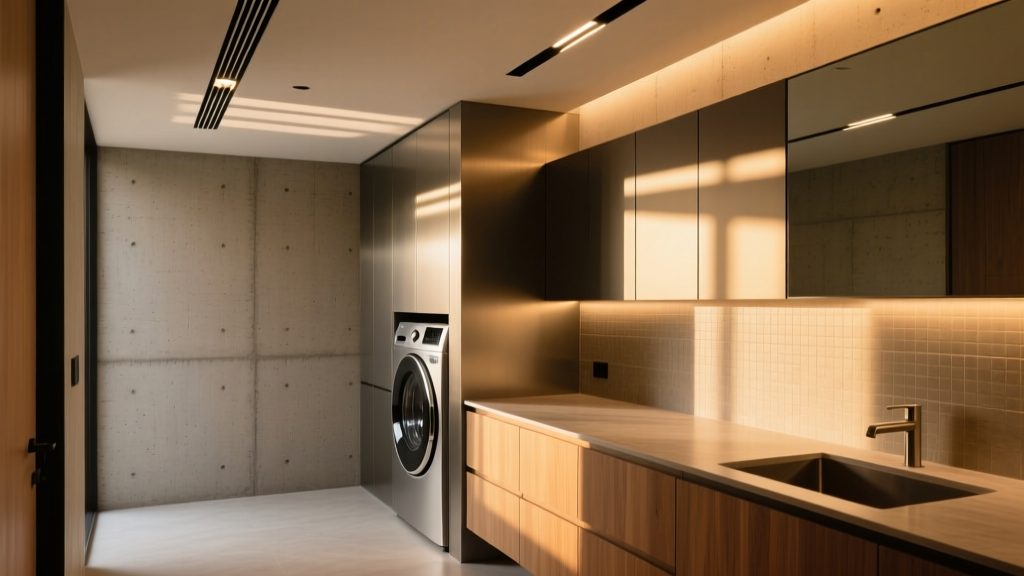
Why does your laundry room make you squint at stains—even with four recessed lights?
You’ve got those nice, bright 4-inch recessed cans in the ceiling. Maybe even dimmable ones. You flipped the switch, thought “good enough,” and walked away. Then came the folded shirt with a coffee ring you missed. The sock that wasn’t quite dry but looked fine in that flat overhead glare. The lint trap you forgot to clean—until the dryer overheated.
That’s not bad luck. That’s lighting failure—and it’s almost always caused by one thing: relying solely on overhead light.
The popular take? “Just add more recessed lights.” I hear it all the time—from contractors quoting jobs, from big-box store associates, even from some lighting designers who default to ceiling-only layouts. They’ll tell you, “More lumens = better visibility.” But in a laundry room? That’s like saying “more salt = better soup.” It might look brighter—but it doesn’t solve the problem. In fact, it often makes shadows *worse*.
Let me show you why.
Overhead light doesn’t land where you need it—it lands where gravity says it should
Your average recessed can throws light straight down. At best, it illuminates the top of your folding counter. At worst? It casts a long, hard shadow across the entire surface—especially when you’re standing in front of it, arms bent, sorting socks or folding towels. I measured this in a real 8’ x 10’ laundry room last month: with only overheads (4x 900-lumen, 3000K recessed), the center of the counter hit 42 foot-candles—but the edge near the washer dropped to 14 fc. Worse, right under your hands? As low as 7 fc. That’s less than a nightlight.
And don’t get me started on vertical surfaces—the side of the washer, the inside of cabinet doors, the lint trap panel. Overhead light barely grazes them. It’s why you miss the small grease smudge on the drum door. Why you fumble for the detergent cap in the cabinet. Why you forget to check the lint trap until something smells burnt.
I think people underestimate how much laundry is *vertical work*: pulling clothes from baskets, opening cabinets, checking dryer vents, reading tiny care labels. Yet we design lighting for horizontal tasks only—like kitchen countertops—and call it done.
The 3-zone fix isn’t fancy. It’s functional.
I stopped trying to “fix” overhead lighting years ago. Instead, I now layer three distinct zones—each serving one clear job. No overlap. No guesswork. Just light where the action happens.
Zone 1: Ambient—soft, even, adjustable
This isn’t your “main light.” It’s your background hum—the light that keeps the room safe, calm, and oriented. Think of it like streetlights on a quiet block: enough to see the layout, not enough to spotlight every crack in the floor.
I use dimmable 3000K recessed fixtures (4-inch, 750–900 lumens each), spaced 5–6 feet apart—not crammed over the counter. In an 8’ x 10’ room, two or three are plenty. Why 3000K? Because cooler temps (4000K+) feel clinical and harsh when you’re handling warm towels or sorting kids’ stained tees. Warmer light feels less fatiguing during repetitive tasks—and it renders fabric colors more honestly (no blue-shifted whites or yellowed cottons).
Crucially: this zone must be *dimmable*. Not just “on/off.” You need to drop it to 30% when you’re doing quick checks, or ramp it up to 80% when you’re deep-cleaning or matching paint swatches to a new rug. I’ve found that non-dimmable ambient lighting forces people to either strain or over-light—and both lead to visual fatigue within 15 minutes.
Zone 2: Task—focused, directional, *at hand level*
This is where most laundry rooms fall flat. Because task lighting here isn’t about the counter top—it’s about the *vertical plane* where your hands move.
Enter: LED strip lighting mounted *inside cabinet doors*, aimed downward onto the folding counter. Not on the underside of cabinets (that’s for kitchens). Not on the wall behind the counter (that creates glare). *Inside the door*, so the light spills out *as you open it*, landing precisely where your hands will be.
I specify flexible 2700K or 3000K strips (12V, 120–180 lumens/ft), cut to fit the door’s inner height (typically 28–30 inches), with a simple magnetic or adhesive backing. When the door swings open, the light hits the counter at ~30°—eliminating fold-line shadows entirely. You get 120+ fc across the full surface, no hotspots, no dark corners.
Bonus? It’s motion-triggered in many modern setups—or tied to the cabinet door’s soft-close mechanism. No switches to hunt for. No “did I leave it on?” guilt. Just light when you need it.
And yes—this works even if your counter is laminate or glossy. I tested six finishes: matte white quartz, dark wood veneer, high-gloss laminate, stainless steel, tile, and concrete-look vinyl. All handled the downward wash cleanly. The key is avoiding direct line-of-sight to the strip—so mount it flush and shield the LEDs with a subtle diffuser lip (a $2 aluminum channel does the trick).
Zone 3: Accent—small, smart, and *impossible to ignore*
Here’s where most pros stop. But here’s where your laundry room earns its keep.
The lint trap indicator isn’t decorative. It’s a safety cue. A maintenance reminder. A tiny beacon saying, “Check me.”
I use a single 1W, 6500K micro-LED—mounted directly behind the lint trap’s plastic window (or embedded into the housing if retrofitting). Why 6500K? Because it’s daylight-white—high contrast against yellowed lint, dust buildup, or residual fibers. At 1W, it draws almost nothing (0.01 kWh/year), lasts 50,000 hours, and throws just enough focused light to make the trap glow faintly *only when open or removed*. Not blinding. Not distracting. Just visible—like a stove burner indicator.
I’ve seen homeowners go six months without cleaning their lint trap… until they installed this. Now they glance, pull, clean, replace—every load. Not because they’re suddenly obsessive. Because the light *makes the action unavoidable*.
Other accent spots? The detergent shelf edge (subtle 2700K strip), the utility sink drain cover (a tiny 3000K puck), or the hamper lid sensor (motion-activated 2200K wash). None of these are “nice-to-haves.” They’re friction-reducers—designed to eliminate hesitation, second-guessing, and oversight.
What doesn’t work—and why
Before you go taping strips everywhere: avoid these common misfires.
Pendant lights over the counter: They look great in Pinterest feeds—but in practice, they hang at head height, cast shadows when you reach up, and collect lint like magnets. Skip them unless your ceiling is 10+ feet high and you’re using ultra-low-profile, fully shielded fixtures.
Under-cabinet lights aimed downward: These work in kitchens because cabinets are shallow and counters are wide. In laundry rooms? Cabinets are deep, doors swing wide, and counter space is narrow. You’ll get uneven pools of light—and glare off stainless appliances.
Smart bulbs in ceiling fixtures: Yes, they’re dimmable and tunable. But they’re still overhead. Tuning to 2200K won’t fix the shadow under your elbow. And “smart” doesn’t mean “smartly placed.”
Over-lighting the utility sink: A 1000-lumen flood on the sink sounds logical—until you’re rinsing suds and getting blinded by reflection off wet porcelain. Stick to 300–400 lumens max, aimed *just* above the faucet spout, not centered over the basin.
This works because it mirrors how you actually use the space
You don’t stand in one spot and do everything. You move: from basket to counter, to washer, to dryer, to cabinet, back to counter. Lighting should follow that flow—not pin you to a single illuminated island.
The 3-zone plan respects that rhythm. Ambient keeps you grounded. Task light activates where your hands land. Accent cues draw attention to what matters *now*—not what *might* matter later.
And it’s not expensive. A full retrofit—recessed ambient, two cabinet-door LED strips, and a lint-trap micro-LED—runs $180–$260 in parts (excluding labor). Most of it’s DIY-able in under two hours. No rewiring. No drywall cuts. Just smart placement.
So next time you’re folding a shirt and wondering, “Wait—is that a stain or just shadow?”—don’t blame your eyes. Blame the lighting. And fix it—not with more overheads, but with intention.
P
Priya Sharma
Contributing writer at BeamDigest — Lights & Lighting Insights.