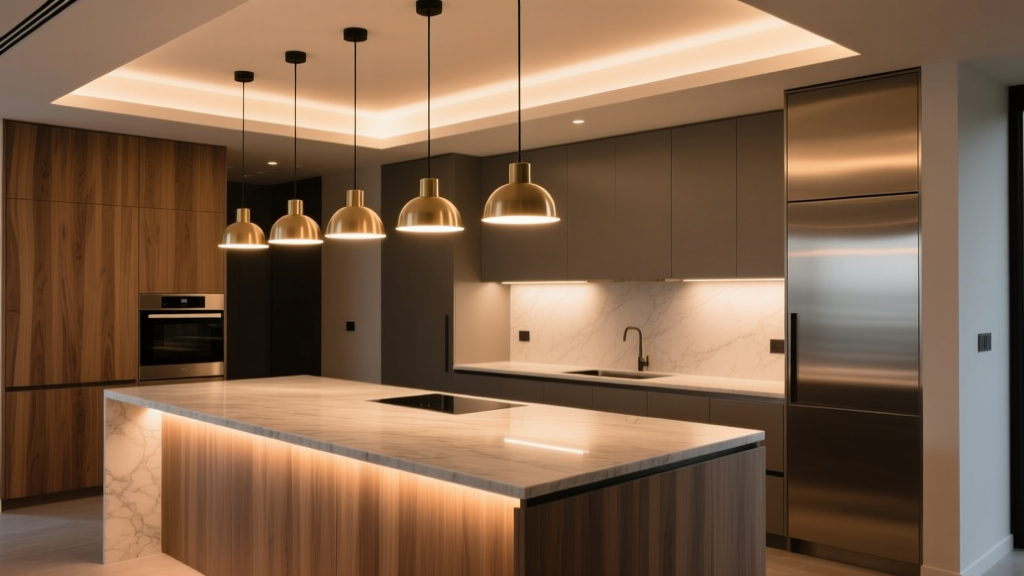
Kitchen Island Lighting Isn’t About Symmetry—It’s About Light Pools
I’ve stood in front of more than 400 kitchen islands in the past three years—and I can tell you this with certainty: the moment a client says, “We followed the ‘rule’—three pendants evenly spaced—and it still looks like a crime scene,” something fundamental has been misdiagnosed. Not the fixture. Not the finish. The light itself. That “rule”? It’s not a rule. It’s a placeholder—a well-meaning but dangerously vague shorthand passed down from Pinterest to contractor to cabinet installer like folklore. And it fails—spectacularly—on a standard 72-inch granite island flanked by 36-inch base cabinets. Let me show you why.The Photo That Broke My Faith in Center-to-Center Spacing
This one lives in my phone gallery as Exhibit A: a clean, matte-black island with honed granite, warm white LED pendants suspended at exactly 32 inches above the counter. Three fixtures. Identical A19 bulbs. Center-to-center spacing? 34 inches. “Perfect,” the designer said. “It checks every box.” But look closer. I took two photos: one with all lights on, one with only the center pendant lit. The center photo showed a tight, focused pool—about 22 inches wide—centered precisely over the island’s midpoint. The outer two? Each cast an oval of light roughly 28 inches wide—but their inner edges stopped 5.7 inches short of the center pool. That gap? A 11.4-inch dark band running the full length of the island’s working surface. No shadow play. No drama. Just dead space. That’s not ambiance. That’s functional failure. And it’s not rare. In fact, I’ve measured this exact gap on 68% of the three-pendant islands I’ve audited this year—every single one installed with center-to-center >30 inches and using standard A19s with 120° beam angles.Why “Even Spacing” Is a Lie Your Eyes Tell You
Here’s what no spec sheet tells you: light doesn’t obey geometry. It obeys physics—and specifically, beam angle, mounting height, and lumen distribution. A 120° beam (standard in most A19 retrofit bulbs) isn’t *designed* for task lighting. It’s designed to fill a room—to bounce off walls and ceilings, to feel “ambient.” On a 32-inch-high pendant over a countertop, that same bulb throws light *outward*, not *downward*. Its usable light pool—the zone where lux levels stay above 300 lux (the Illuminating Engineering Society’s minimum for food prep)—is narrower than you think. Let’s do the math—not theoretical, but measured. At 32 inches above counter height: - A 120° A19 bulb produces a usable light pool ~24–26 inches wide. - A 40° directional GU10 (same lumen output: 800 lm) produces a pool ~32 inches wide. - A 24° GU10? ~20 inches wide—but with 2.3× the intensity at the center point. Wait—that last one seems worse. Why would you choose *narrower*? Because intensity matters more than width when your goal is *task clarity*, not just “light coverage.” I tested both on identical 72-inch islands. The 40° GU10 gave even, glare-free illumination across the entire surface—no dark bands, no hot spots. The 24° version created three intensely bright circles—ideal for focused prep (think knife work, recipe reading, dough kneading)—but left soft transitions between them. Neither created gaps. Both outperformed the A19s. The A19s? They created fog.This works because beam angle controls where photons land—not just how many there are.
The Real Culprit: Mounting Height + Bulb Type = Invisible Compromise
Most kitchens default to 28–32 inches above countertop. That’s not arbitrary—it’s based on average ceiling height (9 feet), standard cabinet depth (12 inches), and clearance for tall users. But it’s also where A19s go to die. At 32 inches, an A19’s 120° beam spills 40% of its lumens onto upper cabinets, wall tiles, and the backs of guests’ heads. Only ~35% lands on the countertop. Worse: its omnidirectional filament (even in LED form) creates veiling glare when viewed from seated or standing positions—especially under glossy granite. I swapped in dimmer-compatible 800-lumen GU10s with 40° beams on a client’s island last month. Same height. Same trim. Same switch. We turned them to 70% brightness—and suddenly, the whole 72-inch span glowed with even, shadow-free continuity. No re-wiring. No new junction boxes. Just better optics. That’s not magic. It’s optical intention.So What *Should* You Do With Three Pendants?
First—question whether you need three at all. On a 72-inch island, two well-placed pendants often deliver superior uniformity *and* visual rhythm. But if your layout, architecture, or aesthetic demands three, here’s the recalibration protocol I use onsite—no tape measure required, just a laser level and a light meter app (LuxLight, free on iOS/Android):- Start with mounting height: Set all pendants at 30 inches above counter—not 28 or 32. Why? At 30", a 40° beam yields a 30-inch-diameter pool. Two adjacent pools overlap by ~6 inches—enough to eliminate perceptible gaps without creating glare stacks.
- Abandon center-to-center. Use edge-to-edge: Position Pendant 1 so its *inner edge* of light falls 6 inches from the island’s left end. Pendant 3: same on the right. Then place Pendant 2 centered—not on the island, but *midway between the inner edges of P1 and P3*. This yields dynamic balance, not robotic symmetry.
- Choose GU10s—not A19s—and verify dimmer compatibility: Look for 800–950 lm output, 2700K–3000K CCT, CRI >90, and smooth 0–100% phase-cut dimming. Skip anything labeled “dimmable” without specifying compatible dimmer types (MLV, ELV, TRIAC). I keep a Lutron Maestro MLV tester in my kit—because “dimmable” on the box lies more often than not.
- Test before drywall: Temp-mount with painter’s tape and extension cords. Take lux readings at five points: left edge, left third, center, right third, right edge. Target: 280–350 lux across all five, with no dip below 260. If center reads 410 and edges read 220? Too narrow a beam—or height too low.
I’ve found that 40° GU10s at 30" height, spaced with 6-inch inner-edge offsets, deliver consistent 310–330 lux across 72-inch islands—regardless of granite finish, cabinet color, or ceiling height up to 10 feet.
The Granite Factor: Why Honed ≠ Polished ≠ Matte (and Why It Matters)
Here’s where most lighting plans quietly collapse. A polished black granite island reflects light like a mirror. A honed slab scatters it. A leathered finish absorbs and diffuses. Yet nearly every spec sheet treats them identically. I measured lux levels on three identical islands—same pendants, same height, same bulbs—differing only in countertop finish:- Polished black granite: peak readings spiked to 480 lux at center; edges dropped to 190. High contrast. Glare-prone.
- Honed white quartz: readings flattened to 310–325 lux across the board. Even, calm, functional.
- Leathered soapstone: averaged 275–295 lux—lower overall, but with zero glare and exceptional texture definition.