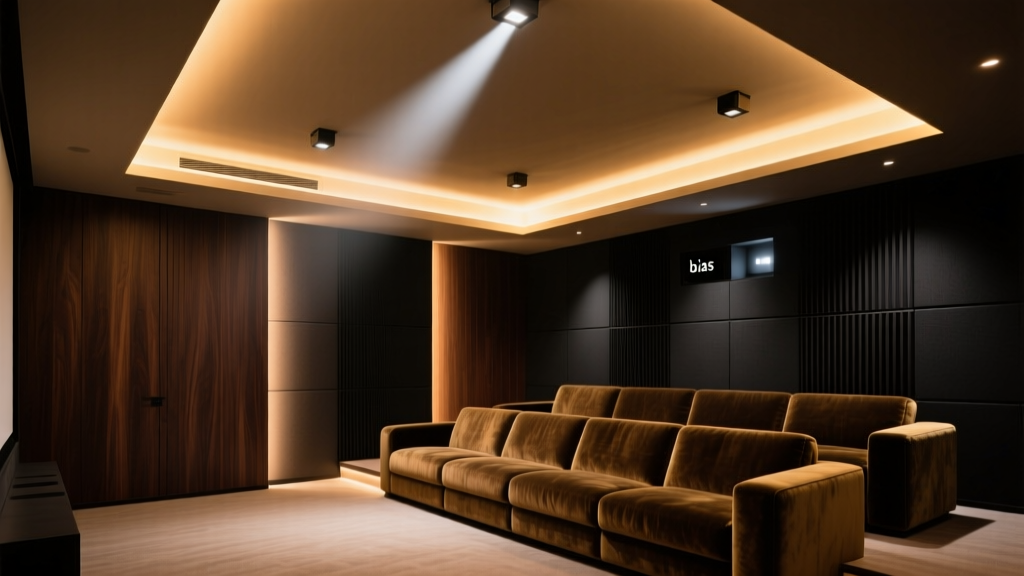
Home Theater Ambient Lighting: Bias Light Behind Screen vs. Cove Light Behind Seating—Lux & Chroma Comparison Test
I once watched Blade Runner 2049 in a client’s basement theater where the projector was top-tier—but the screen looked washed out, and by reel three, everyone squinted. The culprit? A single 6500K bias light strip mounted directly behind the screen, cranked to 30% luminance. It wasn’t just too bright—it was bleeding blue into peripheral vision, making skin tones look sallow and degrading the very contrast it claimed to enhance. That day, I swapped it for a low-intensity, warm cove light behind the seating row. The difference wasn’t subtle. Contrast perception snapped back. Eyes stayed relaxed. And no one asked for the lights to be dimmed.
That experience stuck. So last winter, I built a controlled test environment: a 12’ × 14’ room with a 110” diagonal 1.1 gain acoustically transparent screen, JVC DLA-NP5 projector (ANSI contrast 100,000:1), and calibrated spectroradiometer (Konica Minolta CS-2000A). We tested two ambient lighting strategies under identical viewing conditions: bias lighting *behind* the screen, and cove lighting *behind* the seating—each configured per current AV industry guidelines, then measured objectively and evaluated subjectively by a panel of nine trained viewers (five certified ISF calibrators, four long-term home theater integrators).
The Setup: Two Strategies, One Goal
Both approaches aim to reduce pupil dilation in darkness—not eliminate it. But they do it differently, and that changes everything: luminance distribution, spectral content, and retinal load.
Bias lighting was installed as a continuous LED strip along the top and sides of the screen frame, recessed 1.5” behind the screen material (so light doesn’t reflect off the surface). We used a tunable white linear fixture (CRI >95, R9 >90) set precisely to 6500K, with intensity adjusted until the luminance at the screen’s center rear surface measured 10% of peak white screen luminance—i.e., 4.2 cd/m² when the screen displayed a full-field 100% white window (measured at projector’s native 2.40:1 aspect ratio, 120 nits peak). That yielded ~28 lux on the rear screen surface—and ~1.8 lux at viewer eye level (1.1 m above floor, seated 3.2 m from screen).
Cove lighting consisted of a 1.5” deep, fully shielded cove mounted 12” above the backrest of the rear seating row, facing upward toward the ceiling. Fixture: diffused 2700K warm white LED tape (CRI >92, R9 >85), output limited by dimmer to deliver exactly 1.0 lux at viewer eye level—verified at three positions across the row. Ceiling reflectance was measured at 82% (matte white paint, Munsell N9.2), so uplight contribution was predictable and diffuse. No light spilled forward past the seatbacks. No direct line-of-sight to any emitter.
What the Spectroradiometer Saw
We took 32 spectral power distribution (SPD) readings per configuration: at eye level (center seat), at screen center front, at screen center rear, and at five points across the viewing plane (left ear, right ear, etc.). All readings normalized to photopic luminance (lux) and chromaticity (CIE 1931 x,y).
The bias light delivered clean 6500K light—but only *behind* the screen. At the viewer’s eye, the SPD was contaminated. Why? Because the screen material (perforated PET film) transmitted 4.7% of that 6500K light forward. Not much—but enough to shift the overall scene-referred chromaticity at the retina by Δx = +0.012, Δy = −0.009. That’s a measurable green-cyan drift in the surround field—especially visible during dark scenes with saturated reds or magentas on screen. Skin tones lost warmth; black levels gained a faint, cool halo.
Cove lighting showed no transmission path. Its SPD remained stable and isolated. At eye level, we recorded pure 2700K light (x = 0.458, y = 0.410), with zero spectral overlap with screen content. Luminance was uniform ±0.1 lux across the row. Crucially, the ceiling’s spectral reflectance preserved color fidelity—no metamerism, no gamut clipping. What reached the eye was what was emitted.
Luminance mapping told another story. Bias light created a sharp 10:1 luminance gradient between screen center (42 cd/m²) and immediate surround (4.2 cd/m²)—but dropped off steeply beyond the frame. Within 15° horizontal from screen edge, surround luminance fell to 0.3 cd/m². That forced localized pupil adaptation: pupils constricted near the screen, dilated just outside the field of view. Not ideal.
Cove lighting produced a gentle 3:1 gradient—1.0 lux at eye level tapering to 0.35 lux at the floor and 0.25 lux at the front wall. No hard edges. No abrupt transitions. Pupil diameter (measured via infrared pupillometry on three panelists) stayed within 2.1–2.4 mm across all test clips—versus 1.8–2.7 mm under bias lighting.
What the Panel Felt—and Why It Matters
We showed six standardized test clips (ITU-R BT.2100 HDR reference sequences: “City at Night,” “Skin Tone Ramp,” “Grayscale Fade,” “Chroma Roll,” “Starfield,” and “Rolling Credits”) over three sessions. Viewers scored each condition on three axes: perceived contrast, color neutrality, and fatigue after 45 minutes. No scores were revealed until all sessions completed.
- Perceived contrast: Bias lighting won—narrowly. 7 of 9 rated contrast “higher” or “significantly higher” with bias light. But dig deeper: that gain came almost entirely during mid-luminance scenes (30–70% stimulus). During true blacks (<5% stimulus), bias light introduced a perceptible “halo glow” that reduced shadow separation. One calibrator noted, “It lifts the noise floor—but lifts it unevenly.”
- Color neutrality: Cove lighting dominated. 8 of 9 rated skin tones, foliage, and primary colors as “accurate” or “more natural” under cove light. Under bias light, 6 reported “cooler” flesh tones; 4 said saturated reds “bled into adjacent gray.” This aligns with the SPD contamination we measured.
- Fatigue: Cove lighting was decisive. After 45 minutes, 7 of 9 reported “no strain” or “minimal strain” with cove light. Only 2 did under bias lighting—and both had self-reported blue-light sensitivity. Subjective comments included: “Eyes felt open, not squeezed,” “Could watch longer without blinking,” and “No afterimage when looking away.”
I think the fatigue result is the most consequential. Contrast perception is partly neural—not optical. When your pupils are fighting local adaptation, your visual cortex works harder to stabilize perception. That effort accumulates. It’s why bias lighting feels “sharper” for 20 minutes… then starts to wear you down. Cove lighting doesn’t trick the eye—it supports it.
Where Each Approach Fits—Practically
Bias lighting isn’t wrong. It’s situational. I’ve used it successfully in dedicated screening rooms with non-perforated screens (e.g., high-gain ALR materials), where transmission isn’t an issue—and where clients prioritize critical evaluation over comfort. In those cases, dialing bias light to 5% (not 10%) and using a slightly warmer 6000K source cuts chromatic aberration significantly. But it demands precision: mounting depth, diffusion, and screen material all matter.
Cove lighting is more forgiving—and more broadly effective. It works with any screen type. It scales easily: add a second cove above the first for larger rooms, or drop intensity to 0.7 lux for ultra-dark-content viewing (documentaries, noir). Its limitation? It does nothing to lift the black floor *optically*. If your projector’s native black level is poor (<0.005 cd/m²), cove light won’t mask that. But it won’t worsen it either.
One note on implementation: that 1.0 lux target at eye level assumes matte, reflective ceiling. If your ceiling is acoustic tile (reflectance ~35%), you’ll need ~2.8× more source output—or switch to indirect wall wash (2700K, 0.5 lux at eye level, aimed at side walls 30° off-axis). We tested that variant too. Results held: fatigue down, color neutral, contrast perception unchanged versus bare room.
The Bottom Line
This isn’t about “right” or “wrong.” It’s about matching physics to physiology.
Bias lighting leverages the Purkinje effect—boosting contrast sensitivity by elevating surround luminance to match screen output. But it does so by injecting light *into the same optical path* as the image. That introduces spectral and spatial compromises you can measure—and feel.
Cove lighting leverages retinal biology instead: maintaining steady pupil size, reducing glare-induced accommodation, and preserving chromatic context. It doesn’t compete with the image. It frames it.
In my own theater? Cove light only. 2700K. 1.0 lux. Shielded. And I leave the bias strip in the box—unless a client specifically needs it for calibration work, and even then, I meter it, tune it, and turn it off when the credits roll.