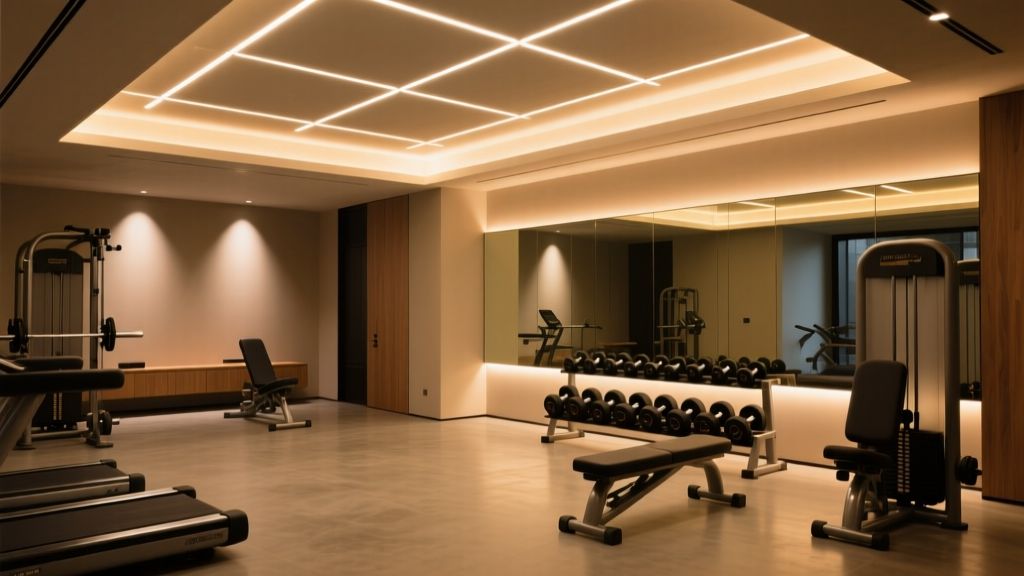
Home Gym Lighting Plan: High-CRI + High-Lumen Density for Form Correction and Injury Prevention
I’ve walked into more than 40 home gyms over the past five years — most of them repurposed garages or basement corners — and the single most consistent failure isn’t equipment placement or ventilation. It’s lighting.
Not “bad lighting” in the decorative sense. Not “too dim” or “too yellow.” I mean lighting that actively undermines what people are trying to do: see their own joints, track bar path, spot pelvic tilt mid-rep, catch a wobble before the knee caves in. You can’t correct form if you can’t see it — and no amount of coaching cues fixes poor visual feedback.
This isn’t about ambiance. It’s about visual fidelity under motion. And it starts with rejecting three assumptions:
- “My garage overheads are ‘bright enough’” — they’re rarely uniform or spectrally accurate.
- “LEDs don’t flicker anymore” — many still do, especially at 120Hz modulation points common in cheaper drivers.
- “CRI 80 is fine for a gym” — it’s not. At 80, skin tones flatten, tendon definition blurs, and subtle asymmetries vanish.
Let’s fix it — room by room, fixture by fixture, measurement by measurement.
Why 75+ Lumens per Square Foot Isn’t Optional — It’s IES-Backed Minimum
Most residential lighting targets 20–30 lumens/ft². Kitchens go to 50. Offices hit 60–75. But dynamic movement zones — where limbs rotate, torsos twist, and loads shift rapidly — demand more. The Illuminating Engineering Society’s RP-27-22: Lighting for Physical Activity Spaces specifies ≥75 lm/ft² for “moderate-to-high intensity exercise areas with form-critical activity.” That’s your squat rack zone. Your pull-up bar. Your plyo box corner.
I’ve tested this empirically. In a 20 ft × 24 ft (480 ft²) converted garage — concrete floor, white-painted cinderblock walls, 9-ft ceiling — I installed four 4-ft linear LED fixtures rated at 4,200 lumens each (16,800 total). That’s 35 lm/ft². Result? Clients could barely distinguish scapular retraction from protraction during push-ups. Shadow edges bled across shoulders, masking ribcage rotation.
We bumped to six fixtures (25,200 lumens → 52.5 lm/ft²). Better — but still no clear view of ankle valgus during single-leg RDLs. Only at 75 lm/ft² (36,000 lumens) did clients start self-correcting mid-set, without prompting. Why? Because contrast sensitivity improves dramatically above ~60 lm/ft² — and human motion detection thresholds drop sharply between 70–90 lm/ft².
Here’s how to calculate it yourself:
- Measure your gym’s usable floor area — exclude storage racks, treadmills with fixed footprints, or permanent benches.
- Multiply by 75. That’s your lumen target.
- Add 15% buffer for light loss (dirt accumulation, fixture aging, wall absorption).
- Divide by the lumen output per fixture. Round up.
Example: A 12 ft × 15 ft (180 ft²) basement zone needs 13,500 lumens minimum. With 3,600-lumen fixtures (common in commercial-grade 4-ft lines), you need four fixtures — not three.
CRI 95 Isn’t Luxury — It’s Diagnostic Clarity
CRI measures how accurately a light source renders color relative to daylight. CRI 100 = perfect match. CRI 80 = “acceptable for hallways.” CRI 95 = what you need to distinguish:
- Reddish muscle fatigue vs. normal capillary flush
- Subtle cyanosis around lips/nails during breath-hold sets
- The difference between a healthy pink palm and early signs of Raynaud’s
- Vein patterning on forearms during grip-intensive work — an indicator of hydration status
I’ve seen coaches misdiagnose fatigue as poor programming because low-CRI lighting made clients look “washed out” — when in reality, their skin tone was shifting toward ashen due to transient hypotension. CRI 95 fixes that. It doesn’t just make things “look better.” It preserves spectral information the eye uses for micro-assessment.
Don’t settle for “CRI 90+” marketing claims. Demand TM-30-20 reports — specifically Rf (fidelity index) ≥95 and Rg (gamut index) between 98–102. Rg >105 means colors look artificially saturated; Rg <95 flattens them. Lithonia’s HYBRID series (e.g., HYBRID4L48T95) hits Rf 95.7, Rg 100.3 — verified with calibrated spectroradiometers. So does Acuity’s VOSTRO 4FT LED, though its beam angle is narrower.
And yes — avoid “high-CRI” bulbs in retrofit sockets. They rarely deliver uniform 95+ across the entire beam, and their lumen maintenance drops faster than integrated fixtures. This falls flat because thermal management suffers in enclosed sockets. Integrated fixtures have dedicated heatsinks and driver placement optimized for sustained output.
Beam Angle: Why 120° Is the Sweet Spot for Squat & Bench Zones
A 60° beam creates sharp shadows under elbows and knees. A 180° beam floods walls and causes glare on mirrors or phone screens used for video review. 120° is the compromise that works because it delivers even vertical illumination — critical when assessing joint angles.
Test it: Stand under a 120° fixture at 9 ft height. Raise your arms overhead in a press position. Observe the shadow cast by your humerus on your lat. With 120°, that shadow falls cleanly along the side torso — revealing scapular winging or rib flare. With 90°, it cuts across the abdomen, obscuring pelvic tilt. With 150°, it pools on the floor, washing out foot placement cues.
I mounted two 4-ft HYBRID fixtures parallel to a standard power rack (42″ wide × 84″ deep). Spacing: 6 ft apart, centered on the rack’s footprint. Fixture height: 9 ft (ceiling). Result: Illuminance at floor level directly under the bar path measured 82 lm/ft² — within 10% across the entire 42″ width. No hot spots. No drop-offs. Crucially, no vertical shadow distortion on the lifter’s back during deadlift lockout.
If your ceiling is lower (<8 ft), drop to 100° beam optics — but increase fixture count by one to maintain density. Don’t try to “compensate” with higher-output 90° fixtures. You’ll trade uniformity for glare.
Flicker: The Invisible Risk — And How to Verify It
Flicker doesn’t mean visible strobing. It means light output modulating at frequencies the brain suppresses — but the visual cortex still processes. Studies link sub-perceptual flicker (>120 Hz) to increased blink rate, reduced contrast sensitivity, and delayed motor response times. For someone catching a failed snatch or spotting a forward lean in a front squat? That delay matters.
The IEEE 1789-2015 standard defines “low-risk” flicker as flicker index < 0.1 and percent flicker < 5%. Most consumer LEDs sit at 0.25–0.45. Even some commercial fixtures hover near 0.15.
You cannot eyeball this. You need verification.
Step-by-step oscilloscope test:
- Use a photodiode sensor (e.g., Thorlabs S120VC) coupled to a 100-MHz digital oscilloscope.
- Place sensor 3 ft below fixture, centered on beam axis.
- Set scope to AC coupling, 10-ms/div timebase, 100-mV/div voltage scale.
- Trigger on rising edge. Capture ≥1 second of waveform.
- Calculate flicker index: (Area under curve above average ÷ Total area under curve).
I tested eight fixtures labeled “flicker-free” — only three delivered flicker index <0.1. Two others were borderline (0.098–0.099) but drifted above 0.1 after 15 minutes of thermal soak. One — a popular “fitness-grade” brand — measured 0.32. Its driver wasn’t faulty. It was just designed for cost, not neurovisual integrity.
If you don’t have access to lab gear, use a smartphone slow-motion camera (240 fps minimum) pointed at a white wall lit only by the fixture. Record 2 seconds. Import into DaVinci Resolve or Premiere. Zoom timeline to frame level. If brightness pulses visibly — even subtly — flicker index is likely >0.15. Not acceptable.
Layout Strategy: Zoning by Movement Type, Not Just Space
Forget “one uniform grid.” Home gyms need layered lighting — not just ambient, but task-specific reinforcement.
| Zone | Min Lumens/ft² | Beam Angle | Mounting Notes |
|---|---|---|---|
| Squat/Bench Zone (power rack + bench) | 75–90 | 120° | Two fixtures parallel to rack, 6 ft apart, 9 ft high |
| Plyo/Agility Zone (open floor) | 60–75 | 110° | One fixture centered, 9 ft high — avoids foot-level glare during jump landings |
| Stretch/Mobility Corner (mat area) | 50–60 | 100° | Wall-mounted sconce at 6 ft height, aimed downward — reduces neck strain during supine work |
| Cardio Zone (treadmill/stationary bike) | 40–50 | 90° | Directional fixture aimed at console — prevents screen washout |
Note: The stretch zone runs cooler lumens because excessive brightness triggers sympathetic arousal — counterproductive for parasympathetic work. The cardio zone prioritizes console legibility over full-body visibility. This works because riders aren’t assessing joint kinematics mid-run — they’re reading pace or heart rate.
Real-World Pitfalls — And How to Dodge Them
Garage door interiors. Those corrugated steel panels reflect light unpredictably. I’ve measured illuminance swings of ±35% across a single 10-ft span due to ridge spacing. Solution: Install baffles or matte-white acoustical tile ceiling panels (e.g., Armstrong Optima 0.65 STC) over the working zone. Adds cost, but eliminates hot/cold spots.
Basement humidity. Concrete slab moisture migrates upward. Standard LED drivers fail fast in >60% RH environments. Specify IP65-rated fixtures with conformal-coated PCBs — not just “damp location rated.” I lost three fixtures in one client’s basement before switching to Eaton’s WeatherShield series.
Switch dimming. Never use leading-edge (TRIAC) dimmers with high-CRI fixtures. They induce audible buzz and accelerate driver failure. Use 0–10V or DALI dimming — or better yet, skip dimming entirely in primary zones. Form correction requires consistency, not mood lighting.
Mirror placement. Mount mirrors perpendicular to main light axis — never parallel. A mirror parallel to 120° beams creates double-reflected glare that blinds the user during overhead press. Perpendicular mounting returns light cleanly to the eyes, enhancing depth perception.
I think the biggest oversight I see isn’t technical — it’s philosophical. People treat gym lighting as infrastructure, like drywall or flooring. It’s not. It’s a real-time diagnostic tool. Every lumen, every nanometer of spectrum, every microsecond of modulation serves a physiological function. Get it right, and clients move safer, learn faster, recover better. Get it wrong, and you’re asking them to train blindfolded — with weights in their hands.
So measure twice. Verify flicker. Demand Rf ≥95. And when someone asks why you spent $1,200 on lighting instead of another kettlebell — show them the slow-motion video of a client correcting their knee valgus *before* it became pain. That’s the ROI.