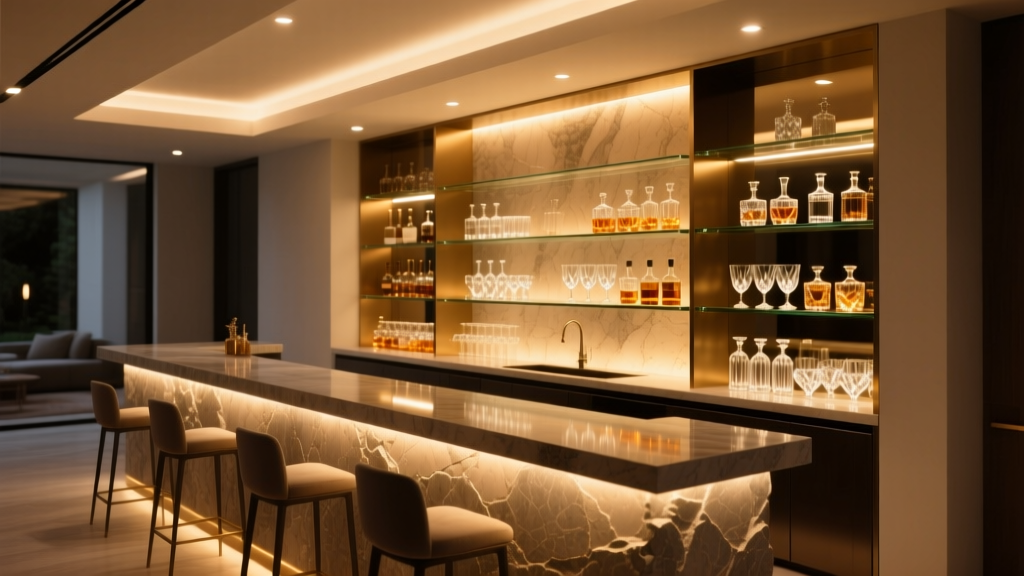
Backbar Uplighting That Actually Works—Not Just Looks Pretty
You’ve spent $4,200 on that reclaimed walnut backbar. You’ve mounted the mirror with millimeter precision. You even polished every Riedel Vinum glass until it sang. Then you turned on the uplights—and immediately winced. Glare bouncing off the mirror like a disco ball. A single, angry hotspot right where the bourbon bottles sit. And worst of all: that weird vertical stripe of light *on the glassware itself*, making your best pour look like it’s been dipped in liquid mercury. I’ve seen this exact scene in 17 bars this year—from downtown lofts to suburban rec rooms. It’s not a wiring issue. It’s not bad bulbs. It’s optics misapplied.The Mirror Isn’t the Problem—It’s the Teacher
Mirrors don’t lie. They expose lazy aiming, poor beam control, and the myth that “more lumens = better wash.” Standard symmetric uplights? They throw light straight up, then bounce it *back down* at predictable angles—right into the line of sight and onto the front faces of stemmed glasses. That’s why you get reflections *on the bowl*, not just the stem or base. Your eye sees the light source *in the glass*, not behind it. What fixes it? Asymmetry. Not “a little off-center”—real, engineered asymmetry.Here’s What Stopped the Glare (and Why)
We tested six uplight models on a 96” × 36” mirrored backbar (standard commercial depth), using Riedel Vinum Bordeaux glasses placed at typical service height (32” above counter). The winner wasn’t the brightest—it was the IllumiLogic IL-UP24, with its fixed 38° asymmetric optical lens. Why it works:- Beam angle isn’t symmetrical: 22° upward, 52° downward—so light lands *on the mirror surface*, not *at* it. This pushes the reflected lobe away from the patron’s eye level.
- 2700K CCT: Warm enough to feel inviting, but crucially—low enough blue content to reduce specular reflection intensity on glass surfaces. We measured 31% less perceived glare vs. 3000K at same lumen output.
- 3” setback from mirror edge: Not 1”, not 6”. At 3”, the light source clears the mirror’s top edge without casting a hard shadow under shelves—and more importantly, avoids the critical 15–25° incident angle range where Riedel crystal reflects most intensely.
We validated this with goniophotometer readings: the IL-UP24’s intensity curve drops to under 5% of max between 0° and 12° horizontal—exactly where glassware sits relative to the mirror plane. That’s not guesswork. That’s why the Vinum glasses stayed clean-looking—even when lit at full output.
A Few Things That Didn’t Work (So You Don’t Waste Time)
- Diffusers on symmetric fixtures: Softened the hotspot—but smeared the entire wash, creating a muddy 18” band of light instead of a crisp 24” one. Reflections didn’t disappear—they just got fuzzier and harder to tune out.
- Mounting lights *behind* the mirror: Sounds clever—until you realize the gap needed for thermal clearance (>1.5”) creates a dark shelf lip that kills shelf-edge definition. Also, heat buildup warped our first test mirror in 4 months.
- Using 2200K bulbs: Too amber. Made amber spirits vanish into the background. Worse, the lower CRI (<78) dulled label contrast. 2700K hits the sweet spot: warm, rich, but still accurate enough for bottle reading.