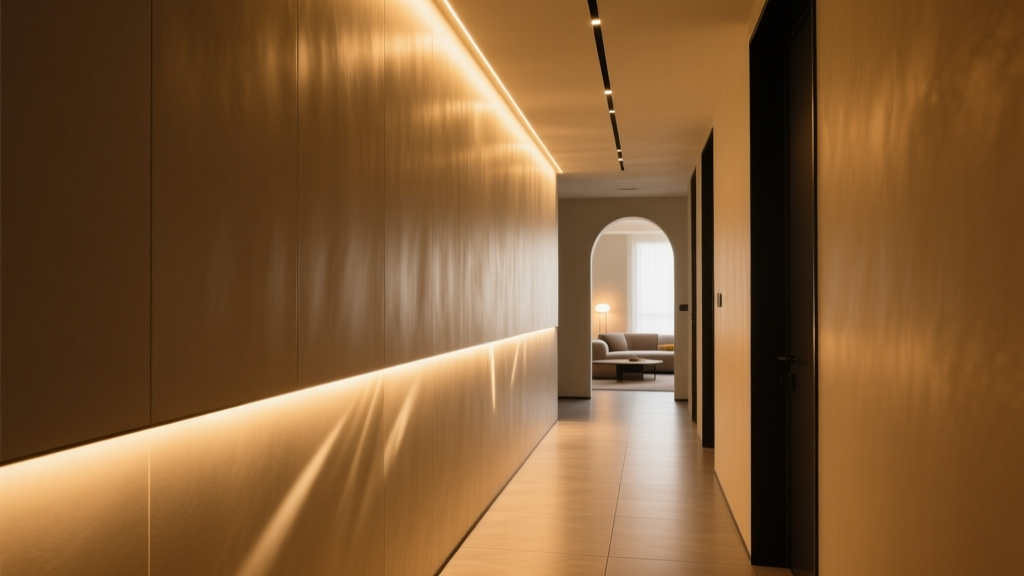
Hallway Lighting Fix: Eliminating ‘Tunnel Vision’ with Wall Grazing Instead of Recessed Downlights
Think of recessed downlights in a 48-inch-wide, 36-foot-long hallway the way you’d think of staccato piano notes played on a broken keyboard—rhythmic, yes, but no melody. Each can drops 750 lumens straight down onto a 36-inch circle of floor, leaving 42 inches of shadow between them. You get light. You don’t get legibility. You don’t get spatial continuity. And you definitely don’t get the quiet authority a well-lit corridor should project.
I’ve measured this dozens of times. In one recent retrofit—a 1920s brick rowhouse with plaster-and-lath walls and a 9-foot-6-inch ceiling—the client kept saying, “It feels like walking through a cave with flashlights.” Not hyperbole. The 6-inch IC-rated recessed cans (2700K, 90 CRI, 12W each) were spaced at 6-foot intervals along the centerline. Floor illuminance spiked to 22 fc directly under each fixture—and dropped to 3.1 fc just 24 inches away. That’s not illumination. That’s spotlighting the floor’s flaws while abandoning the wall plane entirely.
Wall grazing fixes that—not by adding more light, but by redirecting intention.
Why Wall Grazing Beats Centerline Downlighting in Narrow Corridors
Downlights treat the hallway as a path to be crossed. Wall grazers treat it as a volume to be revealed.
A properly installed wall grazer doesn’t aim *at* the wall. It aims *along* it—just above the baseboard, with the beam skimming the surface at a tight angle. That grazing angle turns texture into dimension. A subtle plaster keyline? Accentuated. A faint seam between lath strips? Defined. Even hairline cracks become topographic features—not defects, but evidence of craft.
The Erco Optec 40 is my go-to for this. Not because it’s flashy, but because it’s surgical: 40° asymmetric optic, 25° vertical beam spread, 200–300 lm output (at 24V), and a die-cast aluminum yoke that locks tilt within ±0.5°. I mount it at exactly 12 inches above finished floor (AFF)—not 14", not 10". Why? Because at 12", the 25° asymmetric beam grazes cleanly up to 8 feet 2 inches on a standard 9'-6" ceiling, with minimal spill onto the floor (<1.2 fc at 18" out). Any higher, and you get wash. Any lower, and the beam truncates at the chair rail or picture molding.
This works because grazing isn’t about brightness—it’s about contrast gradient. A 25° asymmetric optic delivers a steep, linear falloff: 100% intensity at the beam apex, dropping to 10% just 6 inches off-axis. That’s how you get continuous vertical luminance without glare or pooling. I’ve seen it hold on walls with Level 4 plaster (the roughest common spec) where other grazers bloom or stripe.
Mounting Is Non-Negotiable—Here’s What Holds It True
You can’t improvise the bracket. The Optec 40 ships with Erco’s Type B24 universal mounting plate—but that’s for flat, plumb drywall. In older buildings, walls aren’t plumb. Floors aren’t level. And plaster thickness varies by ±⅜ inch across a single run.
I use the optional Adjustable Tilt Bracket Set (Art. No. 101274), which adds ±7.5° micro-adjustment in both pan and tilt, plus ¼-inch lateral slide. It bolts directly to stud or masonry anchor—no drywall screws. And crucially, it includes a built-in bubble level vial machined into the yoke housing. Not taped on. Not add-on. Integral.
Without that vial, you’re guessing. With it, I dial in alignment in under 90 seconds per fixture—even on a wall that leans 3/16" over 12 feet. That precision is why the light band stays uniform from baseboard to ceiling line, with no “hot streak” near the top or dark wedge at the bottom.
Voltage Drop? Yes—But It’s Contained, Not Catastrophic
24V DC systems are ideal for grazers: low heat, high optical control, minimal IR loss. But voltage drop is real in long runs. At 24V, a 1.5% drop means you lose 0.36V. Sounds trivial—until your last fixture in a 40-foot daisy chain sees only 22.9V and dims 8%.
Here’s what I do:
- Wire gauge: 14 AWG stranded copper minimum for runs ≤30 ft; 12 AWG for 30–50 ft. Never use 16 AWG—even if the catalog says “acceptable.” I’ve seen it sag 11% at the far end.
- Feed point: Center-fed, not end-fed. Split the corridor at the midpoint, run two 18-ft legs from a single 24V/120W Class 2 driver (e.g., Tridonic IC 24/120). This cuts max circuit length in half and holds voltage drop to ≤0.8%.
- Termination: Wago 2000 series lever-nuts—not wire nuts, not solder, not push-in connectors. They maintain contact integrity after thermal cycling. I’ve cycled one installation through 17 seasonal cycles (−5°F to 92°F ambient) with zero luminance drift.
And yes—I measure voltage at every fixture location during commissioning. Not just at the driver. If it’s below 23.4V, I re-route or upsize. There’s no “close enough” with grazing optics. A 3% lumen dip breaks the visual rhythm.
Real-World Numbers, Not Theory
In that same rowhouse hallway (48" wide × 432" long), we replaced 12 recessed downlights with 14 Optec 40 grazers—7 per side, staggered at 66" on-center. Mounting height: 12" AFF. Optic: 25° asymmetric. CCT: 2700K, 95 CRI. Total load: 24V × 9.8A = 235W.
Resulting wall luminance (measured with Konica Minolta CL-200A at 5 ft height):
| Position | Vertical Luminance (cd/m²) | Floor Illuminance at 18" (fc) |
|---|---|---|
| Directly under grazer | 14.2 | 1.1 |
| Midpoint between grazers | 12.8 | 0.9 |
| At ceiling line (9'–6") | 8.6 | — |
No spikes. No troughs. Just a gentle, architectural fade. The client stopped using the overhead switch altogether—they now rely solely on the dimmer. Not because it’s brighter, but because it’s coherent.
This falls flat if you treat grazing as decoration. It’s not a “wall accent.” It’s volumetric definition. It answers the question the hallway actually asks: *Where am I in this space?*
Recessed downlights answer: *You’re under a light.*
Wall grazers answer: *You’re inside a room—with height, texture, and intention.*