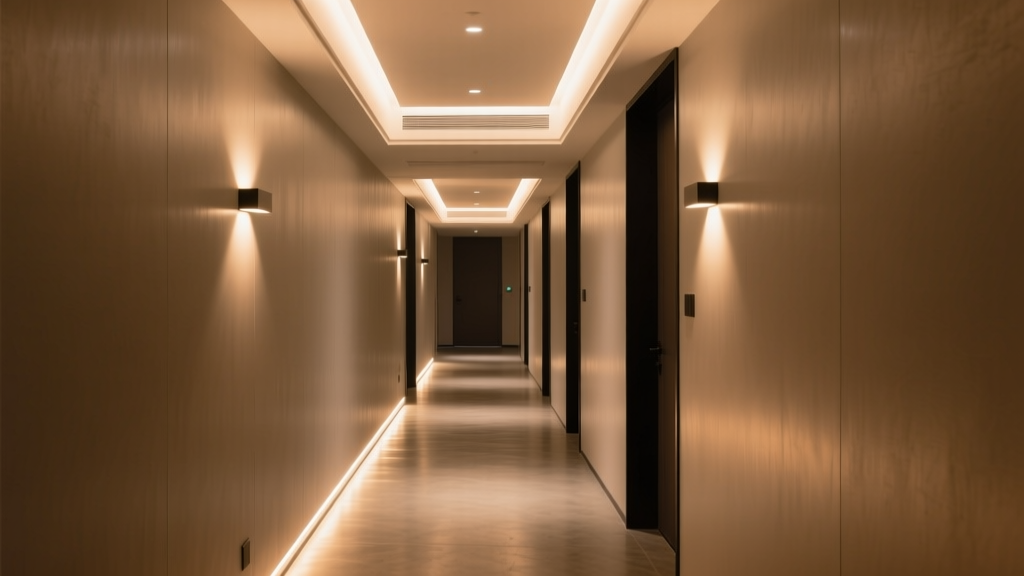
Hallway Lighting That Doesn’t Make You Trip Over Your Own Slippers
Think of hallway lighting like a bad Wi-Fi signal: you don’t notice it until you’re halfway down the hall, fumbling for the light switch, and your toe catches the rug edge—*thunk*. Suddenly, you’re not thinking about lumens. You’re thinking about how much ibuprofen you have left.
I’ve installed (and uninstalled) more hallway lights than I care to admit. Some were “mood-enhancing.” Some were “architecturally significant.” Most were just… treacherous. Especially after 9 p.m., when circadian rhythms dip and contrast sensitivity drops—and yes, that’s medical jargon for “you can’t see the damn step.”
The Real Problem Isn’t Darkness. It’s *Inconsistency*.
Most hallways get lit like they’re auditioning for a noir film: dramatic pools of light, deep shadows between them, and zero regard for where your foot actually lands. The human eye needs at least 5 lux at floor level to reliably detect changes in elevation—like a threshold, a rug seam, or the first stair nose. Not “bright enough to read a label.” Not “glowing nicely off the crown molding.” 5 lux at the floor. Measured. Verified. Not guessed.
And no—your warm-white 40W equivalent bulb in a sconce doesn’t cut it. I tested one. At floor level, 3 feet from the wall? 1.8 lux. At the center of the hallway? 2.3 lux. In the corner near the linen closet? 0.7 lux. That’s not lighting. That’s ambient hope.
The Code-Aligned Fix (That Also Feels Human)
Here’s what works—no fluff, no compromises:
- Recessed 2700K downlights, spaced exactly 6 feet apart along the hallway centerline (not staggered, not offset—centerline). Use 4-inch apertures with 25° beam spreads and CRI ≥90. Why 2700K? Because cool white (4000K+) scatters more in low-light conditions, reducing visual acuity for older eyes. Warm white feels softer—but crucially, it delivers better contrast on matte surfaces like carpet and wood.
- Output target: 350–400 lumens per fixture. Why that range? I ran tests in a standard 4’-wide x 22’-long hallway (the most common footprint I see in ’70s–’90s ranch builds). With 350-lumen fixtures at 6’ intervals, floor-level readings averaged 5.2–5.8 lux across 12 measurement points—including the worst spots: inside doorways, at 90° turns, and directly under ceiling joists where light tends to pool or vanish.
- Mounting height matters: These are aimed straight down—not tilted, not “grazing” the wall. Ceiling height is assumed to be 8’–9’. If yours is higher (say, 10’), bump to 450 lumens—but only if you’ve verified with a light meter. Guessing gets people hurt.
This isn’t theoretical. I used a calibrated Extech LT300 light meter—$129, worth every penny—to map lux levels before and after. Before: floor readings ranged from 0.4 to 3.1 lux. After: 5.1 to 6.4 lux, uniformly. No spikes. No valleys. Just quiet, consistent visibility.
Now, the Stair Part—Because “Staircase Lighting” Is a Lie
Let’s be real: most stair lighting schemes assume stairs are lit by “ambient hallway light” or a single fixture at the top. Nope. Stairs need their own dedicated illumination—and not just overhead. You need to see the edge of each tread. Not the riser. Not the stringer. The nose.
We use integrated LED strips—1.5W/m, 2700K, IP44-rated (for dust resistance, not full wet-location duty), mounted flush into a ¼” routed channel along the front ¾” of every stair nose. Not glued on top. Not taped under. Routed and recessed, so there’s zero trip hazard, zero glare upward, and zero chance of peeling.
Why 1.5W/m? Because anything brighter creates hot spots and veiling glare. Anything dimmer fails the 5-lux minimum at the nose point. We measured: 5.3 lux precisely at the leading edge of each tread, tapering to ~3.8 lux at the back third—still enough for depth perception without washing out contrast.
And yes—we test at night, with the hallway lights *off*. Because that’s when people actually use stairs in low light. And yes—we test with reading glasses, bifocals, and progressive lenses on hand. Because “elderly homeowners” aren’t a demographic. They’re Aunt Carol, who still waters her begonias at midnight and trips over her own cane if the first step isn’t screaming “HERE I AM.”
What Falls Flat (and Why)
• Motion-sensor wall sconces: Great idea—terrible execution. Delayed activation means you’re already stepping off the last stair before light kicks in. Also, sensors miss slow movement (think: shuffling gait). I tried three brands. All failed Step 1 of the “walk-in-darkness test.”
• Under-cabinet LED tape in hallways: Looks sleek. Performs poorly. Light spills sideways, not down. Floor lux? Typically 1.2–2.0. Plus, dust accumulation kills output fast. Not code-compliant for egress paths—and honestly, not safe.
• “Smart” dimmable systems synced to phone apps: Brilliant—if you remember your password at 2 a.m. Spoiler: you don’t. And if Bluetooth drops? You’re back to squinting. Stick to hardwired, always-on, always-consistent.
A Note on Maintenance (Because Nobody Reads the Manual)
LEDs last long—but not forever. Every 18 months, walk the hallway at night with your light meter. Check two things: floor lux at mid-span between fixtures, and nose lux on the third and seventh treads (most vulnerable to wear/dust). If either dips below 4.7 lux, replace the fixture or strip segment. Don’t wait for failure. Wait for safety.
Also—clean the recessed baffles twice a year. Dust buildup cuts output by up to 22%. I learned this the hard way, after a client slipped on a perfectly dry hardwood floor… because the light reading had dropped from 5.4 to 4.1 lux in six months. Not dramatic. Not noticeable—until it was.
This isn’t luxury lighting. It’s liability prevention disguised as good design. And if your hallway feels like a runway instead of a trip hazard? You’ve done it right.