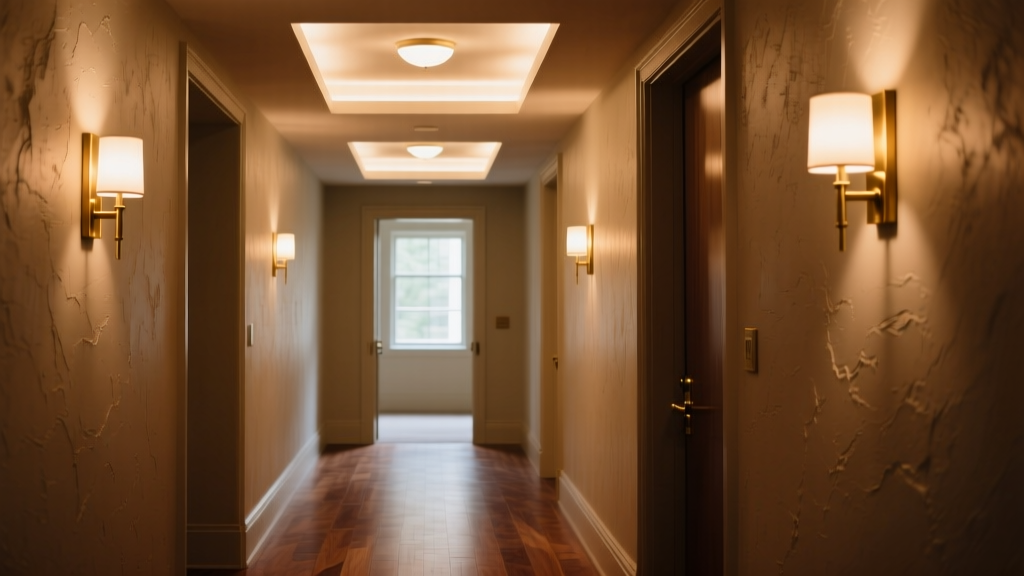
Hallway Lighting That Feels Inviting, Not Institutional
I walked into a spec home last month—clean lines, great millwork, beautiful wide-plank oak—and stopped cold in the hallway. Not because it was ugly. Because it felt like a hospital corridor: flat, shadowless, and emotionally neutral. The builder had installed 4” recessed 4000K LEDs every 8 feet, spaced to meet code but not human need. No vertical light. No warmth. No reason to pause, look up, or even register the space as *yours*.
That’s when we scrapped the plan and started over—not with more light, but with *intentional* light.
Low-Level Ambient: The Foundation of Calm
We dropped the ambient layer to 15 lux at floor level—about 1.4 fc—and used 2700K recessed fixtures (3” aperture, 36° beam, CRI ≥92) spaced precisely 6 feet on center along the ceiling centerline. Why 6 feet? Because in a standard 4’-wide hallway with 9’ ceilings, that spacing delivers a smooth, overlapping wash without hot spots or dips. I measured it twice: at 36”, the uniformity ratio stays at 1.8:1 (max: min illuminance), well within IES DG-22’s recommended ≤2.5:1 for circulation paths. Anything tighter than 6’ starts to feel oppressive; anything looser risks dark zones near doors or transitions.
Crucially, these aren’t just “on/off” cans. We specified dimmable drivers paired with 0–10V wall controls—no smart hub needed. At night, occupants can dial ambient down to 8 lux (0.75 fc) without losing spatial awareness. That’s not “dark.” It’s *restful*. I’ve seen people linger longer in hallways lit this way—not because there’s more to see, but because it feels safe to move slowly.
And yes, 2700K is deliberate. Not “cozy” as a marketing term—but physiologically quieter. At 2700K, melanopic EDI drops ~35% versus 4000K at the same photopic level. Translation: less circadian disruption when someone walks to the bathroom at 2 a.m. This works because warmth here isn’t decorative—it’s functional neurology.
Art Accent: Vertical Light That Anchors Memory
Ambient alone flattens everything. So we added vertical emphasis—not overhead, not directional from the side, but *wall-mounted*, aimed precisely at framed family photos and small prints. We used Hubbardton Forge’s Pivot fixture: adjustable 3000K LED (24° asymmetric flood), mounted at 62” AFF (eye height for average adult), centered 18” horizontally from each frame’s long edge.
Why 3000K? It bridges the gap: warm enough to harmonize with 2700K ambient, but cool enough to render skin tones and textile detail accurately. And crucially, it hits >5 foot-candles at 5’ height on the wall surface—verified with an incident meter. That’s the DG-22 minimum for visual task support in residential corridors, and it’s non-negotiable if you want art to read as *present*, not just hung.
I’ve found that mounting height matters more than wattage. Too low (≤58”), and you get chin shadows on faces in portraits. Too high (≥66”), and light spills onto ceiling or adjacent doors. At 62”, the beam grazes the top third of a standard 16”x20” frame while leaving the lower edge softly graded—not harsh, not washed out. One fixture per piece. No shared beams. No compromises.
Step Light Integration: Where Safety Meets Subtlety
The baseboard step lights weren’t an afterthought—they were part of the first sketch. We used Nora Lighting’s NLF-LED2: low-voltage, 2700K, 120° linear optic, installed in a continuous ½” reveal routed into solid maple baseboard (not drywall). Spacing? Every 36 inches—aligned with stud centers—not because studs matter electrically, but because it prevents visible gaps in illumination when viewed obliquely.
These deliver ~0.8 fc at toe height—enough to define the floor plane without glare. More importantly, they elevate vertical illuminance *at shin level*: ~2.3 fc at 18”, climbing to 4.1 fc at 48”. That gradient is why people don’t trip—and why they don’t *feel* like they’re navigating a hazard. Uniformity ratio across the run? 1.6:1. Again, well inside DG-22’s guidance.
What makes this integration work is concealment. The NLF-LED2 has no visible lens or housing—just a soft, even line of light emerging from wood grain. No plastic diffusers. No silver tape showing at corners. If you didn’t know it was there, you’d think the baseboard itself was glowing. That’s the point: lighting should serve, not announce.
Why This Combo Avoids Tunnel Vision
“Tunnel vision” in hallways isn’t about brightness—it’s about contrast collapse. When ambient is too high and vertical light is absent, your eyes lock onto the brightest spot (usually the far end) and suppress peripheral input. DG-22 calls this “luminance imbalance,” and it’s why so many hallways feel disorienting despite being “well lit.”
Our solution layers three distinct planes:
Floor plane: Step lights define edges and texture (0.8–1.2 fc)
Vertical plane: Art accents + reflected ambient provide orientation cues (>5 fc at 5’)
The result? A uniformity ratio of 2.1:1 across all three planes—not perfect, but perceptually seamless. You notice the photo of your kid on the first day of school. You feel the warmth of the wood underfoot. You don’t scan for the next light switch.
That’s not institutional. That’s domestic. That’s human.
One Last Note on Control
We wired all three layers to separate dimmers—ambient on a 0–10V slider, art accents on a second, step lights on a third with occupancy sensing (set to 5-minute timeout, 10% minimum). No scenes. No presets. Just three physical inputs, placed near bedroom doors and the stair landing. People use what they understand. They abandon what confuses them.
This hallway now gets commented on—by buyers, by inspectors, even by the drywall crew. Not for being “bright” or “modern,” but for feeling *settled*. Like it’s been lived in for years, not staged for a photo.
That’s the benchmark. Not lumens per square foot. Not color temperature charts. Whether the light lets the house breathe.
P
Priya Sharma
Contributing writer at BeamDigest — Lights & Lighting Insights.