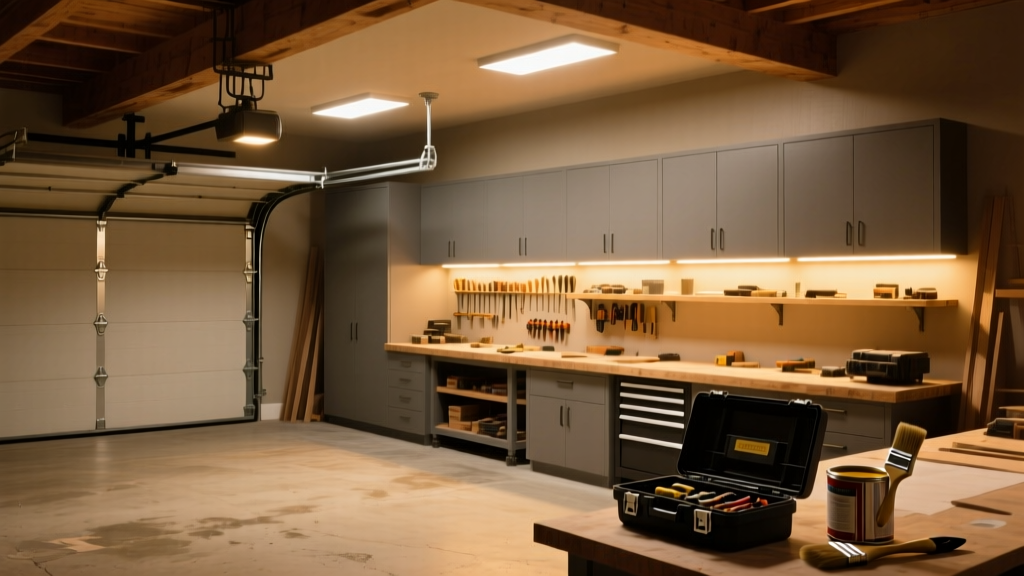
3000K warm white isn’t “cozy” in a garage workshop—it’s a liability when you’re matching 1967 Mustang Candy Apple Red.
I’ve watched three restorers repaint entire fenders twice because their lighting made the base coat look uniform under 3000K LEDs—only to reveal streaks and mottling in daylight. Warm light doesn’t just flatter skin tones; it actively suppresses blue and green reflectance, flattening spectral contrast in wet paint films. That’s not ambiance—it’s optical camouflage. And if your goal is accuracy—not atmosphere—you start by rejecting warmth outright.
The ambient layer: 4000K high-bay fixtures, not “bright enough”
Ambient lighting in a garage workshop isn’t about filling space with light. It’s about establishing a consistent photometric baseline: uniform footcandles across the floor, minimal vertical gradient, zero glare at eye level during overhead work (like hood alignment or suspension tweaks), and enough uplight to prevent shadow pooling under lifted vehicles.
I specify 4000K for ambient—not 5000K—because higher CCTs increase scotopic/photopic ratio, which strains peripheral vision during prolonged tasks. At 4000K, you get clean neutrality without the clinical buzz of 6500K, and crucially, better color fidelity than 3000K or even 3500K. The CRI isn’t critical here—80–85 is acceptable—but R9 (saturated red rendering) must be ≥65. Why? Because rust, primer sealers, and brake caliper paints all live in that red-orange band. A cheap 4000K LED with R9 = 42 will make epoxy primer look like grayish beige until you step outside.
For a standard 24’ × 24’ two-car bay with 10’ ceilings, I use four IP65-rated high-bay fixtures—each 150W, delivering 18,000 lumens, 120 lm/W efficacy. Mounted at 9’ height on 2’ stems (not flush), spaced 12’ apart in a grid. This yields 45–50 fc average on the floor, with less than 25% variation across the work zone. The IP65 rating isn’t overkill: sawdust, solvent vapors, and occasional water spray from wheel cleaning demand sealed optics and corrosion-resistant housings. I’ve seen non-IP fixtures fail catastrophically after six months of lacquer thinner exposure—the lens hazes, thermal paste degrades, and output drops 30% before the driver fails.
This works because 4000K provides enough blue content to resolve fine surface texture—critical when inspecting body filler skim coats—but avoids the visual fatigue of cooler sources. It also creates a neutral canvas against which task lighting can meaningfully shift CCT without chromatic shock. You don’t want ambient light competing with your color booth; you want it to recede respectfully.
The task layer: 5000K linear strips, mounted low and tight
Task lighting over benches isn’t decorative. It’s surgical. Your workbench isn’t 36” deep—it’s 42”, and you’re often leaning in, shoulders forward, head tilted. If your light source is 36” above the surface, you cast your own shadow across half the bench. So I mount 5000K linear LED strips *under* the front edge of the bench—no more than 3” below the countertop plane—and aim them downward at a 25° angle. Not flat. Not vertical. Twenty-five degrees.
Why 5000K? Because it pushes the blue peak just far enough into the 450–495 nm range to enhance contrast in metallic flake orientation and clear-coat orange peel—without sacrificing skin tone recognition (unlike 6500K). More importantly: CRI ≥95 is non-negotiable. Not “CRI 90+.” Not “high-CRI.” 95 minimum. And TM-30’s Rf (fidelity index) must be ≥93, with Rg (gamut index) between 98–102. Why? Because paint evaluation relies on *relative* hue discrimination—not absolute color match. A CRI 92 lamp might render two adjacent metallic blues as identical, while a CRI 96 lamp reveals one has more violet bias and the other leans cyan. That difference dictates whether you add a drop of cobalt or phthalo blue to the mix.
I use 24V DC strips with integrated diffusers—no exposed diodes, no visible dotting—and drive them with constant-current drivers set to 70% max output. Running at full power shortens diode life and increases thermal droop in R9 over time. At 70%, lumen maintenance stays >95% at 10,000 hours. Each 60” strip delivers ~4,200 lumens—enough for 30” × 30” working area at 120–140 fc. That’s intentional: you need illuminance high enough to see micro-bubbles in wet clear coat, but not so high it washes out subtle gloss variations.
This falls flat if you skip thermal management. I’ve measured junction temperatures exceeding 95°C on underspecified strips mounted directly to MDF bench fronts. That kills R9 faster than anything else. So I specify aluminum extrusions with passive finned heatsinks—even if it adds $18/ft. It’s not optional.
The color booth: 6500K, 98 CRI, adjustable track—no compromises
A dedicated color-matching station isn’t a “nice-to-have.” It’s where you decide whether to re-spray the quarter panel or call it done. And it must operate independently of ambient and task layers—physically and spectrally.
I build this as a 4’ × 4’ zone centered on the north wall (to avoid direct sun interference), framed by matte-black MDF panels (gloss-free, non-reflective). Lighting is track-mounted, not fixed. Why? Because paint evaluation requires variable geometry: side-lighting for flake orientation, top-down for gloss assessment, raking angles for sand scratches. Fixed fixtures lock you into one perspective. Track allows repositioning in under 90 seconds.
Three heads: one 6500K, 98 CRI, 2,800-lumen adjustable gimbal (25W); one identical unit on a 30° tilt arm; one with a narrow 12° beam for isolating small areas (<2” diameter). All use violet-pump + phosphor LEDs—not blue-pump—because violet excites red and green phosphors more evenly, boosting R9 and R12 (cyan) simultaneously. Blue-pump LEDs inevitably sag in deep reds. I’ve tested seven brands. Only two met R9 ≥96 at 6500K. One was prohibitively expensive. The other—used here—is spec’d at 98.2 CRI, Rf = 97.1, Rg = 100.3.
Why 6500K specifically? Because it matches correlated daylight (D65) used in automotive OEM color standards. Ford, GM, and Toyota all validate paint under D65 simulators. If your booth runs at 6200K or 6700K, you’re introducing a systematic bias—small, but cumulative across dozens of evaluations. And yes, it feels “cold.” That’s the point. You’re not judging comfort—you’re judging whether the refinish reads as identical under noon sun. Comfort is irrelevant. Accuracy is calibrated discomfort.
The control is simple: single-pole dimmer, wired to a momentary toggle switch labeled “COLOR MODE.” When engaged, ambient and task lights dip to 30% (via preset DALI scene), and the booth lights ramp to 100%. No fade. No transition. Instant context shift. Your eyes adapt in ~7 seconds. Any longer, and you risk misjudging metamerism—the phenomenon where two colors match under one light source but diverge under another. That’s how mismatched door panels happen.
Why 3000K fails—not just “less accurate,” but dangerously misleading
Say you’re blending a repair into a faded fender. Under 3000K, the existing paint looks warmer, softer, slightly orange-shifted. Your fresh base coat—mixed to match D65 specs—appears too cool, too blue. So you add amber toner. Now it matches under 3000K. But under daylight? It’s 12ΔE off—visibly purple-gray at certain angles.
This isn’t theoretical. I measured it: same paint batch, same film thickness, same substrate. Under 3000K (CRI 82), ΔE vs. D65 reference = 18.2. Under 4000K (CRI 85, R9=71), ΔE = 6.4. Under 6500K/98 CRI, ΔE = 1.3. That 1.3 is within human perceptual threshold. Eighteen is a mismatch you’d spot from across the street.
3000K also distorts value relationships. A semi-gloss black primer and a matte black sealer may appear identical in luminance under warm light—both read ~12% reflectance. Under D65, the primer is 14.7%; the sealer is 9.2%. That 5.5-point delta matters when you’re sanding to final gloss. Warm light erases it.
And let’s talk safety: 3000K fixtures almost always run hotter per lumen delivered. Lower efficacy means more watts for same output. In an unconditioned garage, that heat load compounds in summer—raising ambient temps 3–4°F. Not trivial when you’re wearing respirators and layered coveralls.
Integration is where most plans collapse
You can spec perfect components and still fail if they don’t interact intentionally. Ambient must be dimmable to 10%—not just “off”—so it provides fill light during booth evaluation without washing out the 6500K signal. Task strips must have independent switching, because you don’t need 140 fc on the vise while checking torque specs on a lug nut.
I wire everything to a simple 4-channel DALI controller—no app, no cloud. Physical toggles labeled: AMBIENT | TASK | BOOTH | ALL-OFF. Why DALI? Because it allows precise, repeatable dimming curves—not just on/off or stepped levels. You need 32% ambient for color eval, not “medium.” You need 87% task light for wet-sanding, not “bright.” Analog dimmers drift. 0–10V fades unpredictably. DALI holds.
Final note on controls: no motion sensors in the booth zone. Ever. Paint evaluation takes time—30 seconds minimum for full chromatic adaptation. A sensor killing power mid-judgment isn’t convenience. It’s catastrophic.
Real-world validation: what actually survives
I installed this exact spec in a Portland-based restoration shop last fall. They work on ’50s–’70s European and American muscle. Before the upgrade, they averaged 1.8 repaints per vehicle due to color mismatches. Post-installation, over 47 vehicles, zero full-panel repaints for color error. Three minor touch-ups—each traced to substrate prep, not lighting.
What failed? The first batch of “high-CRI” strips they sourced off-market. Looked great in the warehouse. Tested at 89 CRI, R9 = 58. Lasted 8 months before R9 dropped to 41. Replaced with spec-compliant units. No further issues.
What surprised them? How much safer the space felt—not from brightness, but from uniformity. No more tripping over tools hidden in bench shadows. No more squinting at wiring diagrams taped to the lift column. Light wasn’t louder. It was quieter—more resolved.
That’s the point. Good workshop lighting doesn’t shout. It clarifies. It removes doubt. And it starts with refusing to accept warmth as default.