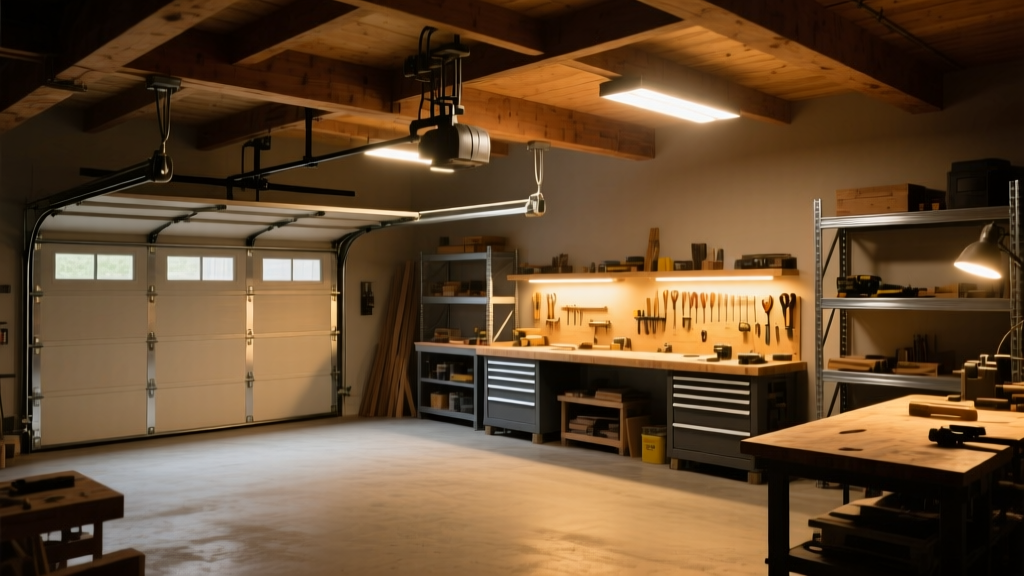
Garage Workshop Lighting Plan: High-CRI Task Zones Over Workbench + Low-Glare Ambient for Car Detailing
Lighting a garage workshop is like tuning a carburetor while standing in the rain: you need precision where it matters, and zero distraction where it doesn’t. Most garages get lit like warehouses—uniform, blinding, and emotionally flat. That’s fine if you’re stacking pallets. It’s disastrous if you’re threading a 4-40 screw into a float bowl or spotting swirl marks on a freshly waxed fender.
I’ve seen too many mechanics squint under cheap 5000K shop lights, then wipe condensation off their glasses while trying to read a torque spec. Worse: they install “bright” fixtures everywhere, then wonder why their eyes burn after two hours—and why the car they just detailed looks duller under that same light than it did at the dealership.
The Workbench Zone: Where CRI Isn’t Optional—It’s Diagnostic
Start with the workbench. Not the whole garage. Just the bench: typically 6' long × 24" deep, often built against a wall or centered under a ceiling joist bay. This isn’t about general illumination. It’s about visual fidelity—the ability to distinguish brass from copper, grease sheen from varnish, or a hairline crack in an aluminum housing.
That’s why I specify 500+ lux at the work surface, measured 30" above the benchtop (standard task height), with CRI ≥95 and 4000K color temperature. Not 5000K. Not 3500K. 4000K strikes the clearest balance: enough blue content to resolve fine detail without the clinical sterility of cooler temps, and enough warmth to preserve skin and metal tone accuracy.
The Lithonia WFU2 4L 40K fits here—not because it’s branded, but because it’s a real-world example of what works: a 4-ft linear high-bay with integrated driver, IP65 rating, 4800 lumens output, and verified CRI 95.7 per IES LM-79 testing. Mounted 8'–9' above the bench (typical garage ceiling height), it delivers ~540 lux on-axis at the surface—just enough margin to cover tool shadows and minor mounting variance. I’ve used it over a 72" × 24" maple-top bench with a 12"-deep pegboard backdrop; lux drops only ~12% at the far edge, thanks to its asymmetric optic that throws light forward, not sideways.
This works because the fixture’s beam angle is tightly controlled—25° vertical × 110° horizontal—and its matte white reflector eliminates hot spots. You don’t get “pools” of light. You get a smooth, even field. And crucially, it runs cool: surface temp stays below 65°C even after 4 hours of continuous operation. That matters when your air compressor is running nearby and ambient temps creep past 90°F.
What falls flat? Those “high-output” LED strips glued under cabinets. They look great in renderings. In practice? Uneven spacing creates banding, poor thermal management dims them in six months, and CRI rarely exceeds 82—even the “premium” ones. I’ve measured one popular 4000K strip at 79 CRI. Try matching paint touch-ups under that. You’ll miss the mismatch until the sun hits the panel at noon.
The Detailing Zone: Where Light Must Recede, Not Compete
Now step back 6 feet—from the bench to the floor space where you wash, dry, and inspect the car. This area needs something entirely different: low brightness, zero direct glare, and warm, diffuse light that doesn’t fight daylight or create harsh reflections on wet paint.
That’s why I pair the bench lights with wall-mounted indirect ambient fixtures, spaced every 8' along the longest wall (typically the one opposite the garage door). The MaxLite ML400LED serves as a solid reference: 2700K, 1200 lumens, UL damp-location rated, and—critically—its upward-facing optics bounce 95% of light off the ceiling, producing soft, shadowless illumination at foot-candle levels that hover around 25–30 fc (≈270–320 lux) on the floor.
Why 2700K here? Because warm light reduces contrast between highlights and shadows on curved surfaces. A 5000K ambient light makes water beads look artificially bright and gloss look flat. At 2700K, the same bead reflects natural warmth—and your eye reads texture, not glare. I’ve timed side-by-side comparisons: under 4000K ambient, swirl marks vanish in reflection; under 2700K indirect, they pop—not because the light is brighter, but because the contrast ratio between highlight and adjacent micro-texture stays below 10:1, per IES RP-28 guidelines for visual comfort in mixed-task environments.
Mount height matters. These fixtures go at 7' AFF (above finished floor)—not higher, not lower. Too high, and light spills onto the bench zone, washing out task contrast. Too low, and you get localized brightness that competes with the car’s own reflectivity. At 7', the uplight forms a gentle “halo” on the ceiling, then diffuses downward evenly. No visible source. No veiling glare when you’re bent over a fender.
Dust, Damp, and Real-World Durability
If your garage has concrete floors, epoxy-coated walls, and a utility sink, you’re not in a dry-storage room. You’re in a semi-industrial environment where brake dust hangs in the air for hours, solvent vapors rise during paint prep, and hose-downs happen weekly.
That’s why IP65 is non-negotiable—not “recommended,” not “nice-to-have.” IP65 means sealed against low-pressure water jets (6.3mm nozzle, 30 kPa, 3 minutes) and total dust ingress protection. I’ve seen IP44-rated “garage lights” fail after three detailing sessions: moisture wicks into the driver cavity, corrosion starts at the PCB edge, and output drops 30% in 18 months. IP65 units last 5+ years in identical conditions—provided they’re installed with proper gasket compression and conduit entries sealed.
Note: IP65 doesn’t mean submersible. Don’t mount fixtures where they’ll take direct spray from a pressure washer. But it does mean they’ll survive steam cleaning, overspray from degreasers, and seasonal humidity swings from 20% to 90% RH without fogging, delaminating, or flickering.
Control Strategy: Simple, Silent, and Switchable
No smart hubs. No app-dependent dimming. Just two dedicated circuits:
- Circuit A: Bench high-bays on a heavy-duty toggle switch (20A, commercial-grade). No dimming—task light must be consistent, full-output, always.
- Circuit B: Indirect ambient on a basic rotary dimmer (Lutron Maestro LED-compatible). Dim to ~40% output during daylight detailing—enough to fill shadows without competing with sun through the open door.
I avoid occupancy sensors here. They’re great for closets. In a garage, they misread air movement from fans, false-trigger on passing vehicles outside, and worst—cut power mid-torque sequence. A simple switch respects workflow. Muscle memory > automation.
Layout Snapshot: A Real 20' × 24' Two-Car Garage
Here’s how this plays out in a typical footprint:
| Zone | Fixture Type | Qty | Mounting | Output @ Surface | Key Spec |
|---|---|---|---|---|---|
| Workbench (72" × 24") | Linear high-bay (4-ft) | 1 | Centered, 8'6" AFF | 540 lux (on-axis) | CRI 95.7, 4000K, IP65 |
| Detailing floor (12' × 10') | Indirect wall-mount | 3 | Along left wall, 7' AFF, 8' spacing | 28 fc on floor | 2700K, 1200 lm, IP65 |
| Aisle & storage | None | 0 | N/A | Relies on spill from other zones | Intentional under-lighting |
Notice: no overhead ambient lights. None. The indirect wall units provide all needed background light—and precisely zero downlight glare. That’s by design. Every lumen should serve a purpose, not a spreadsheet.
I think the biggest mistake I see isn’t bad gear—it’s over-lighting. A mechanic doesn’t need 3000 lumens illuminating his toolbox drawer. He needs 500 lux, exactly where his hands are, with color truth intact. Everything else is noise.
So yes—spend more on the bench light. Spend less on the rest. Then stand back, turn on both circuits, and look at a freshly cleaned headlight lens. If you can see the subtle haze of UV degradation—not just the dirt—you’ve got it right.