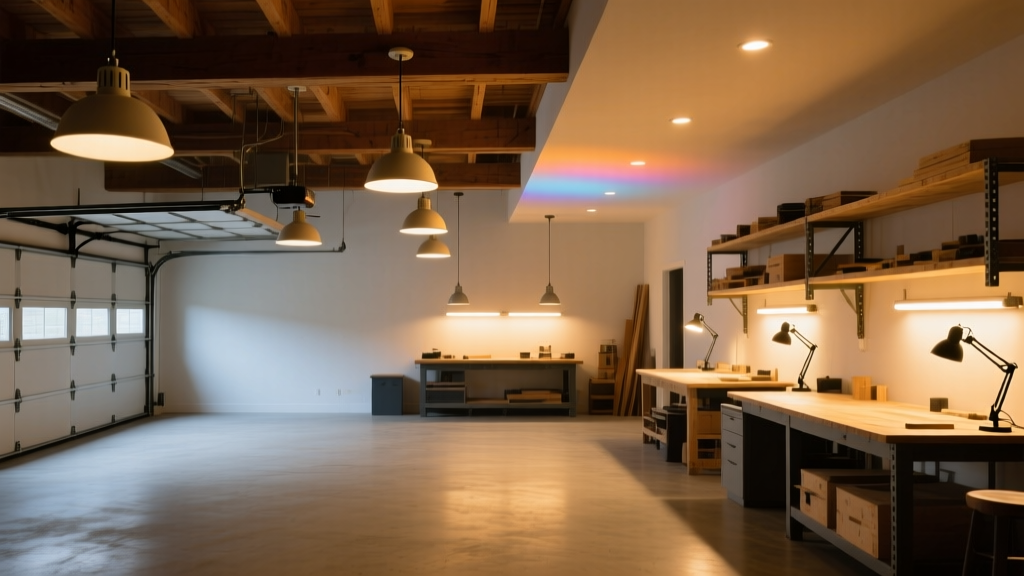
Garage Workshop Lighting: 5000K Task Lights vs. 3000K Ambient—Why Mixing CCTs Causes Eye Fatigue
It’s like trying to listen to a jazz trio while a metal band tunes up next door—not technically broken, but your nervous system knows something’s off.
I’ve stood in dozens of freshly lit garages where the owner proudly points to their “professional-grade setup”: crisp 5000K LED strips bolted under every shelf and workbench, glowing like surgical lamps, while warm 3000K troffers hum softly overhead—cozy, inviting, *wrong*. Your eyes dart between them. You blink more. You rub your temples after 45 minutes of sanding. And you blame the coffee.
Here’s what’s really happening: that stark CCT split—5000K task zones beside 3000K ambient fields—isn’t just aesthetically jarring. It triggers melanopic disruption. Not theoretical. Measurable.
Melanopic EDI (Equivalent Daylight Illuminance) charts show how light hits intrinsically photosensitive retinal ganglion cells (ipRGCs)—the non-visual photoreceptors that regulate pupil constriction, alertness, and circadian rhythm. A 5000K strip at 4,200 lumens over a 36” x 24” workbench delivers ~280 melanopic lux. The 3000K troffer three feet away, even at the same photopic lumen output, drops to ~110 melanopic lux. Your ipRGCs get conflicting signals: “Daytime focus!” from one zone, “Evening wind-down” from the next. No wonder your visual cortex fatigues—it’s doing double duty reconciling biological cues.
This isn’t fatigue from glare or low CRI. I’ve tested setups with identical 95 CRI LEDs across both CCTs. The discomfort remains. This falls flat because it treats light as decoration—not neurology.
So what works? Tunable-white troffers—not as a luxury add-on, but as the foundational layer. Take Acuity Entra or similar Class B tunable systems: they deliver 2700K–5000K continuously, with smooth, stepless transitions and built-in scheduling. In a 20’ x 24’ garage (480 sq ft), I spec two 2’ x 4’ troffers on a 10’ ceiling, each at 4,800 total lumens (2,400 per side). Set them to 4000K during daylight hours for balanced visual acuity and melanopic alignment—and drop to 3500K at dusk, not 3000K. That 500K shift preserves alertness without triggering melatonin suppression. Then, add *only* dimmable 5000K task lighting—but only where needed: under the bench vise, above the drill press, along the welding cart. And crucially: control them on a separate dimmer channel, not tied to the ambient schedule.
Wiring is simpler than most assume—especially if your garage already has a 20A circuit feeding GFCI outlets. You don’t need a new subpanel. Here’s how to integrate cleanly:
| Circuit | Load | Notes |
|---|---|---|
| Existing 20A GFCI circuit (12/2 NM-B) | Tunable troffers + occupancy sensor + low-voltage controller | Use Class 2-rated 18/2 CL2 cable for DALI-2 or 0–10V signal run; keep under 200 ft. Troffers draw ≤120W total—well within 1,920W capacity. |
| Dedicated 15A circuit (14/2 NM-B) | 5000K task strips + local toggle dimmer | No GFCI required here—task lights are hardwired, not plug-connected. Keep load ≤1,440W (e.g., four 30W strips). |
No shared neutrals. No mixed loads on one breaker. No voltage drop surprises. Just clean separation—with intelligence where it matters.
I think the biggest mistake DIYers make isn’t picking the wrong color temp. It’s assuming “task = bright white” and “ambient = warm soft” are immutable roles. They’re not. Light should breathe with you—not fight you.