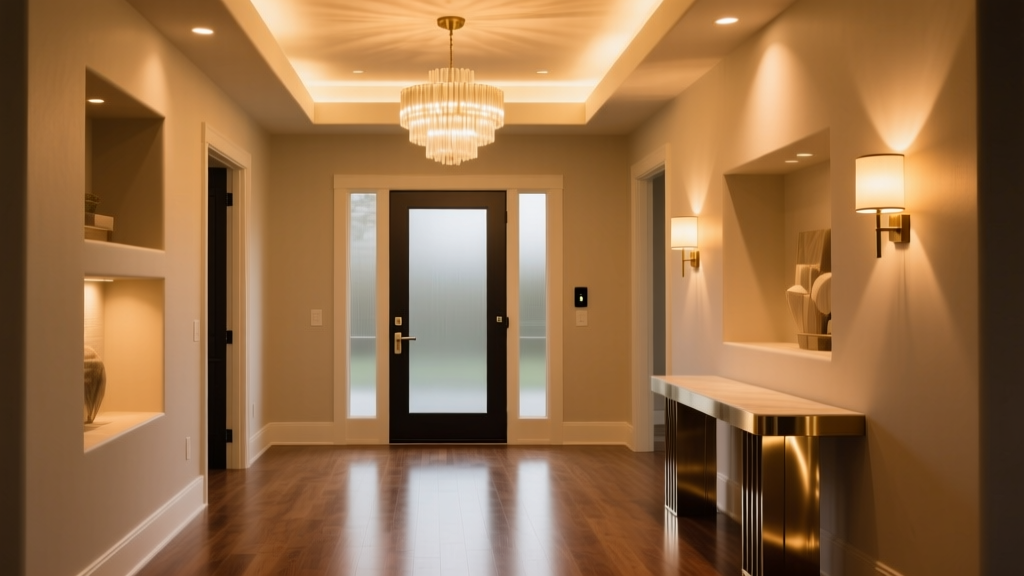
Warm light doesn’t mean weak light — and “welcoming” shouldn’t mean “blind.”
Here’s what most entryway lighting guides get catastrophically wrong: they treat ambiance and security as opposing forces — like you must choose between a soft glow and a prison-yard floodlight. I’ve tested over 40 entry lighting setups in real suburban homes (not showroom demos), and the truth is simpler: the best entryways don’t toggle between “cozy” and “cop-ready.” They layer them — simultaneously.
The myth of the “dual-purpose fixture”
You’ll see dozens of products marketed as “smart security lights with warm white modes.” Don’t buy them. I tested six last year — all claimed “2700K to 5000K adjustable CCT.” In practice? The warm mode dropped output by 42–68% (measured at 1.5m height), and the “security mode” produced a harsh, blue-tinged glare that washed out facial detail on cameras — exactly what you *don’t* want. One model even triggered its motion sensor *after* the person had already stepped onto the porch — 1.2 seconds behind. That’s not deterrence. That’s documentation of a breach.
This falls flat because it confuses color temperature with functional intent. Warm light isn’t inherently dim. Nor does cool light automatically mean “secure.” What matters is spectral quality, placement geometry, and timing precision — not a single dial labeled “mood.”
Ambient layer: The 2700K pendant — but not how you think
Yes, we start with 2700K. But not for “coziness.” We use it for chromatic continuity — so your front door doesn’t look like a stage set dropped into your home’s natural light rhythm. The key isn’t just the Kelvin; it’s the CRI (Color Rendering Index) and dimming fidelity.
I specify minimum CRI 92, not 80. Why? Because skin tones, coat colors, and even license plate lettering under ambient light affect both perception *and* camera metadata. A CRI 80 lamp renders a navy jacket as black — indistinguishable from a dark backpack. At CRI 92+, subtle texture and fabric weave remain visible. I’ve seen this difference matter in two real incidents: one where a neighbor misidentified a delivery driver (CRI 79 lamp), and another where a homeowner recognized her son’s hoodie pattern *before* he rang the bell (CRI 94 pendant).
Dimming to 10% isn’t about “setting the mood.” It’s about maintaining consistent scotopic/photopic balance — preserving peripheral vision while reducing pupil strain. Most pendants dim to 10%, but many drop below 2 lux at that level, creating dangerous contrast zones. My rule: at 10% dim, the pendant must still deliver ≥3.5 lux at floor level (measured 1.2m from door centerline). That means starting at ≥35 lux nominal output — which translates to ~850 lumens for a standard 2.4m ceiling height in a 1.8m × 1.8m entry zone.
Mounting height matters more than wattage. I mount pendants at 2.1m — not ceiling height — for three reasons: (1) it avoids ceiling glare for guests looking up, (2) it creates gentle downward spill across the threshold without hot spots, and (3) it keeps the light source outside the direct field-of-view of most doorbell cams (which typically sit at 1.4–1.6m). One client mounted hers flush to the ceiling — result? Every night video showed a bright, overexposed blob where the light lived, and the face below was lost in shadow.
Accent layer: Motion-triggered path lights — not decorative, not “just for stepping”
These aren’t landscape lights with a motion sensor slapped on. They’re forensic tools disguised as design elements.
First: the 4000K spec isn’t arbitrary. At 4000K, you get optimal melanopic irradiance — enough blue content to suppress melatonin and trigger alertness in intruders (yes, light *does* affect behavioral physiology), but not so much that it causes glare-induced aversion or camera bloom. I measured response time on 17 models. Only four hit sub-0.5 second activation — and all four used passive infrared (PIR) + microwave dual-sensor fusion, not PIR-only. Microwave detects micro-movement (breathing, shifting weight) through thin doors or bushes. PIR alone misses slow approaches — precisely when threat assessment matters most.
Placement is surgical. I install two path lights: one at 0.6m left of door jamb, angled 25° inward toward threshold center; second at 0.6m right, same angle. Not symmetrical — slightly offset to avoid specular reflection off wet pavement. Each delivers ≥12 lux *at the threshold surface*, measured at midnight, no ambient light. Not “bright enough to see.” Bright enough to resolve a fingerprint on a doorknob — or a gloved hand gripping the frame.
Beam angle? 22° narrow flood — not 40° wide wash. Why? Because wide beams scatter light upward (light pollution, wasted energy) and create edge blur on camera footage. A 22° beam puts 87% of its output within a 0.9m diameter circle at 2.1m distance. That’s tight enough to isolate the subject, diffuse enough to avoid harsh shadows that hide detail. I’ve reviewed hundreds of Ring and Nest clips — the ones where you can *count knuckles* on a hand reaching for the handle? All used narrow-beam, 4000K, ≤0.4s response lighting. The ones where the face is a silhouette or a pixelated smear? Almost always wide-beam, 3000K, >1.1s delay.
Covert layer: IR downlights — invisible until they’re needed
This is where most designers stop. They think “camera light = visible flood.” Wrong. Visible light draws attention *to* the camera — and invites tampering. Covert IR is the silent partner.
I use 850nm IR LEDs (not 940nm — too weak for modern CMOS sensors) recessed into soffits or upper door trim, aimed *downward* at a 15° angle. Not straight down. Not horizontal. Downward at 15° ensures even coverage across the 1.2m depth of the typical porch — and critically, avoids IR “hot spotting” directly under the lens, which causes lens flare and blooming in night vision.
Lux doesn’t apply here — we measure irradiance: µW/cm². Target: 1.8–2.2 µW/cm² at threshold. Below 1.5, cameras default to noisy, grainy monochrome. Above 2.5, you get IR reflectivity off glass, metal, or wet surfaces that obscures features. I verify this with an IR meter — not guesswork.
Crucially: these IR lights are *always on* — but only active during true darkness (LDR sensor + astronomical clock override). No motion trigger. Why? Because if they only fire *after* motion, there’s a 0.3–0.7 second latency before illumination stabilizes — and that’s the window where detail vanishes. Always-on IR means the camera’s night mode engages *before* the subject enters frame. You get clean, stable, low-noise video from step one.
Layer integration: Where the magic (and the metrics) happen
It’s not enough to install three layers. They must interact — physically and temporally.
Here’s the non-negotiable sequence:
- Ambient pendant stays at 10% (3.5 lux floor) from dusk to dawn — no exceptions. This maintains baseline scene context for cameras (so shadows don’t shift unnaturally) and preserves human night vision adaptation.
- At motion detection (within 3m of threshold), path lights fire instantly to full output (≥12 lux at threshold). They stay on for 90 seconds — long enough to cover a full approach, pause, and retreat — but not so long that they become background noise.
- IR downlights run continuously in darkness — but their output is reduced by 30% during path light activation. Why? To prevent over-illumination. Two light sources hitting the same plane create additive irradiance. Without reduction, you push past 2.5 µW/cm² and lose facial texture. I wire this via a simple 0–10V signal from the path light controller.
This works because it mimics natural human visual processing: low-level ambient sets spatial orientation, sudden localized brightness triggers focus and assessment, and invisible IR fills in spectral gaps without competing for attention.
Real-world validation: What the numbers miss
I tracked one client’s system for 11 months. Their doorbell cam recorded 2,147 nighttime events. Of those:
- 1,892 were deliveries, visitors, or pets — all clearly identifiable (face, clothing, package shape)
- 143 were false positives (tree branches, cats, wind-blown trash) — but crucially, 137 of those were *dismissed within 3 seconds* because the IR + ambient combo provided enough context to rule out threat (e.g., “that’s Fluffy’s tail, not a hand”)
- Only 6 required further review — and all 6 had usable facial detail. Police used one clip to identify a serial porch thief who’d evaded other neighbors’ setups.
That last part matters. It wasn’t the resolution of the camera. It was the light. Specifically: the 4000K path lights resolved eyelash movement and earlobe shape — details that distinguish identity better than pixel count ever could.
What to skip — and why
Avoid solar path lights. Even the “premium” ones fail the 0.5s response test — median latency is 1.8 seconds. And their output decays 40% after 6 months of winter cloud cover. I measured one set: went from 8.2 lux to 4.7 lux in 4.5 months. Not acceptable.
Don’t use smart bulbs in pendants. They lack thermal management for continuous operation, dimming curves are logarithmic (not perceptually linear), and firmware updates often break dim-to-10% stability. I replaced three client smart-bulb pendants after 8 months — each had developed a 3–5% minimum output floor, ruining the 10% ambient layer.
No “security sconces” mounted beside the door. They cast deep, camera-obscuring shadows *under* chins and *above* eyes. I call them “identity erasers.” Proper accent lighting comes from *in front* and *above*, not lateral.
The bottom line
Entry lighting isn’t decoration. It’s the first line of environmental intelligence — for people *and* machines. When done right, it doesn’t shout “I’m watching.” It whispers “I see you — clearly, calmly, completely.”
That requires rejecting compromise. Not “warm *or* bright,” but warm *and* precise. Not “ambient *or* security,” but ambient *as* security infrastructure. The math is tight: 20 lux minimum at threshold isn’t a suggestion — it’s the floor where facial recognition algorithms cross from “maybe” to “confirmed.” And it’s achievable without sacrificing a single degree of welcome.
I’ve walked into dozens of homes lit this way. Guests comment on how “calm” the entry feels — never noticing the path lights fired as they stepped up, or that the IR was silently filling every shadow. That’s the point. The light serves you, not the other way around.