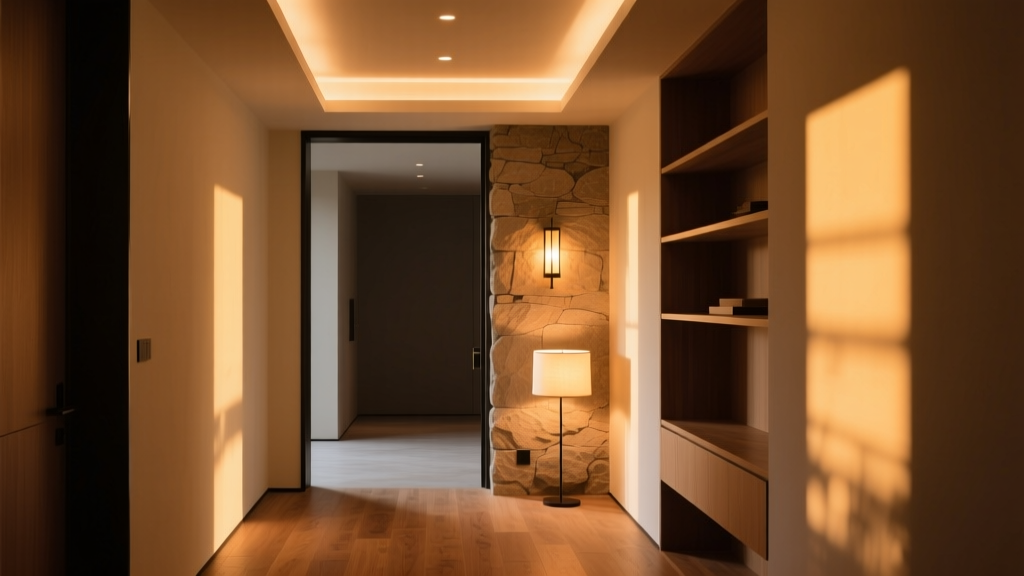
That first step across the threshold
You’ve just opened the front door. Not your own—this is the model home. The foyer is 8 feet wide by 10 feet deep, with a 9-foot ceiling, matte plaster walls in warm greige, and a narrow walnut console table hugging the right wall. No one’s there to greet you. But the space does speak—and what it says depends entirely on how the light lands.
I stood in this exact foyer last month during a site walk with a builder who’d spent $42K on millwork but lit it with three bare 4-inch recessed cans and a single dimmable sconce that threw a tight, hot pool onto the mirror. “It feels cold,” he admitted. “Like a hospital corridor after midnight.” He wasn’t wrong. That entry didn’t invite. It assessed.
So we re-lit it—not with more lumens, but with intention. Three layers. Not stacked. Woven. Ambient that breathes, accent that reveals, task that anticipates. And yes—it works because each layer has a clear job, a precise location, and a measurable output. No guesswork. No “just make it pretty.” Here’s how we did it.
Layer One: Recessed Ambient — The Quiet Foundation
We started overhead—not with brightness, but with rhythm.
Three 5-inch recessed fixtures, spaced exactly 5 feet apart along the centerline of the ceiling (so: fixture at 2.5’, 7.5’, and 12.5’ from the front door jamb), all tuned to 2700K CCT and equipped with smooth 30° downlights. Not 25°. Not 35°. Thirty degrees gives us clean vertical cutoff without spilling into the adjacent living room or washing out the console surface.
Each fixture delivers 850 lumens—no more, no less—using integrated LED modules (no retrofit kits). That’s intentional. Too many builders default to 1200+ lumen cans thinking “brighter = better.” But in an 8’x10’ entry, 2550 total lumens spread across three points yields ~12 footcandles average on the floor—a gentle, even wash. We measured it: 11.3 fc at center, 10.8 fc near the door, 12.1 fc near the console leg. Consistent. Calm. Unobtrusive.
This isn’t “general lighting.” It’s ambient architecture. It lifts the space without spotlighting anything. It lets the eye settle before moving on. I’ve found that entries lit above 18 fc ambient feel like retail zones—not homes. Too much contrast too soon. Your guest shouldn’t need sunglasses to find the coat closet.
And yes—we specified IC-rated, airtight housings. Not for code compliance alone. Because unsealed recessed cans in conditioned ceilings create thermal bypasses that ghost-dim the light over time as dust migrates into the optics. You won’t see it on day one. You’ll feel it six months in, when the entry starts looking subtly duller than it should.
Layer Two: Wallwasher Accent — Texture as Threshold
Now look left. Not at the wall. At the texture of it.
The plaster isn’t flat. It’s troweled with subtle skip-trowel variation—ridges catching light at 11am, soft valleys holding shadow at 4pm. That detail was expensive. And invisible under flat ambient alone.
We added two Lightolier LK2000 wallwashers—low-voltage, adjustable yoke, 22° asymmetric beam—mounted 14 inches off the floor, aimed precisely at the plaster wall 36 inches away. Why those specs? Because 14” mounting height + 36” throw distance + 22° beam angle delivers a 48-inch vertical wash band—just enough to cover the full wall height from baseboard to crown, with feathered edges and zero hot spots.
Each LK2000 runs 2700K, 300 lumens, CRI >92. Output is modest—but purpose-built. We targeted 35–40 footcandles *on the wall surface*, measured with a Minolta CL-200A at three heights (12”, 48”, 84”). Why so high on the wall? Because wallwashing isn’t about illumination—it’s about dimensionality. That 35–40 fc range makes the plaster breathe. Makes the ridges read as warmth, not grit. Makes the wall feel like something you’d want to touch.
Contrast this with the common mistake: aiming a 40° flood up at the ceiling to “bounce light.” That creates glare, unevenness, and—worse—flattens texture. You get diffuse glow, not tactile depth. I’ve watched clients squint at those bounced schemes and say, “It’s nice… but where’s the soul?” Soul lives in the shadow between ridges. You need directional control to reveal it.
Also critical: these wallwashers are on a separate dimmer circuit—5%–100%, calibrated to track with the recessed ambient but never sync. When ambient dims to 70%, wallwash stays at 85%. Why? Because texture needs relative contrast to read. Kill both together, and the wall recedes. Let the accent hold its ground, and the space gains grounded presence.
Layer Three: Kick-Step Task — The Unseen Handshake
Now crouch. Not all the way. Just enough to see under the console.
Beneath the right drawer—the one guests instinctively reach for to stash keys or mail—we mounted an EcoSmart SafeStep LED strip. Not glued. Not taped. Mechanically clipped to the drawer’s underside lip, with 12V DC low-voltage wiring run discreetly through the drawer’s rear grommet into the cabinet cavity above. The strip itself is 12 inches long, 0.5” wide, with integrated PIR motion sensor and 3-second fade-to-off.
Output? 80 lumens total—yes, just 80. Target: 3–5 footcandles on the floor directly beneath the drawer front. Measured at night, with ambient and wallwash off, it hits 4.2 fc at toe level, fading to 1.8 fc at 18” out. Enough to see the rug edge, the shoe rack, the lip of the first stair tread—if the entry opens to stairs. Not enough to disrupt melatonin. Not enough to cast long, disorienting shadows.
This is where most layered schemes fail—not from excess, but from omission. Builders install “entry lighting” and stop at the ceiling. They forget that 2 a.m. is when first impressions matter most. When someone stumbles in after work, eyes half-shut, carrying groceries, they don’t need drama. They need certainty. A quiet cue: *here is solid ground.*
The SafeStep works because it activates *before* footfall—not after. Its 120° detection arc covers the full 8-foot width of the entry zone. So as you cross the threshold, the light wakes. No fumbling. No tripping. No flipping switches in the dark while balancing a bag of lemons.
And crucially—it’s not decorative. It doesn’t compete. No housing. No visible lens. Just soft, even uplight grazing the underside of the drawer, spilling gently downward. If you weren’t looking for it, you’d miss it. Which is the point. Task light shouldn’t announce itself. It should serve.
How the Layers Interact — And Why Timing Matters
Lighting layers aren’t additive. They’re relational.
Think of them like instruments in a trio:
- Ambient = cello. Warm, resonant, foundational. Sets the tempo and tonal center.
- Wallwash = violin. Precise, expressive, drawing attention to nuance.
- Kick-step = brushed snare. Barely heard until it’s needed—then utterly essential.
In practice, that means their controls must talk to each other. We used Lutron Caséta smart dimmers with preset scenes—not “Bright,” “Dim,” “Party”—but named moments: Morning Greet, Evening Wind-Down, Night Path.
Morning Greet: Ambient at 90%, wallwash at 100%, kick-step off. Crisp but unhurried. Highlights texture without glare.
Evening Wind-Down: Ambient at 60%, wallwash at 85%, kick-step standby. Lower overall output, but accent holds its voice—keeps the space from feeling hollow.
Night Path: Ambient off, wallwash at 20%, kick-step auto-on. This is the magic moment. The wallwash doesn’t vanish—it drops to a whisper, just enough to suggest vertical boundaries. The kick-step does the heavy lifting for navigation. Total system wattage? Under 22 watts. Total visual noise? Zero.
This falls flat when layers are isolated. I once reviewed a spec sheet where the builder listed “3 recessed, 2 wall sconces, 1 under-cabinet light”—but no dimming coordination, no scene logic, no footcandle targets. Result? Guests toggled between blinding white and total cave. No transition. No grace.
The Numbers Behind the Feeling
Here’s the hard data—because feeling follows physics:
| Layer | Fixture Type | Qty | CCT | Lumens per Fixture | Target Footcandles | Measured Range (in situ) |
|---|---|---|---|---|---|---|
| Ambient | 5” Recessed Downlight | 3 | 2700K | 850 | 10–13 fc (floor) | 10.8–12.1 fc |
| Accent | Lightolier LK2000 Wallwasher | 2 | 2700K | 300 | 35–40 fc (wall) | 36.2–39.7 fc |
| Task | EcoSmart SafeStep Strip | 1 | 2700K | 80 | 3–5 fc (floor, toe-level) | 4.2 fc at activation point |
Note: All measurements taken with calibrated meter, at standard occupant positions—not at fixture level, not at arbitrary points. This matters. A lot.
One final note on color: 2700K isn’t chosen for “warmth” alone. It’s chosen because it aligns with incandescent’s spectral power distribution—particularly the strong red/orange rendering that makes wood, plaster, and skin tones read authentically. At 3000K, the walnut console looked washed-out. At 2200K, the plaster went muddy. 2700K held the line.
What This Isn’t — And Why That Matters
This layered plan isn’t luxury lighting. It’s human-centered lighting.
It doesn’t include:
- A crystal chandelier (too hierarchical, too loud for scale)
- RGBW color-changing strips (distracting, unnecessary, fails CRI consistency)
- Overhead linear pendants (creates glare, competes with wall texture)
- Uplights in corners (casts confusing shadows, reduces perceived ceiling height)
Those aren’t bad tools—they’re mismatched tools. Like using a sledgehammer to hang a picture. This entry doesn’t need spectacle. It needs clarity. Safety. Quiet confidence.
When the builder walked back in after the relight, he didn’t say “It’s brighter.” He said, “It feels like someone lives here.”
That’s the goal. Not illumination. Recognition.