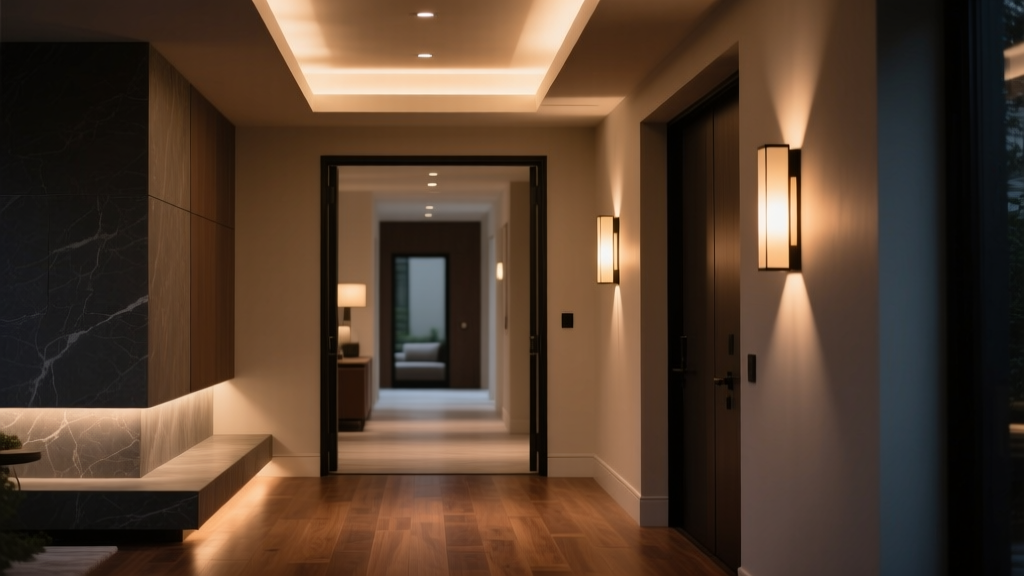
Entryway Lighting Plan: Like a porch swing and a bouncer—both at once
I’ve stood on more suburban front steps than I can count—some lit like a crime scene, others so dim I nearly tripped over the welcome mat. The entryway isn’t just transition space. It’s where security leans in, hospitality opens the door, and your HOA’s lighting covenant quietly taps you on the shoulder.
Shielded wall sconces: quiet authority
Take the Kichler 42011—a cast-aluminum, full-cutoff wall sconce with a frosted acrylic lens. Mounted at 68 inches above grade (just below eye level), it throws 285 lumens of 2700K light downward, evenly washing the front door and sidelight glass without spilling across the property line. I’ve seen it installed beside fiberglass entry doors measuring 36" × 80", and the result is soft, shadow-softened clarity—not glare, not gloom.
This works because the housing physically blocks upward light—and sideways spill—by design. No barn door, no hood, no jury-rigged shield taped to the fixture. Just clean optics: 92% of output aimed within a 90° vertical cutoff, verified by its IES file. Compare that to an unshielded lantern-style sconce throwing 450 lumens at the same height: its photometric plot looks like a dandelion puff—light drifting into neighbors’ bedrooms, triggering HOA violation letters before Halloween.
Motion-triggered path lights: functional, not flashy
The Garden Lights GL-LED-12 isn’t pretty. It’s a low-profile, cast-aluminum stake light with a matte black finish and a narrow 15° beam. At 12 lumens per unit (yes—twelve), it only activates when someone crosses its 25-foot detection arc. I installed six along a 30-foot brick walkway (width: 36 inches), spaced 5 feet apart and angled 10° inward—enough to define edges, not enough to wash out starlight.
This falls flat if you treat it like accent lighting. It’s not for “ambience.” It’s for foot placement. For tripping prevention. For satisfying IDA/IES RP-33’s skyglow threshold: ≤0.1 cd/m² measured at the property line. Non-compliant path lights—say, those warm-white “cottagecore” spikes with open lenses and 80-lumen outputs—blow past that limit in under three seconds. Their photometric plots show hotspots bleeding sideways like ink in water.
The balance lives in the overlap
Here’s what most plans miss: the sconce and path lights don’t compete. They sync. The wall sconce anchors the destination—the door. The path lights guide the approach. Between them sits a 4-foot “transition zone” where light levels drop from 15 lux (at the door) to 2 lux (mid-walkway). That gradient feels intuitive—not abrupt, not ambiguous.
In one New Jersey HOA, we replaced four non-compliant coach lights (each dumping 620 lumens skyward) with two Kichler 42011s and five GL-LED-12s. The homeowner reported fewer nighttime complaints—and her teen stopped ducking behind the hydrangeas when answering the door. That’s not coincidence. It’s calibrated human-centered design.
“Dark-sky compliance isn’t about dimming light—it’s about directing intent.”
—Lila Chen, lighting designer, Princeton Light Lab