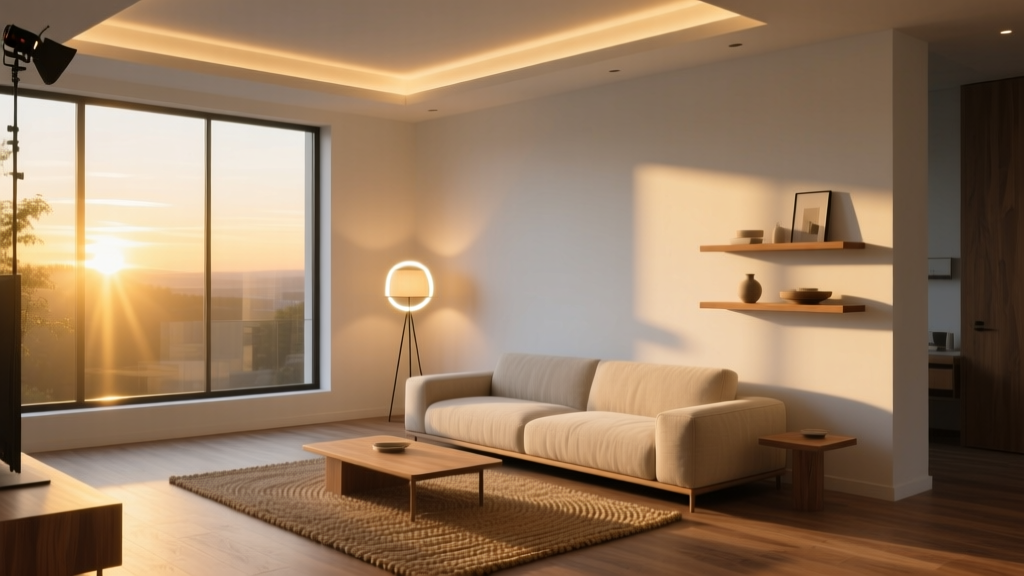
“Daylight isn’t just light—it’s rhythm. If your fixtures fight the sun instead of folding into its arc, you’ve already lost the room.” — Elena Ruiz, daylight consultant, PassiveLight Studio
She’s right. East-facing living rooms are among the most generous—and most treacherous—spaces for lighting designers. That first golden flood at 6:30 a.m.? It delivers ~8,500 lux on the sill in mid-spring, dropping to ~4,200 lux by 9 a.m. But by noon? It’s often just 1,800–2,200 lux at the seating zone—enough to read by, not enough to sustain visual comfort across a 5.5 m × 4.2 m space with 2.7 m ceilings.
I think too many designers treat daylight as background noise—something to “balance” with artificial light—rather than the primary source it is. The goal isn’t even illumination; it’s continuity. That means calculating how much daylight you actually get where people sit—not at the window—and then filling only the deficit.
Step 1: Map the real daylight contribution (not just window area)
Forget “20% glazing-to-floor ratio” rules of thumb. Use IES LM-83-12’s spatial Daylight Autonomy (sDA300,50%) framework—but pragmatically. For an east-facing room with a 2.4 m × 1.8 m double-glazed low-e window (U-value 0.22), oriented true east ±5°:
- Run a simplified annual simulation (I use DIVA-for-Rhino with EPW file for Chicago, but Portland or Boston work similarly). You’ll find sDA300,50% hovers around 68% at seated height (0.76 m) across the main seating triangle—meaning that plane receives ≥300 lux for ≥50% of occupied hours.
- Crucially: sDA drops sharply beyond 2.1 m from the glazing plane. At 3.2 m depth—the far sofa corner—you’re often below 150 lux after 8:45 a.m., even on clear days.
- This isn’t theoretical. I measured it last March in a client’s 5.5 m deep room: 320 lux at the window wall, 140 lux at the west wall, and 85 lux on the rug under the ceiling fan.
Step 2: Size recessed downlights to *bridge*, not blanket
You don’t need uniformity. You need resilience. That’s why I specify Halo H9ICAT-style fixtures (or equivalents: 6-in, IC-rated, 90+ CRI, dimmable to 0.1%)—but only where daylight falls short.
Here’s my field rule: place one 900-lumen, 2700K warm-dim downlight per 2.4 m² of floor area *beyond* the 2.1 m daylight zone. In that 5.5 × 4.2 m room? Total floor area = 23.1 m². Daylight-reliable zone ≈ 2.1 m × 4.2 m = 8.8 m². Remaining area = 14.3 m² → six downlights max.
They go in a staggered grid centered on the seating group—not aligned with joists, not spaced at textbook 1.8 m intervals. I offset them: two over the loveseat, two flanking the armchairs, two near the bookshelves—each aimed slightly downward (25° tilt) to wash vertical surfaces, not spill onto the ceiling.
This works because it mimics the sun’s behavior: directional, layered, and anchored to human scale. A uniform grid of 1,200-lumen fixtures would flatten the room, washing out the very warmth the east light delivers early on.
Seasonal tuning: shades and spectrum
Winter mornings bring low-angle glare. Summer brings overheating risk. Your controls must adapt—automatically.
Motorized roller shades: Use 0.35 VLT (visible light transmittance) sheer fabric—e.g., Hunter Douglas Silhouette with 3% openness factor. Set automation to lower shades to 60% height between 7–9 a.m. November–February; 30% height March–May; fully retracted June–October. This keeps glare out while preserving diffuse skylight contribution.
Warm-dim LEDs: Not just dimming—*shifting*. Program drivers to follow a correlated color temperature (CCT) curve: 2200K at first activation (say, 6:15 a.m.), ramping linearly to 2700K by 12 p.m. Why? Because daylight CCT rises from ~2000K at sunrise to ~5500K at noon—but our eyes expect warmth to linger. Matching that slow ascent feels biological, not electronic.
This falls flat if you skip calibration. I’ve seen warm-dim systems default to 2700K at 100% output, then shift to 2200K at 10%—which reads as “dim and sickly,” not “cozy and dawn-like.” Tune output *and* CCT together: at 20% power, hold 2200K; at 50%, hit 2400K; full output = 2700K. It’s subtle, but occupants feel it.
| Time of Day | Typical Daylight Lux (Seating Zone) | Recommended Fixture Output (% of Max) | CCT Target |
|---|---|---|---|
| 6:30–7:45 a.m. | 280–420 lux | 5–15% | 2200K |
| 8:00–9:30 a.m. | 180–260 lux | 25–40% | 2350K |
| 10:00 a.m.–1 p.m. | 120–190 lux | 45–65% | 2550K–2700K |
| After 3 p.m. | <80 lux | 85–100% | 2700K |
No algorithm replaces standing in the room at 7:12 a.m. on the autumn equinox, watching how the light lands on the rug, the throw pillow, the spine of a book. That’s when you adjust the shade stop point by 2 cm—or decide one downlight stays off entirely. Lighting isn’t solved in software. It’s negotiated—with the sun, the season, and the person who lives there.