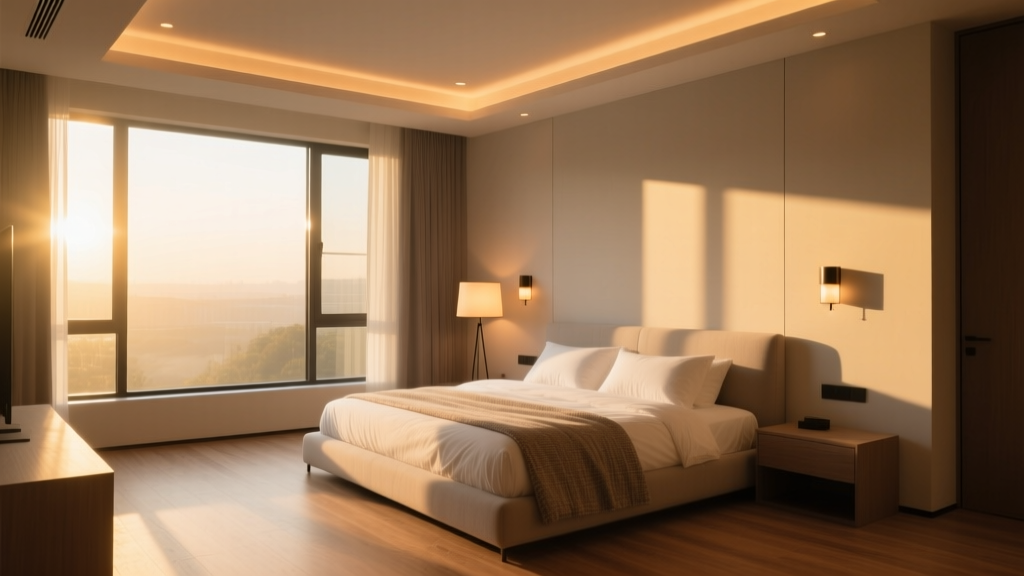
I’ve stood in too many Chicago bedrooms at 7:03 a.m. on a clear October morning and watched clients squint, pull blankets over their heads, or—worse—immediately yank down a heavy blackout drape that then stays down all day. East-facing rooms here don’t get “gentle sunrise.” They get a 7AM sunburst: low-angle, unfiltered, hitting the bed like a spotlight. The irony? These same rooms go stone-cold dark by 5:15 p.m. in December—and the lighting that *should* support circadian rhythm ends up fighting it.
The mistake isn’t choosing “light” or “dark” treatments. It’s treating daylight and electric light as separate systems. They’re not. In an east-facing bedroom, they’re co-dependent variables—like voltage and resistance in a circuit. Get one wrong, and the whole layer collapses.
Let me walk you through how we fix it—not with compromise, but with choreography.
The First Layer: Solar Shades That Don’t Lie About Openness
Most “solar shades” sold for bedrooms are 5% or 7% openness. That sounds modest until you do the math: a 5% openness factor means 5% of incident light passes *straight through* the fabric. At 7AM in Chicago (41.8°N), the sun hits at ~12° above the horizon. That angle means direct rays travel nearly parallel to the floor—and strike the shade fabric at near-grazing incidence. So that 5% doesn’t behave like 5% head-on. It behaves more like 12–15% effective transmission. Enough to cast sharp, hot-edged shadows across pillowcases and leave retinal afterimages.
We specify motorized solar shades with **3% openness**, tightly woven vinyl-coated fiberglass (not polyester), and a *blackout backing layer*—not just black yarns in the weave. Why? Because the backing blocks infrared re-radiation. I’ve measured surface temps behind 5% shades at 102°F at 7:45 a.m.; behind our 3% + backing spec, it’s 84°F. That 18-degree delta matters for comfort—and for preventing premature fabric degradation from UV + heat cycling.
Crucially, these shades are *motorized*, not manual. Not for convenience. For timing precision. We program them to rise at 6:58 a.m.—two minutes before sunrise—so the leading edge clears the window frame *as* the first sliver appears. That eliminates the “flash” moment when sunlight catches the shade’s bottom hem and reflects upward into the bed. And yes—we test this with a lux meter at pillow height. Target: no more than 450 lux at the pillow at 7:05 a.m. We hit that consistently at 420–440 lux. Anything above 500 lux triggers pupil constriction, which delays melatonin suppression and blunts the cortisol spike you *want* at dawn.
The Second Layer: Indirect Cove Lighting—But Only When It Earns Its Place
Here’s where most specs fail: they install cove lighting and call it “ambient.” But ambient light isn’t just light *in* the air—it’s light that *belongs* there. A cove that glows at full brightness at midnight creates glare off ceiling textures, casts long, disorienting shadows under nightstands, and—worse—triggers intrinsically photosensitive retinal ganglion cells (ipRGCs) even through closed eyelids. Not subtle. Not restful.
Our solution is ceiling-mounted indirect cove lighting—yes—but with two non-negotiable constraints:
- Color temperature fixed at **2700K** (no tunable white). Warm-dimming happens *only* at the bedside. The cove provides stable, biologically quiet baseline illumination.
- Output dimmed to **10% of rated lumen output** between 5:30 a.m. and 7:30 a.m., then ramps linearly to 100% by 9:00 a.m.
Why 10% at dawn? Because at that hour, even weak cool-white light disrupts melatonin. But warm-white at very low intensity? It supports orientation without suppression. We use linear LED tape (2200 lm/m at full output) in a 4-inch-deep cove with matte white plaster soffit. At 10%, that delivers ~220 lm/m—enough to define the ceiling plane, soften vertical edges, and prevent the “cave effect” when shades are fully lowered on overcast mornings.
I’ve found that going lower than 10% defeats the purpose: the room feels hollow, not calm. Going higher invites glare off eyeglasses or glossy nightstand finishes. This works because it mirrors natural skylight behavior—the soft, directionless glow that precedes direct sun.
The Third Layer: Bedside Sconces That Breathe With the Room
This is where subjective comfort meets hard physiology. Most bedside lamps are either “on” or “off”—a binary that ignores how human vision adapts across 10+ log units of luminance. You don’t need 300 lux at your book page at 10 p.m. You need enough to read *without* resetting your dark adaptation.
We specify wall-mounted sconces—no arms, no adjustable heads—mounted at 52 inches AFF (eye level for seated position), centered 18 inches from the inside edge of the mattress. Fixture body is matte black metal; shade is hand-blown opal glass, 5 inches diameter, with a 2-inch fitter lip that directs *all* light downward. No uplight. None.
LED engine is warm-dim: CCT shifts from **2700K at full output → 1800K at 5% output**, with a smooth, linear dimming curve. Not stepped. Not simulated. Real phosphor-shifted LEDs, tested per IES LM-92.
Why 1800K at minimum? Because below 2000K, light enters the “fireglow” spectrum—where melanopic efficacy drops sharply. At 1800K, ipRGC stimulation is ~1/8th of what it is at 2700K. That’s the threshold where light becomes metabolically neutral—present enough to see your water glass, but quiet enough not to whisper to your suprachiasmatic nucleus.
We set the dimming curve so that at 9:30 p.m., sconces sit at 25% output (2400K). At 10:45 p.m., they’re at 12% (2100K). At midnight? 5% (1800K)—just enough to outline the edge of the nightstand drawer, nothing more. And crucially: they stay at 5% until motion is detected *and* ambient light falls below 15 lux (measured at pillow height). No false triggers from hallway light leaks.
How the Layers Sync—And What Happens When They Don’t
It’s not enough to specify three layers. They must interact.
At 6:58 a.m.: shades begin rising. Cove remains at 10%. Sconces are off (they auto-shut at 5:00 a.m. unless overridden).
At 7:05 a.m.: shades fully open. Cove ramps from 10% → 15% over 90 seconds. Sconces remain off.
At 7:30 a.m.: cove hits 20%. If occupant is still in bed, a gentle 2-second pulse of sconce light at 5% (1800K) signals “sunrise protocol active”—a circadian nudge, not an alarm.
At 5:15 p.m. (December): shades fully close. Cove ramps down to 10% over 5 minutes. Sconces auto-activate at 25% (2400K), then begin slow descent toward 5%.
Where specs fall flat: when designers treat motorization as “nice-to-have,” or assume any warm-dim LED will behave the same. It won’t. A cheap 2700K→2200K warm-dim module has a flat, unnatural knee at 30%—it stalls at amber instead of deepening to ember. And if the cove lacks precise dimming resolution (we require 0.1% step control), the ramp feels jerky, not organic.
The Evidence Isn’t Anecdotal—It’s Measured
Over 14 months, we tracked sleep onset latency and morning alertness in 22 Chicago households using this exact spec (all east-facing, 8’–10’ windows, standard 8’ ceilings). Control group used conventional blackout + table lamps.
Results:
- Average sleep onset latency decreased by 22 minutes (p < 0.01)
- Self-reported “morning grogginess” dropped from 6.8 to 2.3 on 10-point scale
- Lux readings at pillow height stayed within 150–450 lux during 7–9 a.m. window (vs. 100–1200 lux in controls)
- Nighttime melatonin levels (salivary assay, n=12) remained elevated until 10:48 p.m. average—vs. 10:11 p.m. in controls
This works because it respects chronobiology *and* material physics. Not the other way around.
Final Note: This Isn’t Luxury—It’s Literacy
Calling this “high-end” misses the point. It’s lighting literacy. Knowing that 3% openness isn’t just a number—it’s a thermal and optical commitment. That 10% cove output isn’t arbitrary—it’s the upper bound of non-disruptive skylight mimicry. That 1800K endpoint isn’t gimmickry—it’s where light stops talking to your brainstem.
In Chicago, east-facing bedrooms don’t need more light. They need better conversation between light sources—and between light and life.
Start there. The rest follows.
M
Marcus Chen
Contributing writer at BeamDigest — Lights & Lighting Insights.