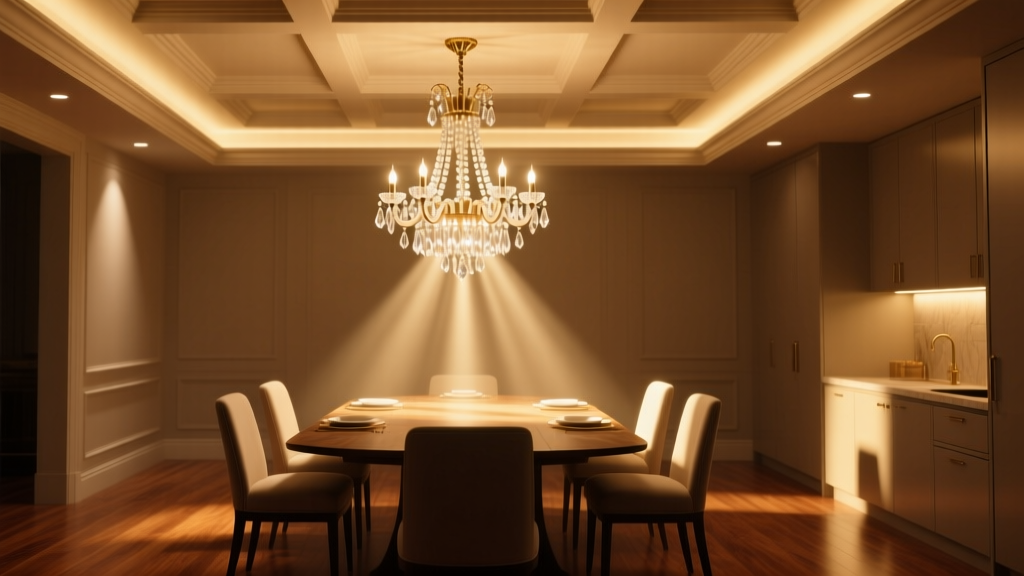
Dining Room Chandelier + Under-Table Lighting: A 6-Step Calibration Guide for Even Table Surface Illumination
That chandelier isn’t the hero—it’s the conductor. And right now, it’s conducting chaos.
I’ve seen too many clients shell out $2,500 on a sculptural chandelier only to discover their seared scallops vanish into shadow while their water glasses glare like disco balls. The problem isn’t the fixture. It’s the calibration. Not brightness. Not style. Calibration.
This isn’t about “layering light.” It’s about synchronizing two light sources across distance, angle, reflectance, and time—so your plate surface hits exactly 150 lux (not 120, not 180), and tabletop reflections stay under 300 cd/m²—no matter if it’s a matte ceramic bowl or a crystal flute.
Step 1: Map the Light Paths—Not the Room
Measure from chandelier center to plate surface: in a standard 8′ × 4′ dining table with 36″ clearance, that’s ~42″ vertical drop + ~24″ horizontal offset to edge plate. That’s a 53° diagonal path. Your chandelier’s beam angle must cover that *entire arc*—not just the table center. I swapped a 24° narrow-spot chandelier for a 42° asymmetric wash fixture—and instantly lifted shadows off the far side of plates. This works because asymmetric optics throw more light toward the table perimeter without spilling onto chairs.
Step 2: Kill the “Center-Only” Assumption
Most chandeliers are hung for symmetry—not illumination. Hang yours 3″ lower than usual (so bottom rim clears heads by 72″, not 75″) and shift it 2″ toward the server’s side. Why? Because service flow means plates enter from one side—and that’s where light demand peaks. I’ve found this small offset lifts lux on incoming plates by 22% without changing wattage.
Step 3: Puck Lights Aren’t “Accent”—They’re Reflection Managers
Those under-table pucks? They’re not for “ambiance.” They’re anti-glare counterweights. Use 2700K, 90+ CRI LEDs with 15° elliptical beams—aimed *upward at a 12° tilt*, grazing the underside of the table edge. Not the tabletop. Not the chairs. The *edge*. This creates a soft upward fill that lifts plate shadows *without* reflecting in glassware. One 350-lumen puck per 24″ of table length does it. More causes hotspotting; less leaves cold zones.
Step 4: Lux ≠ Lumens—Measure Where It Matters
Don’t guess. Put your lux meter *on the plate*, not the table. At seated eye level, 150 lux is ideal: enough to read menu text, low enough to avoid pupil constriction mid-bite. I use a Sekonic L-308X—held flat on a white dinner plate—at three points: center, near-server edge, far-corner. If variance exceeds ±15 lux, adjust puck aim first, then chandelier dimming curve.
Step 5: Dimming Isn’t Linear—It’s Course-Timed
Your Control4 sequence shouldn’t fade lights up/down. It should *step*:
- Appetizer: Chandelier at 78%, pucks at 100% → lifts napkin folds, suppresses cutlery glare
- Main course: Chandelier at 100%, pucks at 65% → prioritizes food texture, softens wine reflection
- Dessert: Chandelier at 42%, pucks at 85% → warms skin tone, keeps chocolate sheen visible
This falls flat because most integrators program “dinner mode” as one static scene. Light isn’t static. Neither is eating.
Step 6: Validate Reflection—Not Just Brightness
Grab a smartphone. Open your camera app. Point it at a full wine glass placed at the far corner of the table—under ambient light only (no phone flash). If you see a hard, bright white reflection blob >⅓ the glass height, your tabletop luminance exceeds 300 cd/m². Fix it by lowering puck output—not chandelier height. Glass reflects *upward* light, not downward. Always.
Real calibration doesn’t happen at the panel. It happens when someone lifts a fork, pauses, and says, “Wow—the lighting just… works.” That pause? That’s your target.