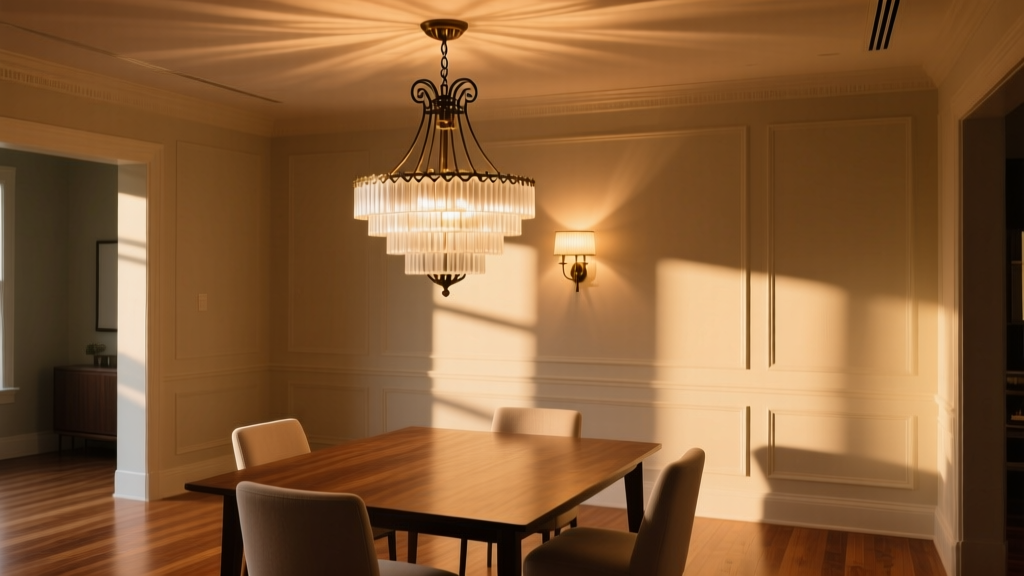
“Shadow Chin” Isn’t a Lighting Problem—It’s a Lighting *Omission*
I used to think “just add a chandelier” was enough for dinner lighting. Then I hosted a friend who squinted at her wine glass like it held classified intel—and asked, deadpan, “Is my jawline hiding?” Turns out: yes. And it wasn’t her jaw. It was my 36-inch-wide, single-source, 1500-lumen, 2700K chandelier hanging exactly where the design blog said to: 30 inches above the table. That’s when I learned: unflattering facial shadows at dinnertime aren’t caused by bad fixtures. They’re caused by *missing layers*—specifically, the absence of soft, upward-aimed fill light near eye level.The Fix (in One Real Dining Room)
My own dining space is 12’ x 14’, with an 8’ ceiling and a standard 30”-high table. We eat most nights around 6 PM—right when ambient light bleeds out and overhead-only lighting throws deep, downward ruts under cheekbones and chins. Here’s what finally worked:- Chandelier: Hudson Valley Lighting’s Savoy (small, 2-light version), hung 30” above tabletop → delivers 1,200 lumens of warm 2700K downlight with a tight 15° beam spread. This isn’t ambient—it’s *focused*. It lights the plates, not the faces.
- Wall Sconces: Visual Comfort’s E.F. Chapman “Pivot” sconce, mounted at 60” AFF (eye-level for seated guests), angled slightly upward → emits 450 lumens of 2900K light with a wide 36° flood beam. Half the light bounces off the ceiling; half grazes the wall and wraps gently across shoulders and faces.
This combo doesn’t “balance” light—it stages it. The chandelier anchors the meal; the sconces lift the people.
Why 2700K + 2900K Works (and Why Matching CCTs Don’t)
I tried matching both to 2700K first. Result? Flat, monotonous warmth—like eating inside a toaster oven. The subtle 200K shift in the sconces adds perceptible depth: the chandelier feels like candlelight on silverware; the sconces feel like late-afternoon sun catching dust motes mid-air. It’s not about color accuracy—it’s about hierarchy. Warmth needs variation to read as dimensional, not just dim.The “Shadow Chin” Test (Do This Before You Buy)
Sit at your table at 6 PM. Turn off all lights except your planned chandelier. Look in a phone camera selfie. If your chin vanishes into a black wedge—yes, that’s shadow chin. Now add one sconce at 60” AFF, aimed up at a 30° angle. Still dark? Add the second. You’ll feel the difference before you see it—the room stops feeling like a stage spotlight and starts feeling like a conversation.I’ve found that anything below 55” AFF leaves a gap between forehead and collarbone. Anything above 62” creates glare or misses the face entirely. And if your sconce beam is narrower than 30°? It becomes a spotlight again—just a quieter one.
Pro tip: Skip “dimmable-only” sconces. You need independent dimming. My chandelier runs at 70% brightness; my sconces run at 100%. That ratio changes nothing about the light quality—but everything about how present everyone feels at the table.