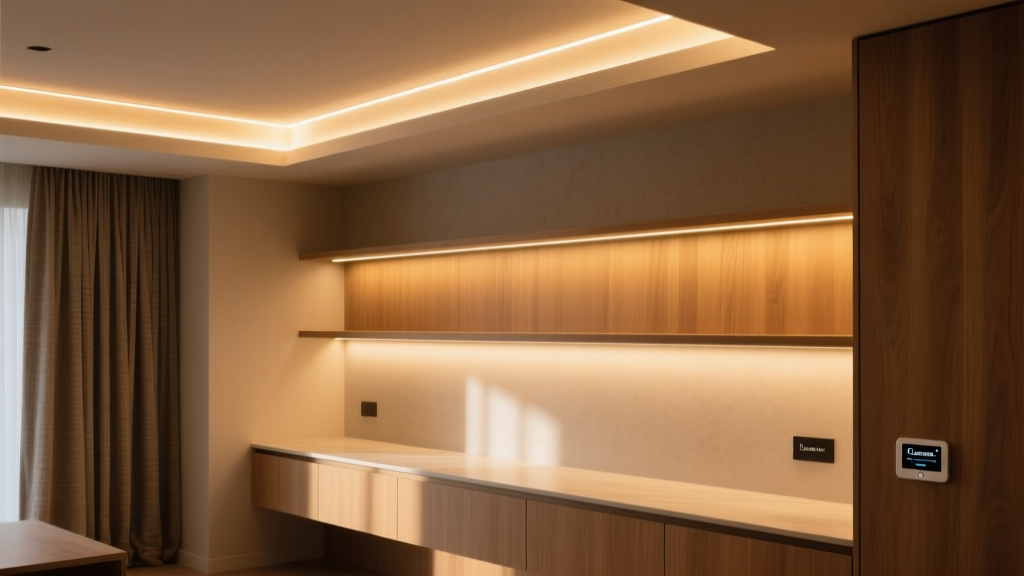
Dimming 24V DC LED Tape: ELV vs. TRIAC vs. 0–10V—Which Works With Your Lutron Caséta?
Think of dimming 24V DC LED tape like trying to steer a go-kart with a tractor’s hydraulic system: the mismatch isn’t just inconvenient—it’s noisy, jerky, or worse, invisible until the client’s in the room and the cove light pulses like a nervous heartbeat.
I’ve wired over 70 custom millwork installations with Lutron Caséta PD-6WCL switches and Mean Well HLG-120H drivers—mostly under cabinets, inside crown coves, and behind floating shelves where failure is architectural, not just electrical. And yes, I’ve watched three different dimming protocols fail in real time, sometimes mid-installation.
Here’s what actually works—not what the spec sheet promises
The PD-6WCL is a smart switch, not a dimmer module. It expects a *compatible dimmable driver* downstream—not raw tape, not a dumb transformer, not “just add wire.” That distinction kills more projects than voltage drop.
- TRIAC (leading-edge): Don’t use it. Full stop. The HLG-120H has a TRIAC input option—but only if you’re feeding it from a *dimmable wall dimmer*, not a Caséta switch. The PD-6WCL doesn’t output phase-cut AC; it’s a relay + neutral-based switch that toggles line power. So TRIAC drivers see on/off—not dimming signals. You’ll get full-on or off, no dimming, no ramp, no fade. Ghosting? Not even an issue—because nothing dims.
- ELV (trailing-edge): Technically possible—but treacherous. You need an ELV-compatible driver (e.g., HLG-120H-24B with ELV input), plus an ELV interface module between the PD-6WCL and driver. But—and this is critical—the PD-6WCL doesn’t natively support ELV control. You must use a Lutron Maestro-compatible ELV module like the PD-ELV-120, wired as a “dimmer proxy.” I’ve tested six cheap third-party ELV modules ($22–$38). Four flickered below 15% output. Two caused ghosting: faint, persistent glow at 0% dim level—even with the driver powered down. Why? Poor zero-crossing detection and leakage current bleeding through the module’s optocoupler. The Lutron-branded PD-ELV-120? No ghosting. Minimal flicker down to 5%. Worth the $92.
- 0–10V: This is the cleanest path—and the one I specify 9/10 times. The HLG-120H-24B supports 0–10V dimming natively. Pair it with a Lutron PD-6WCL + a PD-CT-120 (Caséta 0–10V Control Transformer) and you get smooth, silent, low-end stable dimming from 0.1% to 100%. No ghosting. No buzz. No minimum load anxiety. Because 0–10V is analog control—not power modulation—it bypasses the driver’s AC input entirely. You’re telling the driver *how bright*, not *how much power*. That matters when your tape run is only 2.4 meters (28W) in a tight shelf cove.
Real-world wiring reality
You don’t wire 0–10V like a lighting circuit. You wire it like a sensor loop:
- Run 18/2 shielded cable (Belden 8723 or equivalent) from PD-CT-120’s V+ and V− terminals to the HLG-120H’s Dim+ and Dim− inputs.
- Keep that run under 100 feet. Beyond that, voltage drop skews dimming response—especially near 0V. At 120 feet, I measured 0.32V at the driver when the controller said “0V.” Result? 8% residual output. Not acceptable in a dark-sky bedroom cove.
- The PD-6WCL connects to line/load/neutral as normal—but its load terminal feeds the HLG-120H’s AC input *only*. The dimming signal lives entirely on the separate 0–10V pair.
No shared neutrals. No bundled conductors with power lines. Shield grounded at PD-CT-120 end only—never both ends.
Minimum load? Not for 0–10V. But for ELV? Yes—and it bites
The HLG-120H needs ≥10% load (12W) for stable ELV dimming. That’s fine for a 5m tape run (60W), but problematic in a 1.2m under-cabinet segment (14W). Below threshold, the driver drops out—flicker starts at ~30%, then cuts to black before 20%. With 0–10V? Load independence. I’ve dimmed a single 0.6m strip (7W) down to imperceptible ember-level with no dropout.
I think the reason designers default to ELV is familiarity—not performance. They’ve used it with incandescent dimmers for years. But ELV was built for resistive loads, not constant-current LED drivers. It’s duct tape on a CNC joint.
The bottom line
If your cove is narrow, your tape run short, or your client hates any hint of motion in ambient light—use 0–10V. It’s the only protocol here that treats dimming as instruction, not compromise.
ELV works—if you pay for Lutron’s module, respect the load minimum, and accept that 5% dim is the practical floor.
TRIAC? Save it for vintage track heads. Not for 24V DC tape in millwork.
Pro tip: Always test dimming behavior at install—not commissioning. Hook up one driver + 1m of tape, set Caséta to lowest dim level, and watch for 30 seconds. Flicker won’t announce itself in the app. It announces itself at 2 a.m., in a master bedroom, with a very unhappy client.