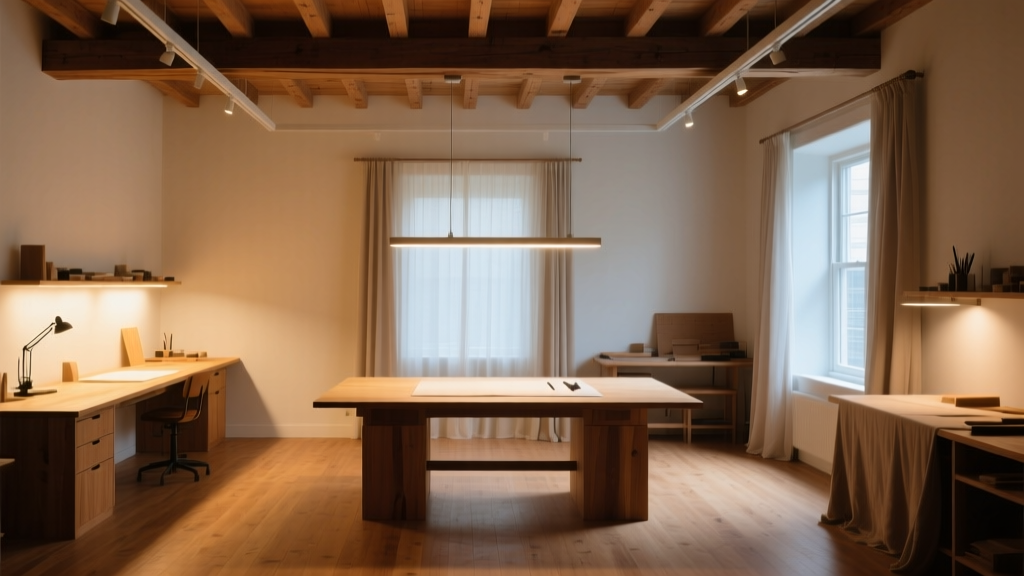
White light isn’t neutral—and cramming all your craft lighting into one color temperature is like mixing watercolor pigments in the wrong order: you’ll get mud, not clarity.
I’ve watched too many crafters squint under a single “bright white” LED panel—then blame their eyes, not their lighting plan. The truth? Your embroidery hoop, your acrylic palette, and your paper-cutting mat don’t just *want* different light. They *require* it—physically, neurologically, chromatically.
Let’s walk through how this zoned system evolved—not from theory, but from real studio frustration.
Phase 1: The “One Light Fits All” Era (and Why It Failed)
Early craft rooms leaned hard on cool-white recessed downlights—5000K, maybe 80 CRI, non-dimmable. Great for spotting dust bunnies. Terrible for telling cadmium red from alizarin crimson. I tried it myself. Painted three versions of the same floral study before realizing my “true-to-life” palette was actually a warm-amber hallucination under that light.
This falls flat because 5000K floods the entire visual field with high-blue energy—activating alertness, yes, but also accelerating eye strain when sustained. Worse, it flattens color contrast. That delicate blush in watercolor wash? Vanished.
Phase 2: Ambient Warmth Arrives (3000K, Dimmable, Strategic)
The pivot came when designers stopped treating craft rooms like offices—and started treating them like studios. Ambient light shifted to 3000K, dimmable recessed (4” cans, 12W each, spaced 36” apart in a 10’x12’ room). Output: ~850 lumens per fixture, total ambient ~3400 lumens at 75% dimming.
This works because warmth cues relaxation without sacrificing visibility—it preserves peripheral awareness while softening glare on matte surfaces like canvas or uncoated paper. And crucially: it doesn’t compete with task light. It recedes. Lets your eyes reset between stitches, brushstrokes, or blade passes.
Phase 3: Task Precision (5000K/95 CRI, Swing-Arm, Focused)
Your sewing machine isn’t just a tool—it’s a micro-surgery station. Thread thicknesses vary by microns. Fabric weaves shift under tension. So the swing-arm lamp over the machine throws 2200 lumens at 5000K, 95 CRI, with a narrow 25° beam. No spill. No bounce. Just clean, crisp, color-faithful illumination exactly where the needle drops.
I think this is where most DIY plans break down: they add brightness, but not directionality. A floodlight over your hoop isn’t helpful. A targeted 5000K spotlight is non-negotiable.
Phase 4: The Detail Zone (6500K/98 CRI, Magnified, Isolated)
This is the breakthrough—and the part everyone gets wrong.
A 6500K magnifier lamp with 5x lens and 98 CRI delivers clinical-grade spectral fidelity. You see individual pigment particles in gouache. You spot stray threads in satin stitch. You verify cut-line accuracy on 80-lb cardstock at 0.2mm resolution.
But here’s the hard rule: 6500K must be physically isolated. Not just “on a different switch.” Isolated—by distance, shielding, or both. In my own 10’x12’ studio, the magnifier lamp sits on a freestanding arm mounted to a wall stud 6 feet from the painting zone. Its beam is fully contained within a 12”x12” working area. No spill onto adjacent surfaces.
Why? Because 6500K triggers acute photopic response—the same spectrum as midday sun. Sustained exposure outside its intended micro-zone fatigues retinal cones faster than any other Kelvin rating. One client reported migraines after installing a 6500K strip under her cutting mat—*right next to* her 3000K desk lamp. The contrast wasn’t helpful. It was neurological whiplash.
Putting It Together: The Layered Effect
You’re not layering light—you’re layering intention.
- Ambient (3000K): Background calm—like breathing room for your eyes.
- Task (5000K): Directed focus—like a scalpel guided by daylight simulation.
- Detail (6500K): Transient intensity—like a microscope lamp: used only when needed, never left on.
No zone bleeds into another. No compromise. Just light that behaves like a craftsperson does: precise when required, generous when appropriate, and always, fiercely intentional.