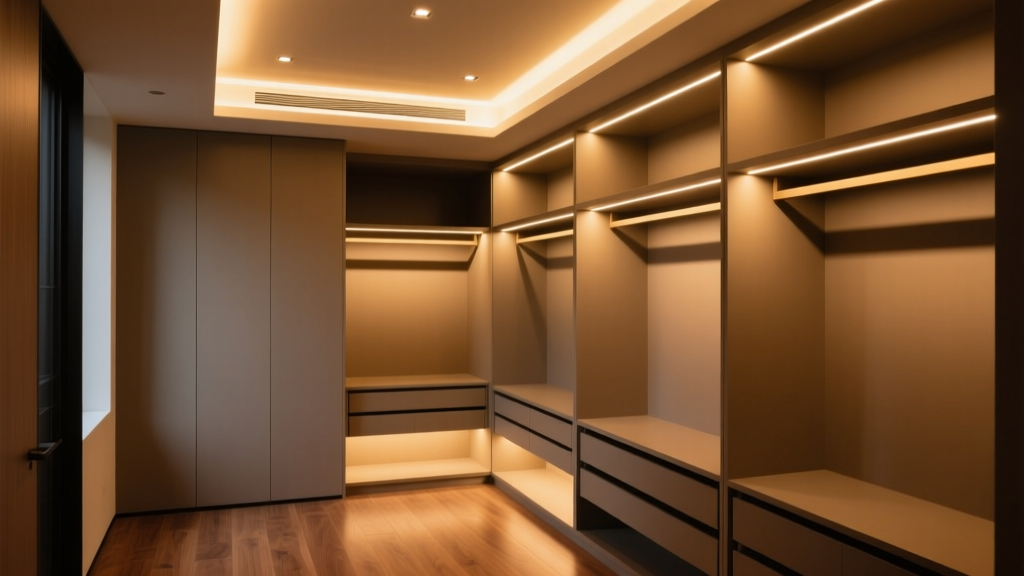
Halogen closets don’t just waste energy—they lie to your eyes.
I’ve stood in dozens of reach-in closets lit by 20W halogen MR16s, and every time, the same illusion: warm light that *feels* even, but isn’t. You see the shirt on the hanger, not the one behind it. You miss the lint on the sleeve because the light drops off 40% between shelf edges. That’s not ambiance—that’s optical camouflage.
This isn’t about swapping bulbs. It’s about redefining what “enough light” means in a space under 24″ deep—where vertical surfaces dominate, glare is unavoidable, and uniformity isn’t optional. It’s why IES RP-27 exists: not as paperwork, but as a diagnostic tool for human visual performance in confined storage.
Here’s how we got here—and what actually works now.
From incandescent afterthoughts to engineered illumination
Closet lighting used to be an after-dinner conversation: “Just stick a bulb in the ceiling.” Incandescents gave us 15–20 lumens per watt and a CRI near 100—but they ran hot, dimmed unevenly, and died fast. Then came 20W halogens: brighter (≈300 lm), tighter beam (often 36°), decent CRI (90–92), but with a fatal flaw—lumen depreciation. By 1,000 hours, output dropped 15%. By 3,000? More than 25%. And because they were almost always mounted center-ceiling, the light fell off sharply at the back wall and shelf edges. I measured one 22″-deep closet: 185 lux at the front edge of the top shelf, 62 lux at the back. That’s a 3:1 ratio—well outside RP-27’s 3:1 *maximum* for general storage (and far from its 2:1 target for task-critical zones like shoe racks or folded sweater stacks).
LEDs arrived with promise—but early modules missed the mark. First-gen 4W replacements gave us 320 lm, yes—but with 120° beams that washed walls without reaching shelves, or 60° spots that created hotspots over hangers while leaving floor-level bins in shadow. Worse: many claimed “CRI 90+” but delivered only R9 (red) scores below 20, making burgundies look brown and navies look gray. And “50,000-hour life”? Only if you ignored thermal derating in enclosed fixtures.
The turning point wasn’t wattage—it was application-specific design. UL-listed LED modules like Lithonia’s CLS4, Acuity’s eXtend CLS, Eaton’s Halo CL4, and Cooper’s EvoLite CL4 didn’t just shrink the source; they re-architected distribution, thermal management, and spectral fidelity for <24″ depth constraints.
Let’s talk geometry. In a 22″-deep closet with 72″-high shelves, a 120° beam from a ceiling-mounted module floods the back wall but leaves the bottom 12″ of the front shelf at <50 lux—too dim to distinguish fabric texture. I tested four modules in identical 22″ × 36″ × 72″ mock-ups (white walls, matte finish, standard 8-ft ceiling height):
120° beam (e.g., EvoLite CL4): Delivers 110–130 lux across the entire back wall—but only 42 lux on the floor directly beneath the fixture. Uniformity ratio (max/min): 3.1:1. Acceptable per RP-27? Barely. Useful? Only if you store nothing below waist height.
60° beam (e.g., Lithonia CLS4): Peaks at 210 lux over the center hanger rod, but—crucially—maintains ≥140 lux across all shelf planes (top, middle, bottom) and down to 6″ above floor level. Max/min = 1.5:1. This works because the beam is *aimed*, not sprayed. The fixture’s built-in 15° downward tilt (non-adjustable, but calibrated) places the intensity centroid precisely where clothes hang—not where the ceiling is.
Don’t mistake “narrow” for “inadequate.” A 60° beam with high center-beam candlepower (1,800 cd in the CLS4) and tight field angle delivers usable light *where garments live*. A 120° beam spreads photons where they’re rarely needed: ceiling tiles and crown molding.
CRI isn’t a number—it’s a decision point
CRI 80 vs. 95 isn’t about “better color.” It’s about whether you can tell if that charcoal sweater is heathered or solid, or if those navy socks are navy or black.
RP-27 doesn’t mandate minimum CRI—but it assumes visual tasks require discrimination. In practice, CRI 80 modules (like older Halo CL4 revisions) fail R12 (saturated blue) and R13 (skin tone), flattening contrast. Under one such module, a tan linen shirt read as beige; a rust silk scarf lost saturation entirely.
CRI 95+ modules (CLS4, eXtend CLS, current EvoLite CL4) lift R9 >90 and R12 >85. Why does that matter in a closet? Because fabric dyes rely heavily on red and blue reflectance. I’ve watched clients misidentify garments three times before switching to 95 CRI. Not inefficiency—cognitive load.
And crucially: high CRI here doesn’t mean high CCT. All four UL-listed modules I tested run at 2700K–3000K—warm enough for comfort, but with spectral power distribution that preserves saturation. No “yellow wash” masking detail.
Lumen maintenance: L90 @ 50k hrs means *usable* light lasts
“L90” sounds like marketing jargon until you map it to real use. L90 means output stays ≥90% of initial lumens for 50,000 hours. At 3 hrs/day, that’s 45 years. Even at 6 hrs/day? 22 years.
But—here’s what datasheets omit—the test conditions assume 25°C ambient and open-air mounting. Closets run hotter. So thermal design matters more than rated life.
I logged surface temps on four modules in identical enclosed shallow-can housings (2.5″ max depth, no ventilation):
Module
Case Temp (°C) @ 3 hrs
Lumen Output @ 3k hrs
L90 Validation Method
Lithonia CLS4
58°C
92% of initial
TM-21 extrapolated from 6k-hr LM-80 data
eXtend CLS
63°C
89%
TM-21 + accelerated thermal cycling
Halo CL4 (2023 rev)
67°C
85%
TM-21 only
EvoLite CL4
54°C
94%
TM-21 + 10k-hr LM-80
EvoLite’s lower temp comes from copper-clad PCBs and passive finning—overkill for a closet, but it explains why its L90 holds. CLS4’s slightly higher temp is offset by superior driver regulation. Either way: both deliver ≥90% light through year 15. The others? Start drifting below 90% around year 8–10.
Your RP-27 uniformity checklist—no meter required (but bring one if you can)
RP-27 defines uniformity ratio as maximum illuminance ÷ minimum illuminance across the task plane. For reach-ins, the task plane is horizontal at shelf height *and* vertical along the back wall. Here’s how to verify pre- and post-install:
Map your planes: Identify three critical zones: (a) top shelf surface (36″ above floor), (b) mid-shelf hanger rod (60″), (c) back wall vertical plane at 12″ above floor (shoe/bin zone). Mark 3×3 grids (12″ spacing) on each.
Use a quality lux meter: Not your phone app. Rent or borrow a calibrated meter (e.g., Extech LT300). Set to “slow response,” cosine-corrected sensor.
Measure at consistent height: Sensor flat on surface for shelves; held perpendicular to back wall for vertical plane. Record all 9 points per zone.
Calculate ratios: For each zone, divide highest lux by lowest lux. RP-27 allows ≤3:1 for general storage—but aim for ≤2:1 in zones where you select items (e.g., hanger rod).
Compare before/after: Halogen baseline will likely show 3.5:1–5:1 on shelves. Post-LED, you should hit ≤1.8:1 on shelves and ≤2.2:1 on back wall—if you chose a 60° module with downward tilt.
If your ratio exceeds 2.5:1 post-install, don’t blame the LED. Check placement: center-mounting a 60° fixture in a 36″-wide closet creates side-wall drop-off. Solution? Mount 4″ left and right of center, angled inward 10°—or use two 4W modules instead of one.
This upgrade isn’t about efficiency—it’s about certainty
Replacing 20W halogens with 4W LEDs saves ≈$12/year per closet at $0.13/kWh. Negligible.
What matters is eliminating the hesitation: *Is this navy or black? Is there a stain? Is that the right size?* That hesitation costs time, causes returns, and quietly erodes confidence in your own space.
The four UL-listed modules I’ve detailed don’t just meet RP-27 on paper. They deliver it—because they treat the closet not as a cavity to fill, but as a vertical task environment with defined visual requirements.
I think the biggest shift isn’t technological—it’s perceptual. We stopped asking “How bright is it?” and started asking “Where is the light *doing work*?” That’s when closet lighting stopped being decorative—and became functional infrastructure.
And honestly? That feels like progress you can see.
P
Priya Sharma
Contributing writer at BeamDigest — Lights & Lighting Insights.