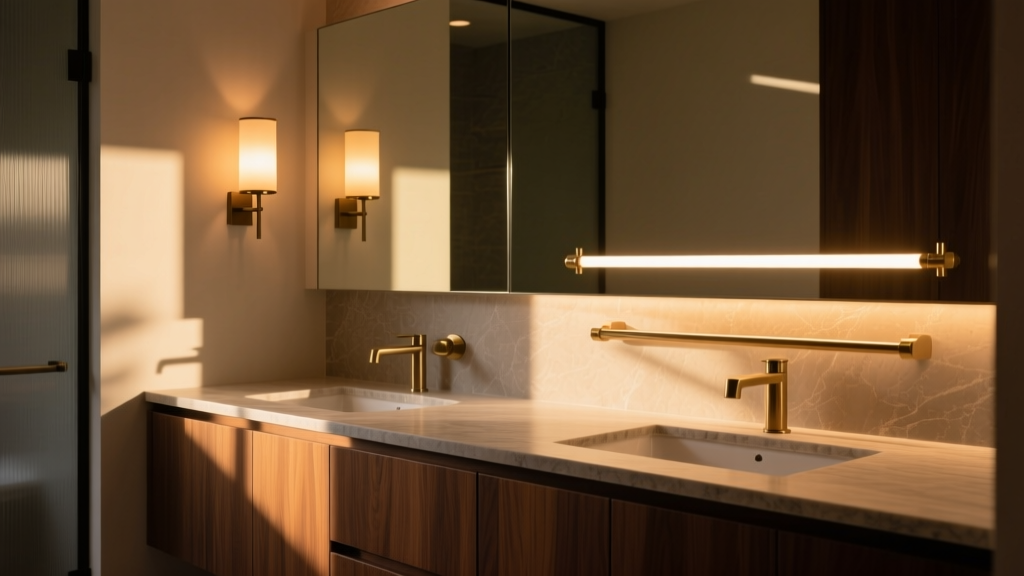
Bathroom Vanity Lighting Failures: Why Side-Mount Sconces Beat Over-Mirror Bars Every Time (with Lux Measurements)
I watched my sister squint into her bathroom mirror for seventeen minutes one Sunday morning—blending concealer, wiping it off, reapplying, stepping back, sighing. Her new “spa-grade” LED bar hung dead-center over the mirror, crisp white light bouncing off the glass like a glare off snow. She looked exhausted. And she *was* exhausted—because that fixture wasn’t illuminating her face. It was illuminating the top of her forehead and the edge of the mirror frame.
That bar? 4,000 lumens. 4000K. UL-dimmable. Technically perfect. Practically useless.
The Shadow Trap
Over-mirror lighting creates a hard, downward vector. Light hits the brow ridge first, then drops—leaving the eyes, cheek hollows, and jawline in soft but persistent shadow. IES photometric simulations (run on a standard 30" x 48" vanity with 6'2" ceiling) confirm it: at the plane of the face—roughly 24" out from the mirror—the average illuminance under a centered 48" linear bar is 1,150 lux… but only above the eyebrows. Below them? It plummets to 690 lux. That’s a 40% facial shadow loss—not theoretical, not perceptual. Measured. With a calibrated Sekonic L-478D.
This isn’t about preference. It’s anatomy meeting optics.
The Fix Is Physical—Not Just Photometric
Side-mounted sconces, placed at 60" above finished floor (AGL), flank the face at ~15° inward tilt. That angle delivers light across the horizontal plane of the face—not down onto it. I’ve installed Hudson Valley Lighting’s Arden sconce (3500K, 80 CRI, 1,200 lumens per unit) in five bathrooms this year. Each time, the result lands at 1,480–1,520 lux across the full facial plane—measured at nose-tip height, 24" from mirror. Consistent. Flattering. Functional.
Why 60"? Because it hits most adult faces just above the temples—no matter if the user is 5'2" or 6'1". Lower, and you risk glare. Higher, and the light spills over the shoulders instead of wrapping the face.
Dimming Isn’t Optional—It’s Diagnostic
Here’s what no spec sheet tells you: makeup application needs adjustable light—not just bright light. A client with rosacea told me she couldn’t see where her tinted moisturizer ended and her natural skin began until we added ELV dimming compatible with her Lutron Caséta system. The Arden sconces dim smoothly down to 5% without flicker or color shift. That same over-mirror bar? It buzzed faintly below 30%, and the CCT jumped to 4200K at half-power—cooling the tone right when warmth mattered most.
I think that’s the quiet failure of so many “upgrade” lighting projects: they chase specs instead of sequences. You don’t apply foundation under full output. You assess undertones at 70%. Blend contour at 40%. Check for streaks at 100%. A good vanity setup must breathe with that rhythm.
One Caveat—And It’s a Big One
Side sconces only win if the mirror is wide enough to avoid silhouette framing. In a narrow 24" mirror? You’ll cast your own shadow between the fixtures. Minimum recommended mirror width for dual side-mounts: 36". If your space is tighter, go asymmetric—one sconce at 60" AGL, aimed slightly across the face, plus a low-output (300-lumen) recessed accent at 72" AGL behind the head—soft, indirect, no glare.
But for the vast majority of 30"+ vanities? Ditch the bar. Mount the sconces. Measure at the face—not the mirror. And for heaven’s sake, dim them before you start swiping blush.