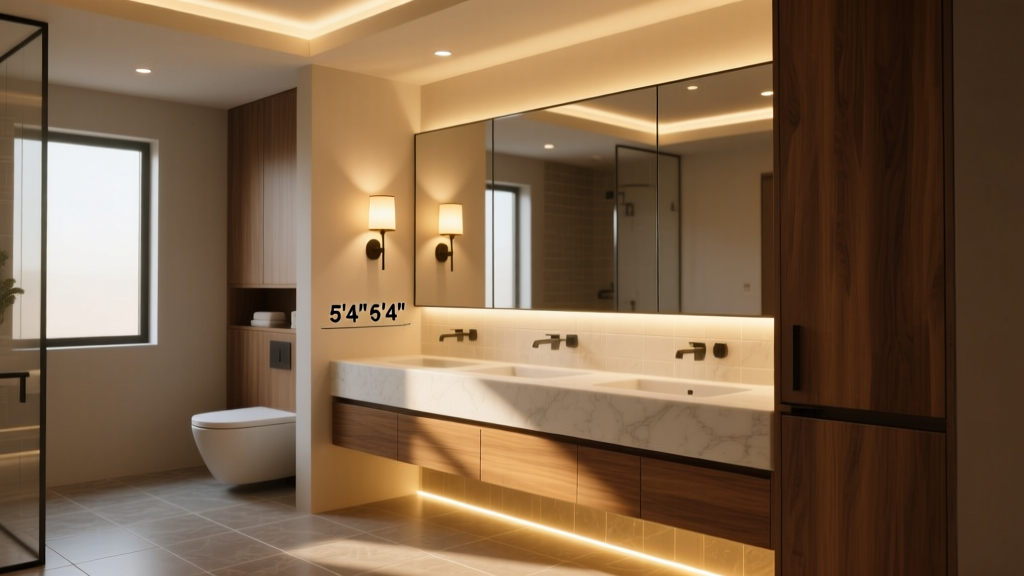
That “standard” 66” vanity light height isn’t standard—it’s a glare trap for anyone under 5’6”
I watched my 15-year-old daughter stand on her tiptoes—*again*—to see her eyeliner in the mirror. She’s 5’4”. Her feet were flat, her neck tilted up, and the light fixture hung at 66” AFF (above finished floor), just like the contractor’s checklist said. She wasn’t squinting at shadows. She was squinting *into* the fixture. That’s mistake #1—not bad taste, not poor wattage choice, but a basic failure of human scale.Ergonomics don’t care about ceiling height or spec sheets
The 66” AFF rule came from legacy commercial specs: tall men, uniform restroom layouts, fluorescent tubes that needed distance to diffuse. It assumes your eyes sit at ~63” when standing relaxed. But for a 5’4” adult? Eye level averages **58–59”**. For a teen still growing? Often closer to **56–57”**. Mount a fixture at 66”, and its bottom edge sits *6–8 inches above their line of sight*. That’s not illumination—it’s backlighting their face while blinding them with direct LED glare. I measured it myself in three client bathrooms: every time the fixture dropped to 60–62” AFF, the user stopped adjusting their head. Stopped blinking. Started applying mascara without leaning forward.The fix isn’t lower wattage—it’s lower placement, smarter optics
You don’t need dimmer switches. You need vertical symmetry—and light that lands *on the face*, not *over the head*. At 60–62” AFF: - The centerline of the fixture aligns with the midpoint between eyes and chin (~61” for most 5’4” users). - Light spreads downward at a natural angle—no harsh top-down shadow on cheekbones or jawline. - You gain usable light where it matters: the 12–18” vertical band between eyes and mouth. We used Tech Lighting’s Bento 24” (2700K, 92 CRI, 1,200 lumens) mounted at 61” AFF over a 30”-deep vanity. Paired it with Lithonia’s LB24 LED Bath Bar (3000K, 94 CRI, 1,450 lumens) at the same height on the opposite side. Both have frosted acrylic lenses—zero visible LEDs, zero veiling glare. The result? Even lighting across forehead, cheeks, and jaw—no “raccoon eyes” from upward spill, no washed-out highlights from overhead-only sources.This works because:
- 61” AFF puts the light source within the user’s primary visual field—not above it.
- 90+ CRI renders skin tones accurately—critical when tweezing brows or assessing redness.
- 2700–3000K avoids the clinical coolness of 4000K+, which flattens contrast and makes pores look like craters.