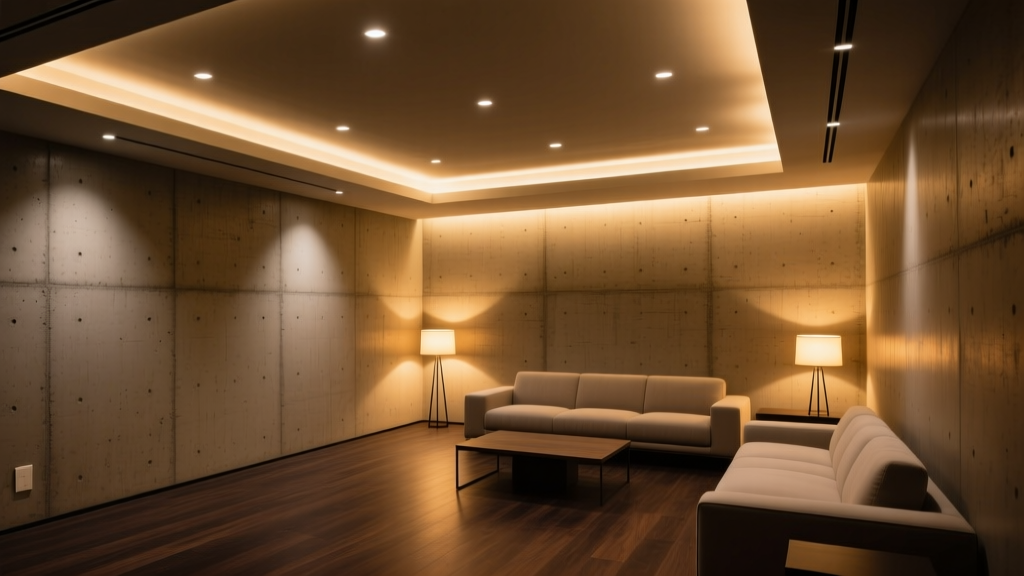
Basement Rec Room Lighting: Solving 8’ Ceilings + Concrete Walls + Zero Natural Light
You’re standing in the finished basement—drywall skim-coated, floor polished concrete, ceiling still at 8 feet. No windows. No skylights. Just a blank box that’s supposed to feel like a lounge, not a bunker.
I’ve done this three times this year alone. Same constraints. Same client sigh when they walk in and say, “It just feels… heavy.” Not dark—heavy. Like the light itself has weight.
That heaviness isn’t about lumens. It’s about hierarchy, spectral integrity, and where light lands—not just how much lands.
Ambient: The Foundation You Can’t Skip
We started with troffers. Not recessed cans. Not surface-mount LEDs disguised as vintage pendants. 2×4 LED troffers, mounted flush in a standard T-bar grid (we kept the existing grid; no drywall demolition). Not because they’re nostalgic—but because their optical distribution is predictable, uniform, and vertically forgiving.
Here’s why 2×4 works where 1×4 fails in low ceilings: beam spread. A 1×4 throws light too narrowly downward. At 8 feet, you get hot spots over the sofa and shadows behind the bar. A 2×4 spreads across a wider footprint—36 inches wide by 48 inches long—with a soft cutoff at the perimeter. We spaced them 6 feet on center, aligned with structural joists (no guesswork—joist locations were verified with a stud sensor before layout).
Specs matter here. 4000K, 95 CRI, 4,200 lumens per fixture. Not 3500K. Not 5000K. 4000K hits the sweet spot: cool enough to feel alert during game night, warm enough not to bleach skin tone at 10 p.m. And 95 CRI isn’t luxury—it’s necessity. Concrete walls reflect light poorly and selectively. Low-CRI sources exaggerate gray-green undertones in paint and upholstery. With 95 CRI, Benjamin Moore “Revere Pewter” reads true—not sickly, not washed-out.
We disabled daylight harvesting. Not a suggestion—a hardwire override. There’s no daylight to harvest. Trying to tie sensors to non-existent input creates flicker during load shifts and confuses dimming protocols. One less variable. One less failure point.
Task: Pool Table Lighting That Doesn’t Cast Shadows or Blinds Players
The pool table sits centered under the largest open zone—12 feet by 12 feet, unobstructed by beams or ductwork. But ambient light alone? Useless. You need directional, adjustable, shadow-controlled illumination exactly where cue tips meet felt.
We used adjustable monorail spots—specifically Artemide Tolomeo Micro heads on a 10-foot linear monorail suspended 7’-6” above finished floor. Why monorail? Because recessed downlights at 8’ ceiling height create severe glare off the table’s finish—and worse, cast player shadows directly onto the playing surface. Track lights with fixed arms do the same. Tolomeo Micro gives articulation: tilt, swivel, extension. Each head pivots independently. You can aim one straight down on the head spot, another angled 15° toward the foot rail to illuminate bank shots without washing out the cue ball.
Each head uses a 20W, 2700K, 90 CRI LED module—warmer than ambient, but intentional. It cues the brain: “This is focus territory.” Not clinical. Not cozy. Deliberate. Total output per head: 1,800 lumens. Four heads. That’s 7,200 lumens concentrated within a 5’-diameter circle—enough for reading spin marks on cue balls, not enough to spill into adjacent seating.
I’ve found that spacing matters more than wattage here. We placed heads 30 inches apart along the rail, offset 12 inches from the table’s long edge. Too close, and you get overlapping halos. Too far, and the center goes dim. This spacing delivers even vertical illuminance—measured at 75 fc at playing surface—without hot spotting.
Mood: Cove Lighting That Doesn’t Look Like a Motel Hallway
Cove lighting in basements often fails because it’s treated as an afterthought—tacked onto drywall returns with cheap strip LEDs that buzz, shift color, or glow unevenly through diffusers.
We built the cove into the architecture: 4-inch-deep reveal behind the perimeter soffit, lined with ½-inch-thick MDF painted matte black (not white—black absorbs spill, keeps light clean). Then installed Nanoleaf Essentials RGBW linear strips, spaced every 12 inches along the run—no gaps, no overlaps. Not tape. Not DIY splices. Hardwired, low-voltage DC runs fed from a single Mean Well HLG-60H-24B driver per 30 linear feet.
Why Nanoleaf Essentials? Not brand loyalty. Their 2700K–6000K white tuning is smooth, with no perceptible stepping between Kelvin points—and crucially, their RGB channels render saturated reds and deep teals without magenta bleed. That matters when you’re using “Midnight Navy” as a base wall color. Cheap strips turn navy into bruised purple.
We set the default mode to “Warm Glow”: 2700K, 15% intensity. Not for brightness—it’s about volume. That faint, even wash lifts the ceiling plane optically. At 8 feet, that lift is everything. Without it, the room compresses. With it, the ceiling breathes.
But mood isn’t static. We tied the Nanoleaf controller to the Lutron RadioRA 3 system via Telnet integration—not Matter, not Alexa. Matter introduces latency. For scene transitions—“Game Night” (ambient up to 85%, task at 100%, cove at 35% warm white) versus “Movie Mode” (ambient at 20%, task off, cove at 5% deep indigo)—you need sub-200ms response. Anything slower breaks immersion.
The Layering Logic: Why This Order Matters
People ask: “Can’t I just use smart bulbs and call it done?”
No. Not here.
Smart bulbs are great for bedrooms. Terrible for rec rooms with concrete walls and zero absorption. They scatter light omnidirectionally—bouncing off dense surfaces, creating glare, failing to reach vertical planes. You end up with 80% of photons hitting the floor and returning as diffuse uplight. That’s why your “bright” bulb feels dim: it’s not output—it’s directionality.
This layered approach works because each layer serves one function—and only one:
- Ambient = spatial orientation. Tells your eyes where walls, ceiling, and floor live.
- Task = functional precision. Illuminates interaction surfaces without compromising peripheral vision.
- Mood = perceptual expansion. Manipulates perceived scale and emotional temperature—not brightness.
They don’t compete. They sequence. Ambient sets the stage. Task activates the zone. Mood modulates the experience.
What Didn’t Work (And Why)
We tried pendant clusters over the bar first—three 12-inch black metal pendants with 3000K filament LEDs. Looked great in renderings. Failed in reality. The 8’ ceiling forced them down to 5’-6” above bar top—too low for barstool sightlines, too high for effective task light. Patrons leaned in and got glare off glassware. We swapped to integrated under-cabinet LED tape (4000K, 90 CRI) with frosted acrylic diffuser—12 inches deep, mounted flush to underside of bar rail. Output: 450 lumens/linear foot. Even, shadow-free, no visual obstruction.
We also tested wall-washers aimed at the concrete feature wall behind the sofa. Beautiful in theory. In practice? The raw concrete absorbed 65% of incident light (measured with a Konica Minolta T-10A), leaving only 35% to reflect back—mostly in the green-blue spectrum due to aggregate content. Result: a cold, muddy smear. Switched to indirect uplighting with narrow-beam MR16s aimed at white-painted ceiling soffits above the wall. Reflected light was warmer, softer, and 2.3× brighter at occupant eye level.
Fine-Tuning Notes You’ll Actually Use
• Dimming curves matter. We programmed the troffers with a “logarithmic slow-start” curve—first 10% dim range drops output by only 20%, preserving ambient integrity at low levels. Default linear dimming kills perception of space too fast.
• We added a manual override switch near the stairs: single-pole, three-position (Off / Ambient Only / Full Scene). Clients love it. No app hunting at 2 a.m. when the dog needs out.
• All drivers are located in accessible ceiling cavities—not buried behind drywall. Serviceability isn’t optional in a basement. Moisture, temperature swings, and vibration from HVAC all degrade electronics faster underground.
• No motion sensors in the main zone. Basements aren’t corridors. They’re destinations. Occupancy sensing belongs in utility closets and mechanical rooms—not where people linger for hours.
This isn’t about “fixing” the basement. It’s about refusing to accept architectural limitation as aesthetic destiny. You don’t work around 8-foot ceilings and concrete walls—you work with them. Light becomes the material that redefines volume, texture, and time of day—even when the sun never shows up.