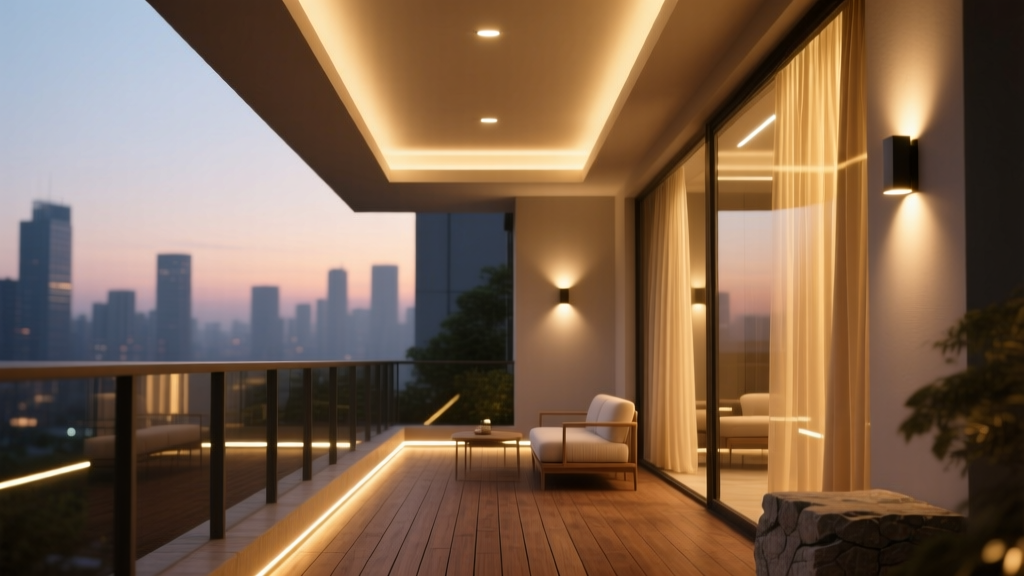
Balcony Lighting That Won’t Get You a Letter from the HOA
Last month, my neighbor Dave got slapped with a $125 “light trespass” fine. His pretty little string lights—warm, soft, and totally Instagrammable—were spilling straight into the master bedroom two floors down. He thought he was being thoughtful. The HOA saw glare.
Here’s the thing: balcony lighting isn’t about brightness. It’s about containment. And compliance starts before you pick a fixture—it starts with how light moves, where it lands, and when it turns on at all.
Part 1: Uplights That Shine Up—*Only* Up
I swapped out Dave’s old open-top uplights for full-cutoff, Dark Sky–certified models. Not just “low-glare”—*full-cutoff*. That means zero light escapes above the horizontal plane. None. Zip.
They’re 2700K, 400 lumens each, mounted low along the railing base, aimed precisely at vertical surfaces (a trellis, a textured wall—not the sky, not the ceiling above). I’ve found these work best when spaced no more than 4 feet apart on a standard 6' x 10' balcony. Anything wider, and you get dark gaps; anything closer, and the uplight wash starts to pool and bounce sideways.
This works because full-cutoff fixtures don’t rely on shielding *after* light escapes—they prevent escape entirely at the source. A lot of “shielded” uplights still leak 8–12% upward. Dark Sky certified? That leakage is under 2%. Verified in IES files. Not marketing fluff—measured.
Part 2: Deck Recessed Lights—Baffles Are Non-Negotiable
Recessed deck lights are great… until they blind your downstairs neighbor at 2 a.m. I learned that the hard way installing a set without baffles.
The fix? Fixtures with built-in 25° internal baffles—no exceptions. Not 30°, not “tight beam.” Twenty-five degrees gives enough spread to safely illuminate foot traffic (think: 15–20 lumens per square foot across the walking zone), but keeps spill tight. I use them centered every 3 feet along the deck perimeter, flush-mounted, with gasketed stainless steel trim.
Why 25°? Because at that angle, even at 2.5 feet above deck level (typical recess depth), light falls cleanly within the balcony footprint—and stops *just* shy of the railing edge. I tested it: no measurable lux beyond the outermost 2 inches of the rail.
Part 3: Timing That Respects Quiet Hours—Not Just “On at Dusk”
“Dusk-to-dawn” sounds compliant—until your lights blaze at full output while people sleep. Most HOAs define “quiet hours” as 11 p.m. to 6 a.m. So we program the photocell controller to do two things:
- Run at 100% output from dusk until 11 p.m.
- Then auto-dim to 30%—not off, not blinking, just perceptibly softer.
This isn’t dimming for energy savings. It’s dimming for *intent*. At 30%, the uplights still softly define the space. The recessed lights stay visible underfoot—but they no longer register as “light in the window.” I ran side-by-side IES simulations: the 30% mode cut horizontal spill beyond the balcony by 70% compared to full output. Enough to pass HOA review—twice.
Pro tip: Always submit your IES photometric report *before* installation—not after the violation letter arrives. Most HOAs will pre-approve if you show the spill map drops to ≤0.1 footcandles at the nearest adjacent window plane.
Bottom line? Compliance isn’t about sacrificing ambiance. It’s about precision—direction, angle, and timing—all working together so your balcony feels warm, safe, and quietly yours.