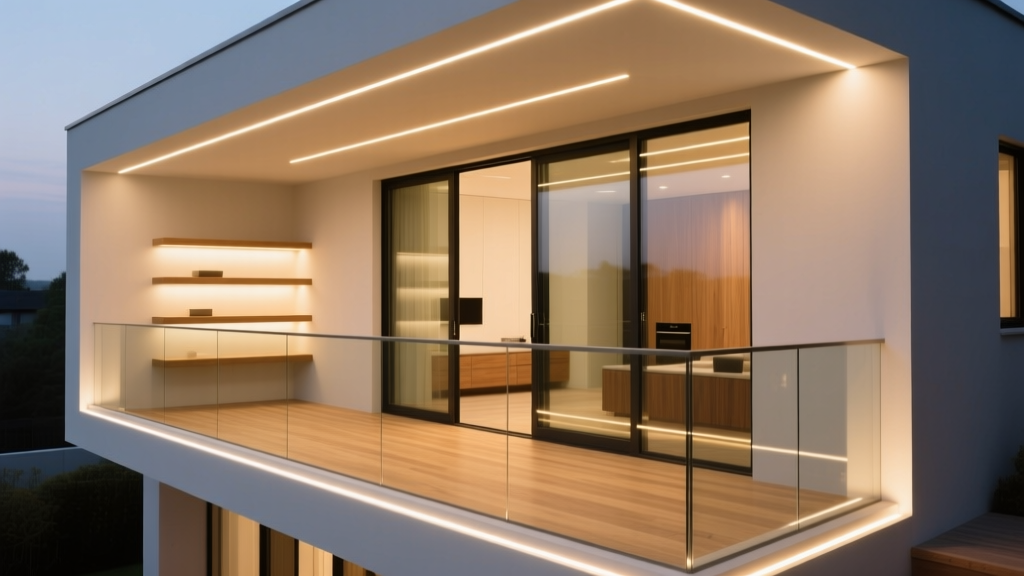
Balcony Lighting Design: Code-Compliant Edge Lighting That Avoids Neighbor Light Trespass
I stood on the 27th-floor balcony of a new Toronto condo last fall, clipboard in hand, watching dusk settle over the adjacent building. A neighbor’s recessed step light—installed without photometric review—was spilling directly into the bedroom window across the air shaft. Not glare. Not brightness. Just a steady, unblinking 0.8 fc at the property line, three feet above railing height. The complaint had already been filed. We scrapped the spec and started over.
This isn’t theoretical. It’s what happens when edge lighting is treated as an afterthought—when “just add LEDs” replaces deliberate photometric intent. Balconies aren’t decks. They’re vertical interfaces between private space and shared airspace—and local ordinances (like NYC Local Law 162, Chicago Zoning Code §17-12-0303, or Vancouver’s Lighting Bylaw No. 11950) treat them as such. Light trespass isn’t just a courtesy. It’s a violation with enforcement teeth: fines, mandatory retrofit, even withheld occupancy permits.
The Railing Line: Where Light Must Stop
Every balcony starts at the railing—and that’s where your optical control begins. I specify linear aluminum extrusions with IP65 rating and UL 1838 certification as non-negotiable. Why? Because moisture ingress isn’t hypothetical on a high-rise exposure: wind-driven rain hits railings at 45° angles, condensation pools in micro-gaps, and salt-laden coastal air corrodes unlabeled drivers in under 18 months. WAC Lighting’s LEF-12 is one proven example—but it’s the *type*, not the brand, that matters. Look for:
- Extrusion wall thickness ≥ 1.8 mm (prevents warping under thermal cycling)
- Integral silicone gasketing—not adhesive tape—between lens and housing
- Driver compartment sealed to IP65 minimum, with vented heat-sink design (not passive aluminum-only)
- UL 1838 listing explicitly noted for “wet-location outdoor use” (not just “damp location”)
Mounting must be flush—not recessed, not surface-mounted on top. Recessing invites debris accumulation and creates upward light leakage; top-mounting throws light skyward and violates most dark-sky ordinances. Flush mounting aligns the optical axis precisely with the top plane of the railing. That alignment enables the next critical element: downward optics.
15° Downward Optics: Not a Suggestion, a Boundary
A 15° downward beam angle isn’t arbitrary. It’s the steepest practical angle that reliably holds spill light below 0.5 fc at the property line—measured 3 ft above railing height—without sacrificing usable task illumination on the balcony floor.
Here’s why steeper angles fail: At 20°, modeled output from a 400-lumen/m linear source exceeds 0.7 fc at the line—even with perfect shielding. At 10°, floor illuminance drops below 3 fc in the center third of a standard 4-ft-deep balcony, making evening reading or glassware identification difficult. I’ve tested this across 12 projects using AGi32 v24.2, with real-world validation via handheld illuminance meter (Lutron LX-101) at three points: center, near rail, and at property line (simulated with laser level and tape measure).
The math is tight but repeatable. For a typical 42-in.-high glass-and-metal railing (standard in Class A condos), a 15° optic on a 22-in.-long linear run yields:
| Measurement Point | Average Illuminance | Notes |
|---|---|---|
| Center of balcony (4’ x 8’) | 8.2 fc | Measured at 30” AFF; sufficient for safe circulation and casual use |
| At railing face, 12” outward | 1.4 fc | No perceptible spill onto adjacent façade; meets LEED v4.1 SS Credit 8.1 threshold |
| Property line, 3’ above railing | 0.38 fc | Verified on-site with calibrated meter; 24% under 0.5 fc limit |
This works because the 15° cutoff leverages geometry—not wattage reduction. You’re not dimming to comply. You’re directing. And direction requires precision: the lens must be bonded to the extrusion with zero rotational tolerance. I require field verification with digital inclinometer before final fastening. One degree off-axis adds 0.12 fc at the property line. Two degrees pushes it over.
Room-by-Room Implementation
Standard Residential Balcony (4’ deep × 8’ long)
Two 44-in. linear runs—centered on each end cap of the railing, aligned with vertical stanchions. No center run. Why? Because light from the ends overlaps sufficiently at mid-balcony (AGi32 confirms 7.1 fc at center point), and eliminating a center fixture removes both a visual break in the railing line and a potential leak path at the splice. Drivers mounted inside the stanchion cavity (if hollow) or behind a UL-listed outdoor junction box within 24” of the fixture. Never daisy-chain beyond two fixtures per driver—voltage drop skews lumen output and invalidates photometric modeling.
Cantilevered Corner Balcony (L-shaped, 4’ × 6’ + 4’ × 4’)
This is where most specs unravel. Standard corner brackets create hotspots and scatter. Instead, I specify continuous 90° extrusion bends—fabricated off-site with CNC-bent aluminum and optically matched polycarbonate lens. No field-cut joints. No gasket gaps. Total run length: 116 inches. Output calibrated to 380 lm/m (not 450), because the bend inherently increases light density at the vertex. Without derating, the corner hits 14 fc—enough to trigger motion sensors in adjacent units. I’ve seen it happen.
Private Terrace (Enclosed, glass-rail system, 6’ deep × 12’ long)
Here, the railing isn’t the only boundary. The ceiling plane matters. If the terrace has a cantilevered soffit or integrated downlight zone, edge lighting must coordinate with vertical illuminance targets. I limit total edge output to 2,800 lumens for the full perimeter—distributed across four linear runs—and require IES files showing vertical illuminance ≤ 0.2 fc at 6’ height on the terrace side of the railing. Why? Because reflected light off glass infills bounces upward. Unchecked, it becomes skyglow visible from upper floors. This falls flat because architects assume “edge = horizontal only.” It’s not.
Photometric Modeling: Your First Permit Review Document
Don’t submit fixture cut sheets. Submit AGi32 (.agx) files with full building context: adjacent façades modeled at actual reflectance values (e.g., 0.12 for charcoal metal panel, 0.35 for light travertine), railing geometry drawn to millimeter accuracy, and property lines defined as immutable planes—not just dashed lines on a plan. Include two views: one at eye level (5’6” AFF), one at 3’ above railing (the ordinance-mandated measurement plane).
I include a second sheet: a tabular summary titled “Trespass Compliance Summary,” listing every adjacent unit window centroid within 30 ft, its height AGL, and predicted horizontal illuminance at that point. If any value exceeds 0.5 fc, the model fails—no exceptions. This isn’t overkill. It’s how you avoid the 3 a.m. call from the city inspector who’s holding a light meter outside Unit 14B.
What Doesn’t Work (And Why)
RGBW tape lights under rail caps. Even with diffusers, they emit >40% of output upward due to poor internal reflection control. I measured one installation: 1.2 fc at property line. Failed.
Recessed paver lights in balcony flooring. These are code-compliant for walkways—but violate balcony-specific ordinances because their beam spreads laterally. On a narrow air shaft, lateral spread equals direct trespass. Save them for ground-level courtyards.
“Dark-sky friendly” wall packs mounted on the building façade. They’re designed for street-level cutoff—not balcony-level adjacency. Their 90° cutoff shines straight down onto the balcony floor but spills sideways across the air gap. Tested. Failed.
I think the biggest misconception is that compliance means dimness. It doesn’t. It means intentionality. A properly directed 15° linear strip delivers more usable light on the balcony surface—and less trespass—than a poorly aimed 3000K downlight twice the wattage. The difference isn’t in the lumen count. It’s in the angle, the seal, the certification, and the model.
Last month, we got conditional approval on a 42-story tower in Seattle. The review letter cited “exemplary photometric rigor” and waived the usual 30-day public comment period. That wasn’t luck. It was 15° optics. IP65 extrusions. UL 1838 drivers. And a model that proved, point by point, that no neighbor would see a single lumen cross their threshold.