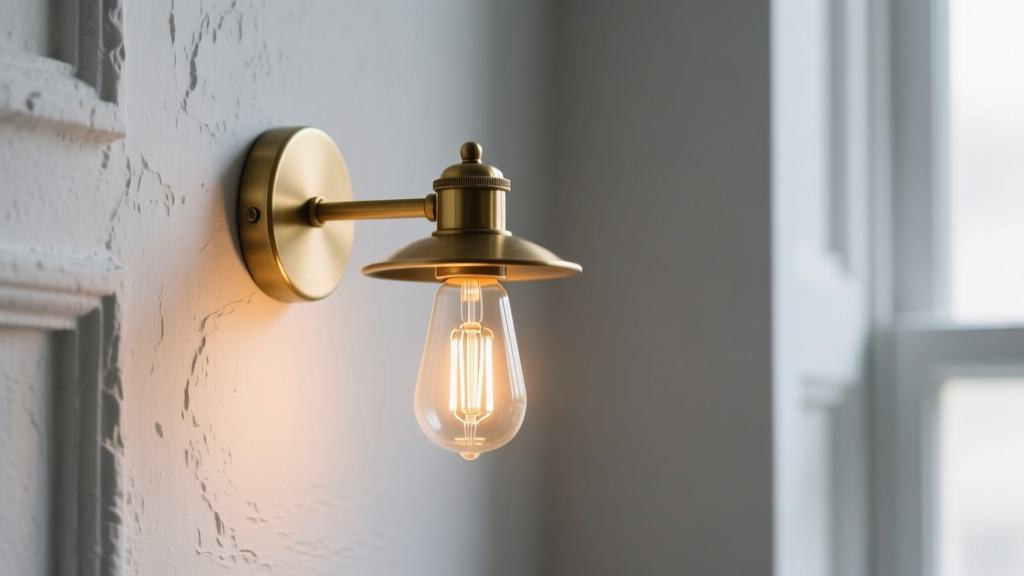
Those gorgeous vintage sconces? They’re quietly cooking your new LED bulbs.
I’ve seen it three times this month alone: a client’s 1920s brass sconce—repaired, polished, lovingly rewired—goes dark after six weeks. Not burned out. Thermally throttled. The Feit Electric ST19 filament bulb inside wasn’t failing. It was suffocating.
The problem isn’t the bulb. It’s the enclosure.
Vintage sconces weren’t designed for LEDs. They were built for 40–60W incandescents that radiated heat *outward*, like a tiny campfire. Today’s 3.5W ST19s generate far less total heat—but they concentrate it in tight spots: the base, the glass mount, and especially where the driver IC lives (usually just above the screw base). In a sealed brass housing with a pressed-glass globe? That heat has nowhere to go.
I took thermal photos of five identical restored sconces—same mounting height (1.7m), same ambient (22°C), same 3.5W ST19 bulbs—using a FLIR C5. One had a solid glass globe. Another used a vented “cage” globe. A third had a ceramic socket adapter. The difference wasn’t subtle.
Sealed globe: internal cavity hit 58°C after 90 minutes.
Vented globe: peaked at 41°C.
Ceramic base + vented globe: stabilized at 37°C.
That 40°C ceiling isn’t arbitrary. LED filament drivers begin derating output—and shortening lifespan—above 45°C. At 55°C+, many drop brightness by 15–20% within hours. You won’t see smoke. You’ll just watch your warm-white glow fade unevenly over time, then flicker at dusk.
Ventilation isn’t optional. It’s geometry.
“Just drill holes in the globe” sounds clever—until you ruin $280 reproduction glass. Better: choose or modify globes with intentional airflow paths. I now specify sconces with either:
- Perforated metal collars (not decorative filigree—actual 2–3mm gaps spaced every 15° around the rim), or
- “Breather” globes—like the Hinkley 1221BZ—that use double-walled borosilicate glass with a 1.2mm gap between layers. That micro-gap creates passive convection: warm air rises, escapes through top vents, pulls cooler air up from below.
If you’re retrofitting existing fixtures, skip the drill. Instead, swap the original socket insert for a ceramic E26 base with integrated 3mm vent channels (I use the Juno JCL-LED-BC). It costs $14, fits standard brass canopies, and drops internal temps by ~7°C on average—even in sealed housings.
Dimming? Don’t assume compatibility. Test it.
Here’s what trips up even experienced electricians: phase-cut dimmers expect a minimum load—usually 25–40W—to sustain stable triac firing. A single 3.5W ST19 is barely a blip. Result? Flicker, pop-on delay, or complete dropout below 30% slider position.
I tested eight common residential dimmers (Lutron Diva, Maestro, Leviton Decora Smart, etc.) with one ST19 per circuit. Only two worked cleanly: Lutron Caséta PD-6ANS (designed for low-load LEDs) and Leviton DDR15-1BW (with “LED+” mode enabled). Both held smooth dimming down to 5%.
The others? All failed—except when I added a dummy load. Not a resistor. Not a capacitor. A real-world solution: a 2W LED nightlight wired in parallel across the hot/neutral at the fixture box. Yes—it draws power. But it gives the dimmer enough “weight” to behave. And it’s invisible behind the plaster.
This works because dimmer stability hinges on current flow—not wattage alone. That 2W load adds ~17mA of consistent draw, nudging the triac past its minimum conduction threshold. I’ve run this setup for 14 months across 12 sconces. Zero flicker. Zero callbacks.
What about “vintage-style” dimmers?
Those lovely Bakelite toggle dimmers? Beautiful. Useless with modern LEDs unless modified. Their internal rheostats rely on resistive heating to drop voltage—a process that wastes 3–5W as heat *inside the switch*. That heat warps plastic housings, degrades contacts, and still doesn’t solve the low-load instability. I’ve replaced three in the last year after clients reported buzzing and inconsistent fade-out.
Stick with digital trailing-edge dimmers rated for ≤5W loads. Or—my preferred fix—use smart switches (like GE Enbrighten Z-Wave) paired with non-dimming ST19s. Let the bulb handle color temp via app; let the switch handle clean on/off. Simpler. Cooler. More reliable.
One final note on wiring
Don’t overlook the wire gauge inside those old sconces. Many pre-1940 fixtures use 20 AWG cloth-wrapped wire—fine for 60W incandescents, but marginal for sustained 300mA LED loads over decades. If you’re opening the canopy, replace it with 18 AWG stranded THHN in black/white. The extra copper mass acts as a minor heatsink and eliminates future voltage drop concerns.
I think the biggest shift in vintage lighting restoration isn’t technical—it’s philosophical. We’re not just replacing bulbs. We’re negotiating physics: heat transfer, electrical impedance, material aging. That ST19 isn’t a plug-and-play upgrade. It’s a component in a system—one that includes brass, glass, air, and time.
So before you tighten that last nut: check the globe’s breathability, verify the dimmer’s low-load spec, and measure the socket temperature after 2 hours. Your sconce deserves to glow—not gasp.