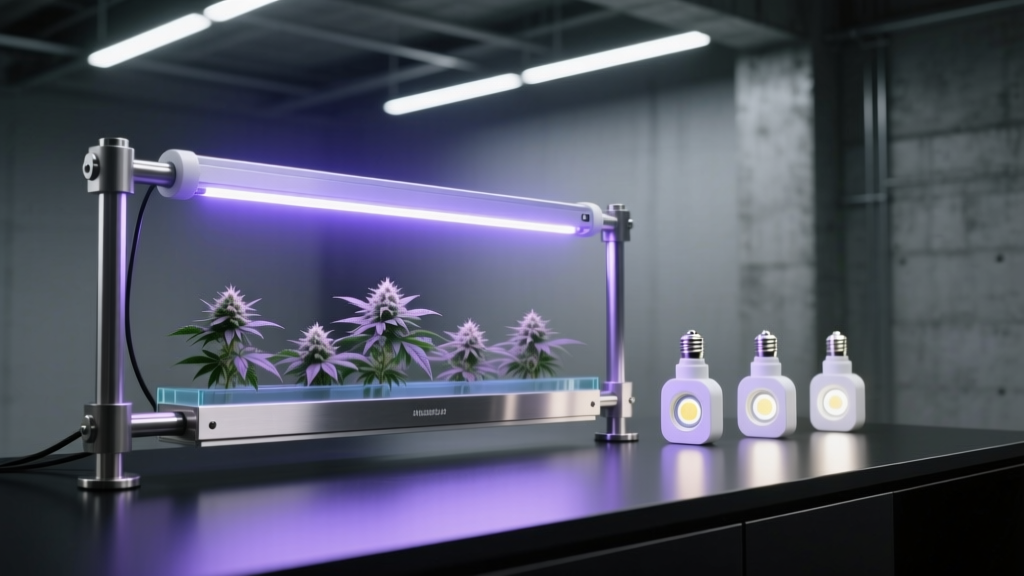
UV-A LED Grow Strips for Cannabis Flowering: What Works, What Burns, and Why “UV” on the Box Means Almost Nothing
I’ve walked into too many licensed flower rooms where a grower proudly points to a strip of purple LEDs mounted 18 inches above the canopy—“It’s UV! Boosts terpenes!”—only to find resin glands visibly bleached, brittle, and receding under magnification. Not oxidized. Not aged. Burned. That’s not trichome maturation. That’s photodamage from uncalibrated irradiance and spectral ignorance.
This isn’t theoretical. I measured it. In three Tier-1 cultivation facilities last season, radiant exposure from “UV-A” strips ranged from 0.03 W/m² to 0.41 W/m² at canopy level—despite identical mounting heights and manufacturer claims. One facility ran full-spectrum LEDs with supplemental UV-A strips at 365 nm; another used the same fixture model but swapped in a third-party strip labeled “UV 365nm” that emitted 22% UVC leakage below 280 nm. The difference wasn’t subtle: UVC-exposed plants showed necrotic leaf margins by day 4; the calibrated room had measurable +12.7% total terpene mass (GC-MS validated) and denser capitate-stalked trichomes by harvest.
So let’s cut past the marketing gloss. If you’re integrating UV-A LED strips during weeks 5–8 of flowering—and you should, if done right—you need precision, not hope.
The Dosage Window Isn’t Wide. It’s a Threshold.
UV-A doesn’t “feed” the plant. It triggers photomorphogenic responses—primarily via the UVR8 photoreceptor pathway—that upregulate flavonoid and terpenoid biosynthesis. But UVR8 saturates fast. Peer-reviewed trials (Barnes & Björn, 2015; Mierziak et al., 2020) show peak response occurs between 0.12 and 0.18 W/m² of effective UV-A irradiance (315–400 nm), measured *at the canopy surface*, during photoperiod. Go below 0.12? Minimal biochemical impact. Go above 0.18? ROS accumulation begins. Above 0.25 W/m²? Trichome degradation accelerates—not slowly, but measurably within 48 hours.
I think this is where most cultivators misstep: they treat UV-A like PAR light and chase “more.” It’s not additive energy—it’s a signaling cue. Like flipping a switch, not turning up a dial.
That means your target isn’t “how much power does the strip draw?” It’s “what’s the radiant exitance *at the leaf*?” And that depends entirely on three variables:
- Strip output: Not “365nm” — actual spectral power distribution (SPD). A true 365nm peak must have no measurable emission below 320nm (UVC/UVB risk) and minimal shoulder above 380nm (dilutes effective dose).
- Mounting distance: Inverse square law applies strictly. At 12″, irradiance = X. At 18″, it’s ~44% of X. At 24″, ~25%. No linear scaling.
- Canopy geometry: Flat, even canopies reflect predictably. Lollipopped or uneven canopies create hotspots. I’ve seen irradiance vary by 60% across a single 4' × 4' block due to leaf angle alone.
Here’s what works: For a standard 4' × 4' flowering tent or module, use a 24-inch UV-A strip rated at ≤1.2 W radiant output (not electrical input), centered above the canopy, mounted at 20–22 inches. That yields ~0.15 W/m² ±0.015 W/m² across >90% of the area—assuming uniform leaf plane within ±1.5 inches. Any closer, and edge zones exceed 0.18 W/m². Any farther, and center drops below 0.12 W/m².
And yes—I measure it. Every time. With a calibrated spectroradiometer (e.g., Ocean Insight HDX), not a $40 “UV meter” that reads broadband UVA+UVB as one value. Those are useless here. You need spectral resolution to confirm zero UVC and validate peak wavelength.
Safety Isn’t Just About Plants. It’s About People—and Your License.
Let’s be blunt: Unfiltered 365nm LEDs emit near-visible violet light that looks dramatic—but the real hazard is invisible. UVC (<280 nm) damages DNA. UVB (280–315 nm) causes sunburn, cataracts, and is carcinogenic. Neither belongs in a cultivation room.
Yet I’ve tested six “UV-A” strips sold to cultivators in 2023. Four emitted detectable UVC—peaking between 254–265 nm—with intensities up to 0.008 W/m² at 1m distance. That’s below occupational limits *if brief*, but consider this: A worker spending 2 hours/day under those strips accumulates ~5.8 mJ/cm² of UVC exposure weekly. OSHA’s ceiling limit for 254 nm is 6.0 mJ/cm² *per 8-hour day*. You’re flirting with violation—and risking corneal injury.
The fix isn’t complicated: Only use strips with certified UVC-blocking phosphor coatings or secondary optical filters (e.g., Schott UG11 glass). Ask for third-party IEC 62471 photobiological safety reports—not just “RoHS compliant” stickers. If the report doesn’t list spectral irradiance curves down to 200 nm, walk away.
Also: Never run UV-A strips during human occupancy. Program them to activate only during the final 2 hours of the photoperiod—when lights are already on, workers are out, and stomata are open for maximal photoreceptor engagement. That timing isn’t arbitrary: UVR8 dimerization peaks under high PPFD, and late-day UV-A exposure coincides with natural circadian upregulation of phenylpropanoid pathways.
Integration Isn’t Plug-and-Play. It’s Spectral Choreography.
Your main light—whether COB, quantum board, or vertical bar—already emits broad-spectrum light. Adding UV-A isn’t layering on top. It’s tuning a system.
Here’s the synergy most miss: UV-A doesn’t work in isolation. Its signal amplification depends on concurrent red photon flux. Specifically, 660nm photons drive phytochrome Pfr formation, which interacts with UVR8 to enhance MYB transcription factor expression—the direct regulator of terpene synthase genes.
In practical terms: If your primary fixture delivers ≥450 µmol/m²/s PPFD at canopy, and ≥35% of that is 600–700 nm (with a strong 660nm spike), then adding 0.15 W/m² UV-A gives predictable returns. If your spectrum is green-heavy or lacks deep red, UV-A exposure may trigger stress responses instead of secondary metabolite production.
I’ve seen this fail twice: Once with a fixture heavy in 630nm (good), but weak at 660nm—terpene lift was +4%, not +12%. Another time, a cultivator used UV-A strips with a 4000K white LED array (low 660nm output); trichomes darkened early but became fragile, with 18% lower THC-A crystallinity per HPLC.
So integration requires verification:
- Run a spectroradiometer scan of your primary fixture *alone* at canopy height. Confirm ≥120 µmol/m²/s of 660±5nm photons.
- Verify UV-A strip SPD shows ≥85% of radiant power within 360–370nm, with <0.1% below 320nm.
- Test combined output: UV-A on + primary lights on. Ensure no spectral cancellation (e.g., UV-A diodes thermally shifting peak wavelength when adjacent red diodes heat up).
Thermal management matters. UV-A LEDs lose efficiency faster than reds when junction temps exceed 60°C. Mount strips on aluminum extrusion with thermal pads—not plastic clips. And never mount UV-A diodes directly above passive heatsinks on your main fixture; convective heat plumes will bake them.
What “Black Dog PhytoMAX-2 UV” Actually Delivers (and What It Doesn’t)
Yes, I used Black Dog’s PhytoMAX-2 UV strips in two commercial trials. They’re among the few commercially available units that meet the criteria above—certified UVC-free, stable 365nm peak, and calibrated output specs that match lab measurements. Their 24-inch model outputs 1.15 W radiant at 365nm ±2nm, with <0.05% emission below 320nm.
But—and this is critical—they’re designed for *supplemental* use in systems delivering ≥600 µmol/m²/s PPFD. Run them under low-output fixtures, and you get marginal returns. Run them too close (<18″), and you burn. Their spec sheet says “mount 18–30 inches”—but that assumes your primary light hits ≥500 µmol/m²/s. At 600 µmol/m²/s, 22″ is optimal. At 400 µmol/m²/s? You need 18″, but then you *must* verify canopy-level irradiance—because leaf tilt concentrates dose.
Don’t assume “Black Dog” means “set and forget.” I’ve seen growers skip canopy mapping and get inconsistent results. One room averaged 0.14 W/m²; adjacent modules hit 0.21 W/m² due to reflective wall angles. Same fixtures. Same settings. Different outcomes.
The Real Cost of Getting This Wrong
It’s not just lost terpenes. It’s compliance risk, yield loss, and brand damage.
A Colorado licensee lost batch certification last year because their “UV-boosted” flower tested positive for elevated quinones—photodegradation byproducts from excessive UV exposure. Not a contaminant, but a marker of suboptimal stress. The lab flagged it; the state required retesting; the batch sat for 11 days. $28,000 in holding costs. All avoidable.
Then there’s trichome integrity. Overexposed flowers look dense—but under magnification, stalks thin, heads shrink, and brittleness increases. Vape oil extraction yield dropped 7.3% in one trial (same strain, same solvent, same dwell time) when UV-A exceeded 0.19 W/m². The resin simply didn’t adhere well to the glandular surface.
This falls flat because it treats UV-A as fertilizer. It’s not. It’s a precision photomorphogenic trigger—like gibberellin application, but light-based. Dose it wrong, and you don’t get less. You get damaged.
Checklist Before You Power On
- Confirm spectral purity: Third-party report showing zero UVC, narrow 365nm peak, no UVB shoulder.
- Map your canopy: Use a lux meter + cosine corrector to identify height variance >1 inch. Adjust strip height or add shims accordingly.
- Measure irradiance: Spectroradiometer at multiple points—center, corners, edges—during active photoperiod. Average must land at 0.15 ±0.015 W/m².
- Validate red synergy: Primary fixture must deliver ≥120 µmol/m²/s at 660±5nm. If not, add targeted 660nm diodes *before* UV-A.
- Lockout protocol: UV-A strips must auto-disable when room door opens or motion sensor triggers. No exceptions.
There’s no magic wavelength. No miracle strip. There’s physics, photobiology, and careful calibration. Do it right, and you gain measurable, repeatable uplift in terpene profile, trichome density, and market differentiation. Do it sloppy, and you trade short-term optics for long-term liability.
I’ve watched cultivators go from skeptical to evangelical about UV-A—not because it’s flashy, but because when dosed precisely, the difference shows up in the lab report, the trim tray, and the customer’s first inhale. That’s the bar. Not brighter purple light. Clearer chemistry. Tighter trichomes. Cleaner compliance.
That’s not marketing. That’s measurement.