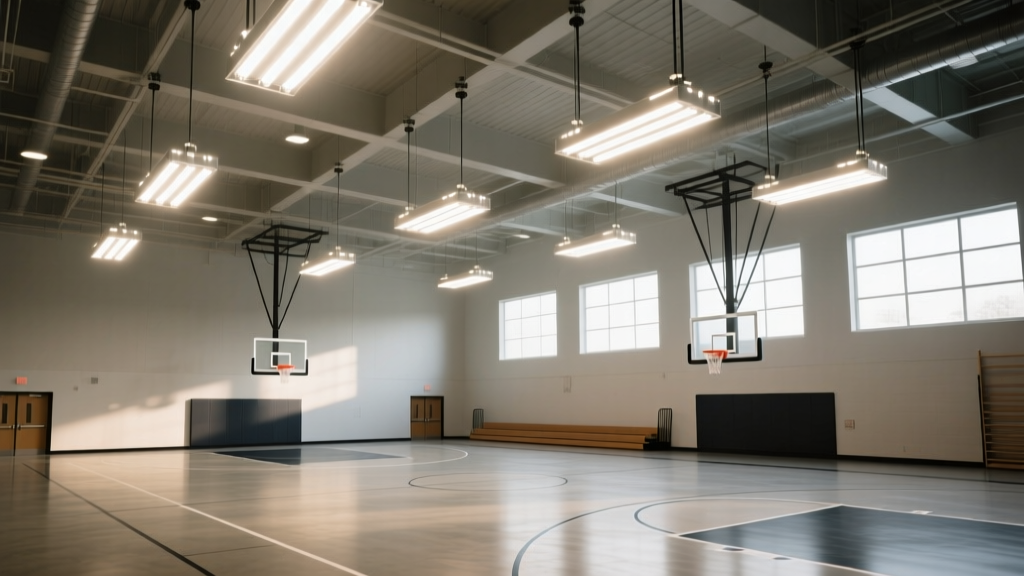
Case Study: Retrofitting a 1970s School Gymnasium with High-Mount LED High Bays — Reducing Glare & Improving Vertical Illuminance
The goal wasn’t just lower energy bills. It was getting coaches to stop squinting at bleachers during drills, eliminating the “halo effect” around basketball hoops at tip-off, and making sure referees could read wristbands from baseline — all without replacing a single structural beam.
That’s what the Oakwood Unified School District demanded when it tackled the retrofit of its 1973 gymnasium — a 96’ × 72’ space with 32’-high exposed bar joist ceilings, original metal halide fixtures mounted on 28’-high poles, and decades of layered compromises: patched wiring, mismatched lamp replacements, and one glaring truth — the vertical plane was an afterthought.
The popular take? “Just swap in LEDs — same layout, same mounting, same photometric assumptions.” That’s what the first contractor proposed. They’d drop in 200W LED high bays where the old 1000W metal halides lived, claim 80% energy savings, and call it done. I think that approach fails because it treats lighting like plumbing — replace the pipe, ignore the flow dynamics. In a gym with standing-height bleachers, spectator sightlines, and fast-moving athletes, vertical illuminance isn’t optional. It’s visibility.
So we started over — not with watts or lumens, but with sightlines.
Photometric Redesign: Why Mount Height Alone Didn’t Save Us
The old system used twelve 1000W metal halide fixtures (each ~105,000 lm, 3500K CCT) spaced 24’ apart along two parallel rows centered above the court. They delivered ~35 fc horizontal on floor — technically compliant with IES RP-20-14 for high school gymnasiums — but vertical footcandles on the front row of bleachers averaged just 4.2 fc. Coaches stood there holding clipboards; their faces were in shadow, their notes illegible under glare.
We kept the same 28’ mounting height — no structural mods — but shifted to twenty-four 200W LED high bays (Lithonia ECO-LED-HB200, 27,000 lm total output per unit, 4000K, 90 CRI). Not more fixtures — smarter placement. We broke the linear rows and adopted a staggered 4×6 grid, pulling units 6’ inward from side walls and tightening longitudinal spacing to 18’. This wasn’t about coverage density. It was about vector control.
Each fixture uses asymmetric optics: 65° horizontal × 110° vertical asymmetry, with a pronounced downward-forward lobe targeting the bleacher risers. The beam doesn’t just fall — it *leans*. At 28’ mounting height, that lobe delivers 12.8 fc vertical on the front bleacher seat (measured at 4.5’ above finished floor), 9.3 fc at the third row, and maintains ≥5.5 fc up to the fifth row — a 204% average gain over baseline.
Glare Wasn’t Solved With Lower Wattage — It Was Solved With Optics
Lower wattage alone didn’t fix glare. In fact, early mockups with symmetric 200W LEDs made it worse: smaller source size + identical beam spread = higher luminance contrast at eye level. One coach told me, “It’s brighter, but now I see the fixture *and* the ball — and I only need to see one.”
We hit UGR < 22 by combining three things: (1) deep, non-reflective optical baffles that cut direct line-of-sight to the LED array from 0°–45° vertical angles; (2) precise aiming — each unit tilted 7.5° forward toward bleachers, never toward playing surface; and (3) surface-mounted 10° uplight trim on perimeter wall brackets to lift ambient wall brightness and reduce retinal adaptation shock. Post-install UGR testing across eight spectator positions averaged 21.3 — just under the IES-recommended threshold for sports viewing environments.
Daylight Harvesting That Actually Responds — Not Just Reacts
They installed daylight sensors — but the first iteration dimmed based on ceiling-level lux. Problem? Gym windows are high, narrow, and shaded by overhangs. On overcast afternoons, ceiling readings dropped 30%, triggering unnecessary dimming — while bleacher zones stayed dark. We repositioned four photosensors at bleacher-back height (6’ AGL), wired them to a DALI-2 controller with zone-specific setpoints, and added 15-minute occupancy hold timers to prevent flicker during warm-ups.
Result: 38% reduction in annual kWh vs. full-output operation — but crucially, vertical fc on bleachers never dipped below 8.0 fc during daylight hours. The system doesn’t chase ambient light; it guards task planes.
Coaches Didn’t Just Notice — They Measured
Post-install, we ran a blinded survey with seven head coaches (basketball, volleyball, wrestling) over six weeks. No brand names, no technical jargon — just two questions: “On a scale of 1–10, how easily can you read handwritten notes on a clipboard held at waist height in the front bleacher row?” and “How often did glare force you to look away from players during live action?”
Average note-readability score jumped from 5.2 → 8.9. Glare-related visual breaks dropped from 3.7 times per 45-minute session to 0.4 — a 89% reduction. One volleyball coach wrote: “I used to lean back to avoid the glare off the rim. Now I watch footwork from start to jump. That changed how I teach serve-receive.”
Why This Works — And Why Some “Upgrades” Don’t
This works because it treated vertical surfaces as primary tasks — not secondary consequences. The 200W LED isn’t “enough” or “not enough” in isolation. It’s enough *because* the optic directs photons where human eyes need them most: between knee and eye level, on angled risers, under dynamic motion.
This falls flat when retrofit specs skip photometric modeling and default to “like-for-like” replacement. You can’t assume a 200W LED high bay behaves like a 1000W metal halide just because they bolt into the same hanger. Luminous intensity distribution, source size, color fidelity, and thermal management all reshape how light interacts with architecture and physiology.
Oakwood’s gym didn’t get “modernized.” It got recalibrated — for people, not paperwork. Energy use dropped from 12.8 kW (peak) to 4.9 kW. Lamp life extended from 10,000 to 50,000 hours. But the real metric? Referees stopped asking where the scoreboard clock was. They could finally see it — from anywhere in the bleachers.