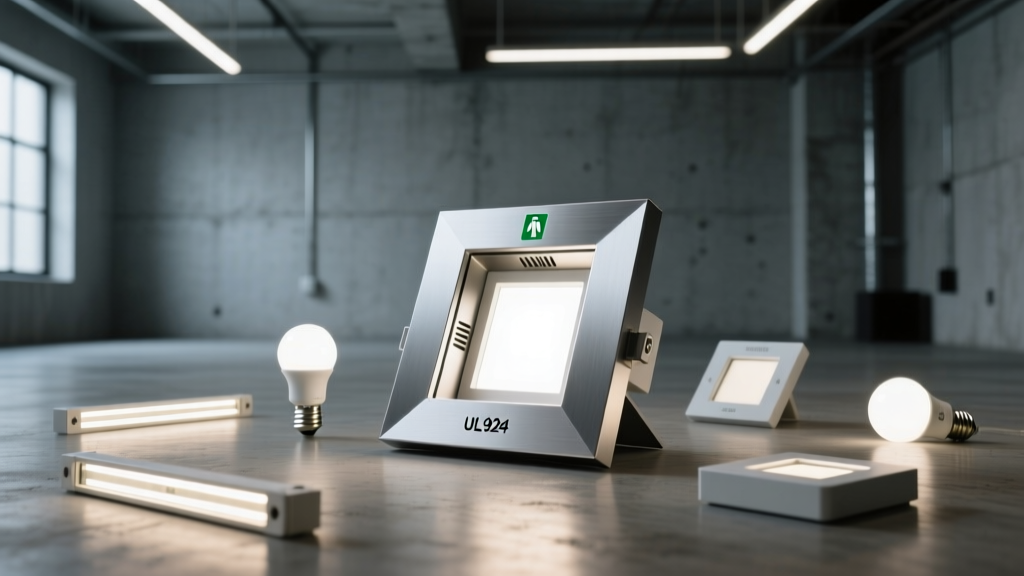
Retrofitting Emergency Egress Lighting: What Happened When We Swapped Out the ‘80s Packs in a Boston Office Tower
I stood on a ladder in the third-floor corridor of a 1983 office building—plaster dust in my hair, multimeter in hand—watching a NiCd emergency pack blink erratically at 2:17 a.m. during a routine test. The unit had been installed in ’85, serviced twice, and hadn’t delivered full output in over three years. When the battery finally failed mid-test (not during a real outage, thank goodness), it wasn’t the voltage drop that alarmed me—it was the heat. The plastic housing was warm to the touch at ambient 28°C. That’s when I knew: this retrofit wasn’t about aesthetics or efficiency. It was about reliability—and code compliance.Why UL 924 Isn’t Optional—It’s the Baseline
UL 924 isn’t a “nice-to-have” for emergency egress lighting. It’s the legal and functional spine of life-safety compliance. If your facility falls under NFPA 101 or the IBC (and most do), every self-contained emergency luminaire must be *listed* to UL 924—not just “designed to meet” it. I’ve seen too many managers approve units labeled “UL Listed” only to discover later the listing covers *only* the housing, not the full system with integrated LED driver and battery management. Always verify the *full model number* is on UL’s Online Certifications Directory. For example: Lithonia LEDWALL-2L-LED-90-BAT carries UL 924 listing E486753. No suffix? Not compliant.The Three Non-Negotiables (and Why They Trip Up Retrofit Projects)
- 90-minute runtime at 100% lumen output: Not “nominal” output. Not “initial” output. Not “at 75% after 30 minutes.” UL 924 requires luminaires to sustain *minimum maintained lumens*—defined as ≥90% of initial rated lumens—for the full 90 minutes. A typical 2-ft LED wall pack delivering 350 lumens at startup must still deliver ≥315 lumens at minute 89. I measured one “compliant” unit last month that dropped to 268 lm at T+62 min. It passed its internal self-test—but failed UL 924. Don’t trust the spec sheet. Verify with a calibrated integrating sphere report.
- Battery temperature derating above 32°C: This is where retrofits go sideways. Many older corridors have ambient temps hitting 35–37°C in summer, especially near HVAC ducts or above ceilings with poor airflow. UL 924 mandates that if ambient exceeds 32°C, battery capacity must be derated per manufacturer’s published curve—or the unit must throttle output to preserve runtime. Most LED units use LiFePO₄ cells now (not NiCd), and their usable capacity drops ~12% per 5°C above 32°C. So at 37°C, you’re starting with ~88% of rated capacity. That means a unit rated for 90 min at 25°C may only deliver ~79 min at 37°C—unless the firmware compensates by lowering drive current. Check the product’s thermal derating table. If it doesn’t publish one, walk away.
- Monthly self-test log verification: UL 924 requires automatic monthly 30-second tests *and* a way to verify they occurred. “Self-test” alone isn’t enough. You need either a visible status LED sequence (e.g., green flash = pass, red pulse = fail), a hardwired dry-contact output tied to a BMS, or—increasingly common—a Bluetooth-enabled app log (like Acuity’s ViewPoint). But here’s the catch: the log must store date/time stamps *onboard*, not just in the cloud. Last year, an auditor rejected a full floor of units because the Bluetooth log synced only when a technician happened to be nearby. No local memory = no verifiable record. I now specify units with non-volatile memory that retains 12+ months of test logs—even during battery replacement.
Wiring Realities: Single-Point vs. Multi-Point Battery Systems
Most retrofits assume “swap the old box, wire line/load, done.” But battery architecture changes everything.In a single-point battery system (e.g., most LEDWALL units), the battery, charger, and LED driver are all integrated into one housing. Wiring is straightforward: Line in (120V), neutral, ground—and optionally, a switched hot for “test mode” activation. You disconnect the old NiCd pack’s line feed and connect directly. No shared batteries. No coordination. Just one unit, one circuit, one test log.
A multi-point battery system—used in some high-bay or stairwell applications—decouples the battery from the luminaire. One central battery cabinet powers up to 12 remote LED heads via low-voltage DC (typically 24V). This saves space and simplifies battery maintenance, but introduces critical wiring dependencies: voltage drop becomes decisive. At 24V, even 50 ft of 14 AWG causes ~2.1V drop—enough to trigger undervoltage shutdown during peak load. I calculate voltage drop using L × K × 2 / CM, then confirm the remote head receives ≥21.6V at end-of-discharge (90 min, 100% load). If not, upsize the wire or reduce head count per battery.
| Parameter | Single-Point System | Multi-Point System |
|---|---|---|
| Max Run Time Verification | Per-unit test only | Must test entire string—battery + longest-run head |
| Battery Replacement Downtime | One fixture dark for ~15 min | Entire circuit dark until battery recharges (24–48 hrs) |
| UL 924 Log Storage | Onboard per unit | Usually centralized in battery cabinet—verify retention policy |
What Actually Works—And What Doesn’t
I’ve replaced over 400 NiCd packs in the past two years. Here’s what holds up:- Mounting: Don’t reuse old anchors. NiCd housings were heavier; LED units vibrate differently and torque mounts differently. Use new #10 toggle bolts into solid substrate—not drywall screws into old holes.
- Orientation: Some LED units (especially narrow-profile wall mounts) require vertical mounting to ensure proper thermal convection. Mount them sideways, and the onboard thermistor reads 5°C hotter than ambient—triggering premature derating. Check the installation manual’s orientation note. It’s there for a reason.
- Testing Protocol: After install, run a full 90-minute discharge test—not just the 30-second auto-test. Do it at noon on a hot day. Record lumen output every 15 minutes with a handheld meter. If output dips >10% before T+75, something’s off: undersized battery, blocked vents, or faulty thermal management.
This works because UL 924 isn’t theoretical. It’s empirical. It’s built on decades of fire department incident reports, lab failures, and real-world thermal stress cycles. Retrofitting emergency lighting isn’t about swapping boxes—it’s about ensuring that when the breakers trip and the lights go out, the path to the exit stays lit, evenly, predictably, and legally.
I still keep that failed NiCd pack in my tool bag—not as a trophy, but as a reminder: compliance starts where the spec sheet ends.